There’s nothing you would change about Metallica’s Master of Puppets, right?
Released on March 3, 1986, the band’s third album is widely regarded as their masterpiece, the point at which they took thrash metal to unprecedented levels of sophistication.
But like any band recording a new album, at several points Metallica faced creative decisions that could have made Master of Puppets turn out differently, in both big and small ways. Here’s a look at five of those “what if?… moments:
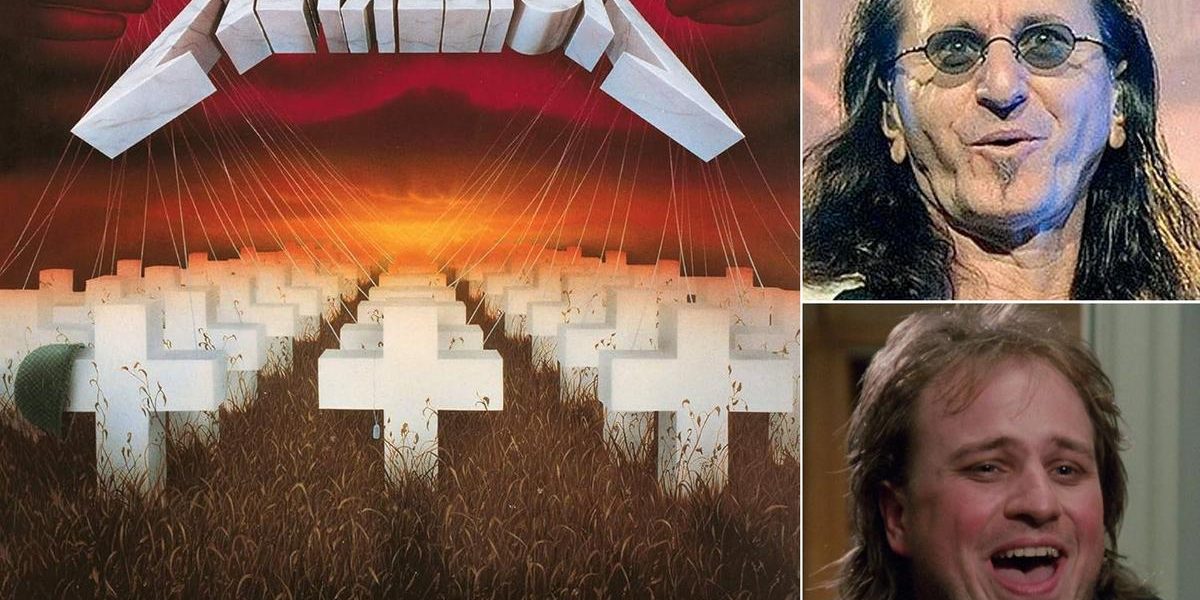
1. Geddy Lee Once Discussed Producing ‘Master of Puppets’
In a 2015 interview, Geddy Lee confirmed that he could have been the producer on Master of Puppets.
“It’s sort of true,” Rush’s legendary singer and bassist explained. “There was some discussion with Lars, back in the day, about working with them. I was friends with their management, and I met Lars back in England.
“I remember going to see them here in Toronto when they played at the Masonic Temple [in 1985]. We talked about it, and I liked their band a lot at that time. But it just never came together.”
Master of Puppets was instead co-produced by Metallica and Flemming Rasmussen, the same team credited on 1984’s Ride the Lightning. Rasmussen would later team up with Ulrich and singer/guitarist James Hetfield as co-producers on 1988’s …And Justice for All.
2. The Album Was Originally Going to Begin With… Bobcat Goldthwait?
Instead of the deceptively soothing acoustic guitars that kick off “Battery,” the first thing you hear every time you put on Master of Puppets might have been the strangled cat vocal stylings of comedian and Police Academy star Bobcat Goldthwait.
“The band had just loaded all the session tapes back into their car [when] Lars remembered that they were going to use a sound bite from the comedian Bobcat Goldthwait at the beginning of the album,” mixing engineer Mchael Wagener recalled in the liner notes to the 2017 box set edition of Master of Puppets.
“Suggestions were made to get all the tapes back out of the car and set up the studio again,” he continued. “But in the end, we all decided against it, thinking it could be added in mastering, which never happened, as far as I know.”
Read More: 30 Battering ‘Master of Puppets’ Facts
3. ‘Welcome Home (Sanitarium)’ and ‘Orion’ Started Out as One Song
The fourth and seventh songs on Master of Puppets were at one point joined together in a nine-minute epic known as “Only Thing.” You can hear them together in this form in a late June 1985 demo, taken from the 2017 box set edition of the album.
4. ‘Disposable Heroes’ Donated a Riff to ‘Damage, Inc.’
Confession: This is by far the smallest change on this list. But if you listen to the June 1985 demo version of “Disposable Heroes,” you’ll hear a familiar riff (right around the six-minute mark) which was later removed and donated to Master of Puppets‘ closing song, “Damage, Inc.”
5. Two Cover Songs Were Recorded for B-Sides, Then Scrapped
In a 1986 interview with Metal Forces magazine, Ulrich reveals that Metallica recorded two cover songs during the Master of Puppets sessions, intending to release them as B-sides as they did with “Am I Evil?” and “Blitzkrieg” on Ride the Lightning‘s “Creeping Death” single.
“We didn’t finish the recordings because we didn’t like the way they sounded, as they sounded too much like the album material, so we binned them,” he explained. We should have made them sound like [the] previous B-side stuff.”
One of the two 1985 tracks, a cover of Diamond Head’s“The Prince,” was later re-recorded with Jason Newsted on bass and released as an …And Justice for All-era B-side. The Puppets-era recording was eventually released on the 2017 box set.
The other song from those 1985 sessions was a cover of Fang’s “The Money Will Roll Right In,” which lead guitarist Kirk Hammett said Metallica‘s version didn’t get exactly right.
“The reason [our version] wasn’t released in the first place was that it had none of the punk-rock charm when we recorded it; it was too slick, and it was a bit overplayed,” he told Revolver. “I mean, Cliff and I don’t even play on it, and it’s a bit overplayed. [Laughs] It was just something that we tried and thought, ‘You know …’ It doesn’t have that raunchiness and that humor that the original had.”
Metallica Lineup Changes: A Complete Guide
They became the most successful heavy metal band in history but not without occasional personnel shifts.
Gallery Credit: Ed Rivadavia