
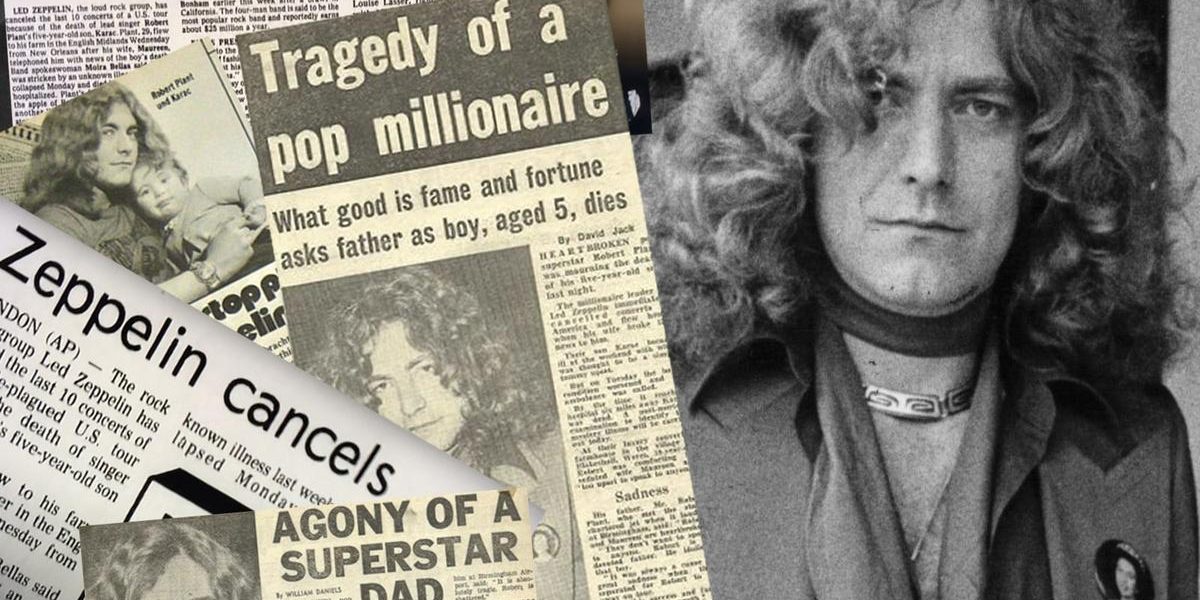

During the early phase of their career, Led Zeppelin seemed to enjoy a remarkably charmed existence, achieving monumental success with fans despite facing typically harsh criticisms from music reviewers. They quickly ascended to a revered position within the rock ‘n’ roll pantheon. However, by the mid-1970s, it appeared that the band was afflicted by a curse, as various setbacks hindered their ability to leverage the momentum they had established.
The tragic loss of singer Robert Plant‘s five-year-old son, Karac, to a stomach virus on July 26, 1977, nearly brought Led Zeppelin to the brink of dissolution.
This devastating tragedy struck the Plant family amidst what was anticipated to be a triumphant American tour for Zeppelin. Just two years prior, the band had faced a significant hiatus when Plant and his wife were involved in a serious automobile accident while vacationing on the Greek island of Rhodes. Although this time away allowed Plant to heal from his injuries, it did nothing to shield the band from a cascade of misfortunes that plagued the tour, starting with Plant suffering from laryngitis, which pushed their initial concert date from February to April.
Despite still robust ticket sales, the rescheduling created a ripple effect that complicated the tour. Jimmy Page, the band’s legendary guitarist, later reflected on the situation, noting that their equipment had already been sent overseas, making it difficult to rehearse. “We didn’t have any instruments for a month,” he lamented. “All the equipment was shipped over there five days before we were due to go. I didn’t play a guitar for a month. I was terrified at the prospect of the first few shows.”
Once they finally had the opportunity to perform in front of fans, additional issues continued to arise. An April 1977 performance in Cincinnati was marred by chaos when a throng of ticketless fans attempted to force their way into the Riverfront Coliseum, leading to a mini-riot that erupted after a rainout during their June concert in Tampa. The situation escalated further in July, when manager Peter Grant led a group, including drummer John Bonham, in a violent confrontation with a Bill Graham employee following their performance on July 23 in Oakland, California.
“There was an extraordinary amount of tension at the start of that tour,” recalled a band employee later. “It just got off to a negative start. It was definitely much darker than any Zeppelin tour ever before that time … The kind of people they had around them had deepened into some really criminal types. … They still had their moments of greatness (but) some of the shows were grinding and not very inspired.”
After departing from Oakland, the band members split up to reach their next scheduled performance in New Orleans. Shortly after arriving in the city, Plant received the heartbreaking news that would reshape his life forever. He was stranded thousands of miles away from his son during his final moments. “The first phone call said his son was sick,” recounted tour manager Richard Cole, detailing the fateful calls from Plant‘s wife. “And the second phone call, unfortunately, Karac had died in that time.”
“Karac was the apple of Robert’s eye; they idolized one another,” shared Plant‘s father in an Associated Press report that announced the abrupt cancellation of the tour, which had been slated to continue into August. In search of solace following this unimaginable loss, Plant retreated to his home, seeking comfort from his wife Maureen and their daughter Carmen, while Zeppelin entered a state of hiatus. As Page later articulated, “We were all mates. We had to give the man some space.”
However, Plant did not completely sever ties with his bandmates. “After the death of my son Karac in 1977, I received a lot of support from [Bonham], and I went through the mill because the media turned on the whole thing and made it even worse,” Plant shared with Barney Hoskyns. “I had to look after my family and at that time, as we regrouped, I applied to take a job at a Rudolph Steiner training college in Sussex. I wanted to just get out of it – to go away and forget it.”
Listen to Led Zeppelin’s 1977 Performance at Tampa
In a separate interview with Rolling Stone, Plant expressed, “I lost my boy. I didn’t want to be in Led Zeppelin. I wanted to be with my family.” He also recounted how he quit all his substance habits cold turkey. “I stopped taking everything on the same day,” Plant revealed. “The most important thing to me is my family and when I got off my face, I found it difficult to be all things to the people that meant a lot to me.”
Plant was genuinely serious about pursuing a new career in education for a time. Acknowledging that “it’s not something that we, as a family, have been able to get over yet,” he shared with GQ in 2011 that “our family had always been close to the Rudolf Steiner Waldorf education in the West Midlands and I just liked the way it all worked.”
“I just thought there was something far more honest and wholesome about just digging in and putting the ego away in the closet. Because no matter what we say, entertainers are usually quite insecure, wobbly characters underneath – and maybe that bit of glory or that bit of expression or whatever it is compensates in some area. But I thought I should be rid of it. … Sometimes I still feel like that.”
In 2013, Plant reminisced, “during the absolute darkest times of my life when I lost my boy and my family was in disarray, it was Bonzo who came to me. The other guys were [from] the South [of England] and didn’t have the same type of social etiquette that we have up here in the North that could actually bridge that uncomfortable chasm with all the sensitivities required … to console.”
The esteemed Zeppelin biographer Mick Wall expanded on Plant‘s sentiments, asserting that the emotional distance he described was even more significant. He noted that when Jimmy Page, bassist John Paul Jones, and Grant chose not to attend Karac‘s funeral, it fostered a rift that never truly mended. “Until then, Robert was still in thrall to Jimmy and what he had created with Zeppelin. After that incident, Jimmy no longer held the same mystique for Robert,” Wall claimed in 2011. “It was also the beginning of Robert having much more power over what the band did or didn’t do next. He truly no longer cared and therefore was ready to walk at any point if they didn’t fit in with him. And that’s the way it remains to this day.”
Although Bonham remained closest to Plant during the difficult months following Karac‘s death, it was ultimately Page who persuaded him against retiring from the music industry. “I was thinking about leaving the group, but Jimmy Page kept me from doing it,” Plant recounted in an interview at the time.
“He said without me, the band’s nothing. He wanted me to take a break until I felt ready for playing again. I realized that we are more than business partners. We are real friends. We have enough money to live a life without troubles, but nobody knows how long our fans can wait. They might forget us if we don’t play anymore. I don’t want this to happen to the band. Our friends kept calling us every day. They helped us through this.”
Regrettably for Zeppelin fans, the future ahead for the band would not last much longer. They persevered and released In Through the Out Door in 1979, but Bonham‘s untimely death on September 25, 1980, marked the end of the band as a creative entity forever. While it is impossible to predict what they might have achieved together had he not passed away, those final days discovered the group in a state of artistic flux, struggling to progress while reconciling the trials they had endured.
“In Through the Out Door wasn’t the greatest thing in the world, but at least we kept trying to vary what we were doing, for our own integrity’s sake. Of all the records, it’s interesting but a bit sanitized because we hadn’t been in the clamor and chaos for a long time,” Plant pointed out in 1990. “In ’77, when I lost my boy, I didn’t really want to go swinging around. ‘Hey hey mama, say the way you move‘ didn’t really have a great deal of import anymore.”
Discover the Most Iconic Song From Each Led Zeppelin Album
Selecting the finest song from their catalog is no simple task, as many of their LPs function cohesively as a whole and feature numerous classic tracks.
Gallery Credit: Michael Gallucci
The Reasons Behind Led Zeppelin’s Decision to Never Reunite