Key Takeaways
- Executive Order: President Trump signed an executive order to prevent states from creating their own AI regulations.
- Industry Concerns: The order aims to protect the AI industry from a confusing patchwork of state laws.
- State Regulations: Several states have already enacted laws regulating AI, focusing on transparency and data collection.
- Investment Risks: Trump emphasized that multiple state approvals could hinder significant investments in AI.
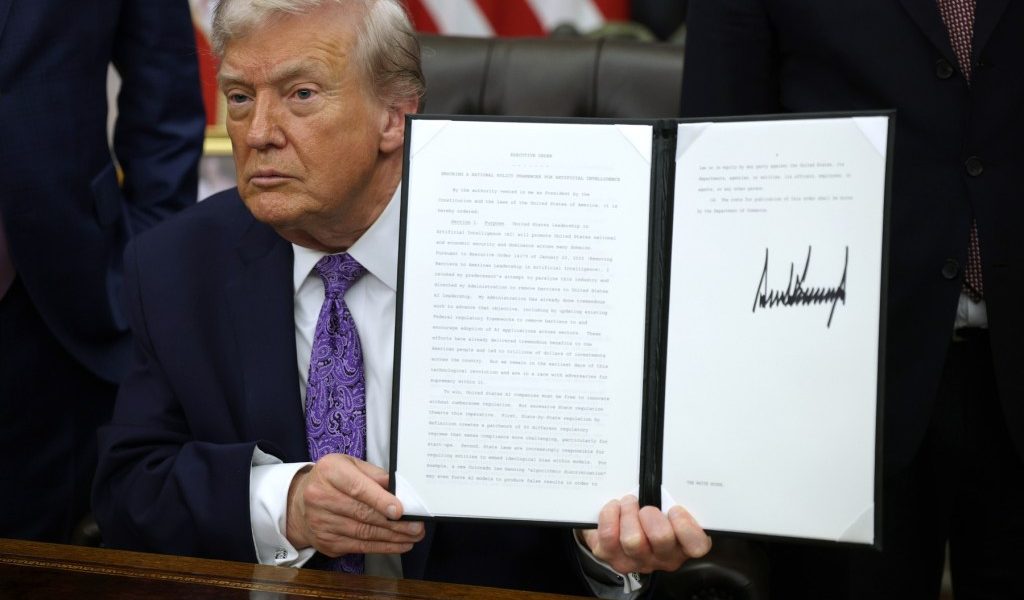
President Donald Trump signed an executive order Thursday aimed at blocking states from crafting their own regulations for artificial intelligence, saying the burgeoning industry is at risk of being stifled by a patchwork of onerous rules while in a battle with Chinese competitors for supremacy.
Members of Congress from both parties, as well as civil liberties and consumer rights groups, have pushed for more regulations on AI, saying there is not enough oversight for the powerful technology.
Related

But Trump told reporters in the Oval Office that “there’s only going to be one winner” as nations race to dominate artificial intelligence, and China’s central government gives its companies a single place to go for government approvals.
“We have the big investment coming, but if they had to get 50 different approvals from 50 different states, you can forget it because it’s impossible to do,” Trump said.
The executive order directs the Attorney General to create a new task force to challenge state laws, and directs the Commerce Department to draw up a list of problematic regulations.
It also threatens to restrict funding from a broadband deployment program and other grant programs to states with AI laws.
David Sacks, a venture capitalist with extensive AI investments who is leading Trump’s policies on cryptocurrency and artificial intelligence, said the Trump administration would only push back on “the most onerous examples of state regulation” but would not oppose “kid safety” measures.
Four states — Colorado, California, Utah and Texas — have passed laws that set some rules for AI across the private sector, according to the International Association of Privacy Professionals.
Those laws include limiting the collection of certain personal information and requiring more transparency from companies.
The laws are in response to AI that already pervades everyday life. The technology helps make consequential decisions for Americans, including who gets a job interview, an apartment lease, a home loan and even certain medical care. But research has shown that it can make mistakes in those decisions, including by prioritizing a particular gender or race.
States’ more ambitious AI regulation proposals require private companies to provide transparency and assess the possible risks of discrimination from their AI programs.
Beyond those more sweeping rules, many states have regulated parts of AI: barring the use of deepfakes in elections and to create nonconsensual porn, for example, or putting rules in place around the government’s own use of AI.
This story was originally published by The Associated Press.