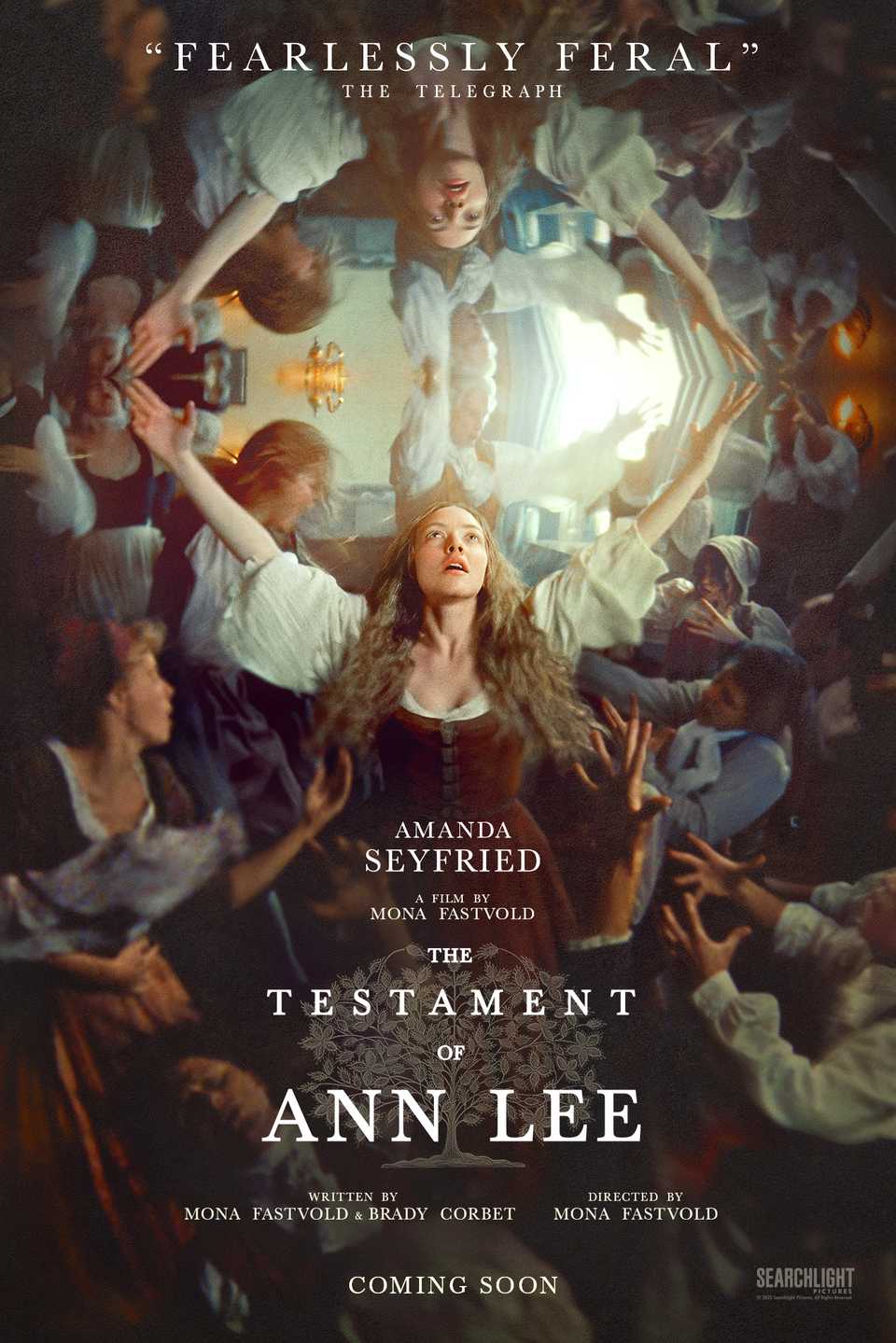
Who knew the founding of a 300-year-old celibate sect would turn out to be the hottest stomp-clap musical of the year? Mona Fastvold’s The Testament of Ann Lee, in theaters now, is a swooning, bizarre, jaw-dropping dive into the world of the Shakers, an 18th-century religious group who believed wailing, flailing, and communal dance could purge sin. Amanda Seyfried stars as the titular prophet, Ann Lee, a woman who turned grief, trauma, and a distaste for physical intimacy into a movement that crossed the Atlantic and reshaped a small corner of the New World. Lee’s piety and resolve were so strong, she even convinced her followers that God was a woman (and that woman was her).
Fastvold’s film is part biopic, part fable, threading musical numbers – adapted from actual Shaker hymns by Daniel Blumberg – with frenzied, exorcism-like movement and intimate narrative to guide audiences through the fog of history. It’s sometimes dizzying and oddly sensual, with Seyfried playing a figure that’s both achingly human and grandiosely mythic. Fastvold doesn’t just tell us the story of a woman leading a celibate, egalitarian sect; she throws us into it, leaves us there, and dares us to sort out fact from legend, awe from absurdity, devotion from delusion. But what’s fact, and what’s just divinely wrought fiction when it comes to the real Ann Lee’s life? Here’s what we could suss out from the history books.
The Truth Behind Ann Lee’s Disturbing Origin Story
Ann Lee’s origin story is grim and strangely cinematic all on its own. Born in 18th-century England as the second of eight children crammed into a single room, she reportedly witnessed her parents having sex often, a formative trauma that the film leans into as the seed of her lifelong repulsion toward physical intimacy. Unfortunately for Ann, she had no choice but to procreate after her family married her off to a blacksmith named Abraham Standarin (played by Christopher Abbott in the film). She suffered through the loss of all four of her children in infancy, which only helped to reaffirm her belief in celibacy.
The film’s wild, whiplash-inducing musical numbers are rooted in real Shaker practices. Lee attended the Wardley Society’s “Shaking Quaker” meetings in Manchester, where worshippers screamed, groaned, and fell to the floor as part of their worshiping practice. Believe it or not, that was tame compared to their radical ideas about gender equality and the second coming of God as a woman that shocked others of the time. While Lee didn’t originate the Shaker movement, she did eventually become the face of it. She received confessionals from other members and is rumored to have spoken over a dozen languages while pleading for asylum from the Church in England.
Why Ann Lee Was Obsessed With Celibacy
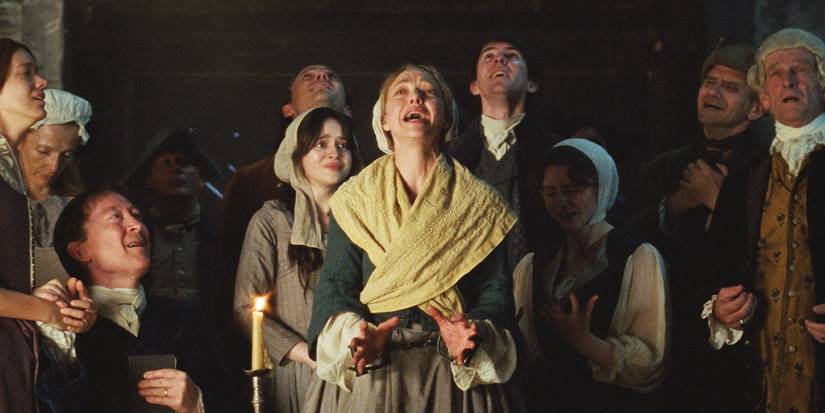
Lee’s dedication to sexual abstinence and her uncompromising pacifism are two more pillars of historical truth that Fastvold faithfully captures. She preached celibacy as the path to spiritual purity, discouraged her followers from participating in the Revolutionary War, and traveled tirelessly to recruit new members (the group wasn’t exactly generating its own). These beliefs often put her in conflict with the authorities. In the film, Ann is taken to jail after neighbors call the police over her loud, unconventional worship services. As in real life, she goes on a hunger strike, eventually having a vision of Adam and Eve cast out of the Garden of Eden. She took that to mean that the act of sex is what caused God to be displeased with mankind and used the experience to persuade her followers to abstain from engaging in sex even if they were already married.
Speaking of visions, Lee’s move from England to the New World, like so many prophets before her, was sparked by what she claimed were divine instructions. In 1774, she and a small band of followers sailed across the Atlantic to establish a Shaker colony near Albany, New York. They found peace for a time but soon rumors about witchcraft and improper behavior in the woods plus their pacifism during the time of the American Revolution made them easy targets. The film covers all of it though with arguably more modern dance moves.
How ‘The Testament of Ann Lee’ Reimagines History
The film toys with the idea of Ann Lee as a near-supernatural figure hinting that she spoke many tongues (was it 12 or 72? Who really knows?) and possessed miraculous powers. But that version of “Mother Ann” lives more in Shaker lore than in any documented fact; a legend that Fastvold amplifies to convey how Lee was experienced by her followers not necessarily who she was in objective terms. And while Shaker worship did involve movement, the film’s sweeping intricately choreographed dance sequences are a stylistic leap. Real Shaker dances were slower more rigid and designed to enforce discipline rather than emotional release.

Amanda Seyfried Is Still Fighting For Roles: “All the Good Ones Get Given Away”
Seyfried appears on Collider Ladies Night to celebrate her epic one-two punch — ‘The Housemaid’ and ‘The Testament of Ann Lee.’
The film’s depiction of mob violence reflects a very real pattern of harassment faced by the Shakers too but the specific details surrounding the death of Ann’s brother and the injuries that killed Lee herself are more dramatized. The same is true for the details of Ann’s early life since that time period wasn’t written down by her followers and Fastvold had to pull from other sources.
Ultimately when it comes to hard facts,The Testament of Ann Lee is surprisingly sturdy where it counts. Ann Lee’s commitment to celibacy and pacifism her role in shaping Shaker worship out of Wardley-era ecstatic rituals the group’s missionary work persecution and eventual migration to America are all grounded in written history. Where the film drifts into invention – miracles polyglot prophecy heightened choreography and an intensely psychologized origin story – it does so openly using speculation as a way to convey belief rather than biography. Fastvold isn’t trying to prove that Ann Lee was divinely chosen she’s showing how it might have felt to believe she was. It’s what makes the film feel so alive and so undeniably compelling.
The Testament of Ann Lee is now playing in theaters.