
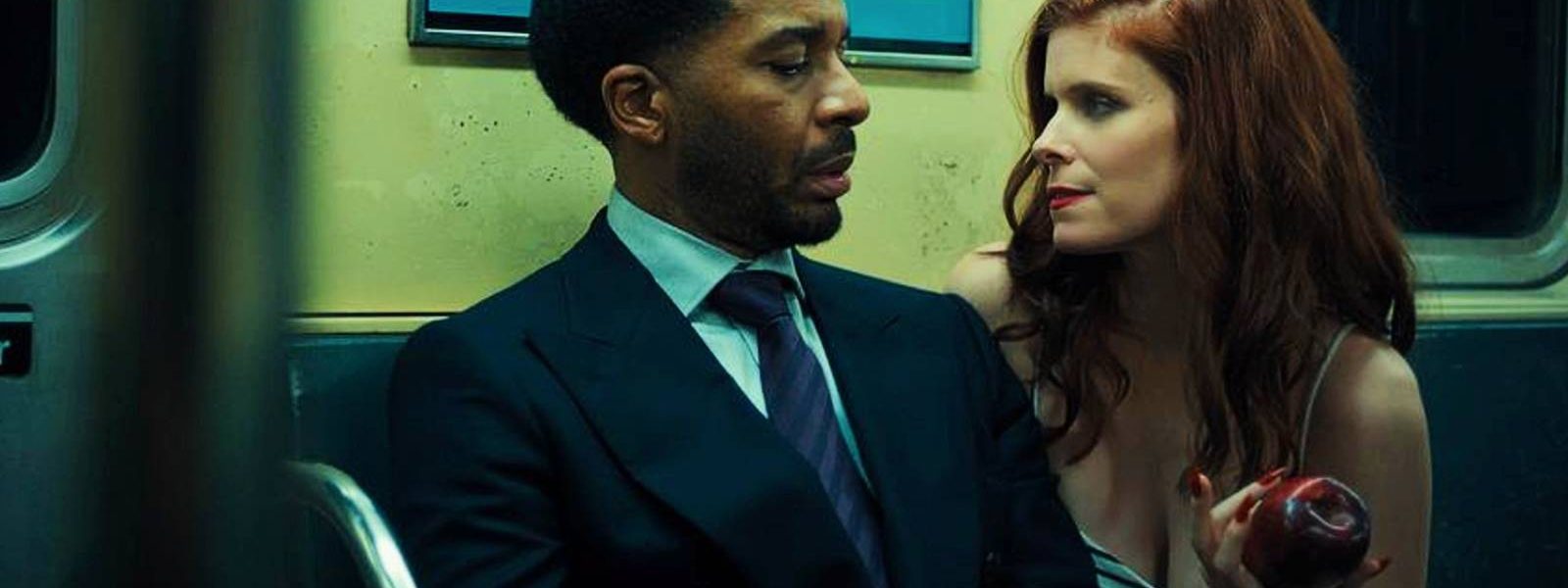
In The Dutchman, we meet Clay (André Holland), who, like his name, is adaptable and impressionable. His wife, Kaya (Zazie Beetz), has been unfaithful, and she shows little commitment to therapy. Nonetheless, he participates in the process, even though it remains uncertain whether he truly desires to be there or to remain with her. His therapist, Dr. Amiri (Stephen McKinley Henderson), appears to be minimally engaged in their relationship.
Instead, Amiri, sharing a name with the playwright of the original piece this film is based on, seems overly focused on Clay as he navigates two contrasting lives — one that is outwardly respectable where he commutes home in a business suit and organizes a fundraiser for a friend running a political campaign in Harlem. The other life is suggested by Lula (Kate Mara), a woman Clay encounters on the subway, who assumes he conceals something beneath his calm facade.
The Dutchman Is An Unnerving Thriller
It Is An Adaptation & Metatextual Examination Of The Original Play
The Dutchman is adapted from the 1964 play of the same name by Amiri Baraka; however, similar to the therapist sharing the author’s name, it adopts a metatextual lens regarding its source material. In many ways, the play itself becomes a character within the film, with the therapist acting as an author. Clay emerges as an unwitting subject, and it remains ambiguous how much control he possesses over his circumstances. This situation is quite dire.
The Dutchman struggles to find equilibrium between its surreal elements and more relatable human drama.
Lula sits beside Clay on the subway and immediately begins to provoke him, flirtatiously touching his leg and chest while revealing she knows quite a bit about him. She resembles an apparition, the quintessential seductress, with striking red hair, red lipstick, and red nails. She even produces a ruby red apple from her bag, slicing it with a knife before sensually consuming it as Clay observes. When these tactics fail to sway Clay, who is merely trying to keep to himself, Lula shifts to a more sinister approach.
She ridicules Clay’s Blackness and exploits her white femininity to gain leverage both publicly and privately. She seduces him and then screams at the top of her lungs when he attempts to leave her apartment, refusing to let her accompany him to a party. “It’s your word against mine,” she asserts. Once at the party, Lula hurls microaggressions at Clay’s friends while openly flaunting her relationship with him in front of Kaya. This is clearly a test, but its purpose remains uncertain.
I found that imbalance helpful in comprehending Clay’s mindset; however, certain revelations render the logic of the film’s world somewhat unclear even if its message is not.
There exists an overtly surreal aspect to The Dutchman, creating an impression that Clay is battling for his life within a limbo-like realm where the odds are decidedly against him. Director Andre Gaines effectively renders this New York as almost suspended in time, cyclical like the subway where Lula and Clay first encounter each other. The unsettling music by Daniel Hart complements this atmosphere.
Ultimately, however, The Dutchman struggles to strike a balance between its oddities and more grounded human drama. The conflict between Clay and Kaya culminates in a confrontation at their friend’s party — one of the film’s most powerful scenes — with Beetz and Holland delivering performances that lend their characters significant weight; yet it feels disconnected from everything else occurring in the narrative. While I found this imbalance beneficial for understanding Clay’s psyche, several twists lead to fuzzy logic within the film’s universe despite its clear intentions.
The original play scrutinized race relations during its time of creation. The 2025 version of The Dutchman has been appropriately updated to address contemporary issues regarding how Black men are treated today; Lula’s threats represent just one of many challenges Clay faces in New York City. He experiences unwarranted stops by police officers upon entering train stations; his guilt is presupposed regardless of situational facts.

Mickey 17 Review: I Can’t Believe WB Made Me Worry Bong Joon Ho’s New Movie Would Be Anything But Great
Bong has crafted a large-scale genre film that, for all its oddness, goes down pretty easy. But Mickey 17 still manages to have a lot on its mind.
By the end of The Dutchman, we return to the subway where Lula and Clay first met, finding them once again seated together on the train. This cycle of psychological violence appears unending for Clay. If Lula embodies every insidious aspect of society made manifest, how can Clay even begin to confront her? The film cleverly addresses this question by diverging from its source material at critical junctures to produce different outcomes.
It all circles back to Dr. Amiri, the film’s orchestrator. As a meta-commentary on its source material, The Dutchman proves intriguing but did not need to amplify the surreal nature of events further for impact. We inhabit a surreal world already, and what transpires in the film closely mirrors real-life occurrences. With Holland and Mara’s performances reflecting their commitment to The Dutchman, although its conclusion may feel overly neat, the film succeeds as an unsettling journey through one night in New York.
The Dutchman premiered at the 2025 SXSW Film & TV Festival.
Note: This review was originally published on March 8th, 2025.








