
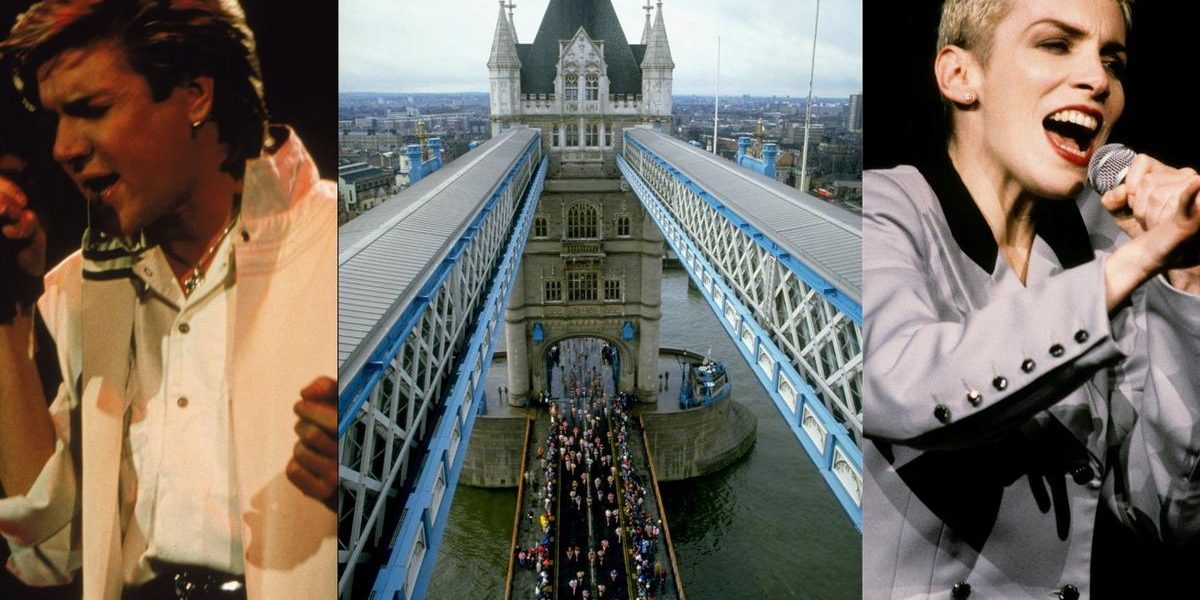
London in the ’80s offered a diverse musical landscape for all tastes.
On one side, the punk rock scene continued with bands like the Clash, the Psychedelic Furs, the Jam, the Pretenders, and Siouxsie and the Banshees, maintaining the genre’s intensity into the new decade. However, a transformation occurred as groups like Echo & the Bunnymen and New Order began to explore new sounds, laying the groundwork for future gothic and indie rock bands.
Additionally, there was a wave of new romantic music, a sub-genre of new wave that embraced fashion and synthesizers, exemplified by artists such as Adam and the Ants, Culture Club, and Spandau Ballet.
For some reason, several synth-pop duos also emerged to dominate the charts, including Eurythmics, Pet Shop Boys, and Wham!
“What we like to do is make commercial music that is very special, so it can be commercial but also very individual,” said Annie Lennox of Eurythmics in a 1985 Smash Hits interview with Neil Tennant of Pet Shop Boys. “We’re always looking for something really fresh.”
Despite the challenges, we’ve managed to identify the “big 4” of ’80s London bands listed below. Not all are originally from London, but each significantly influenced the city’s broader musical landscape.
1. The Smiths
The Smiths may not appeal to everyone, especially those who are happy and well-adjusted. You don’t listen to The Queen Is Dead for an uplifting experience.
However, the Smiths dominated much of the ’80s with just four albums: The Smiths (1984), Meat Is Murder (1985), The Queen Is Dead (1986), and Strangeways, Here We Come (1987). At the heart of their songwriting were Morrissey, the singer, and Johnny Marr, the guitarist, whose approach would later influence a generation of indie bands and writers.
All four studio albums reached the Top 5 in the U.K., with Meat Is Murder even hitting No. 1. They also produced several Top 20 singles such as “This Charming Man,” “Heaven Knows I’m Miserable Now,” “Last Night I Dreamt That Somebody Loved Me,” and “How Soon Is Now?”
The Smiths’ music featured just enough jangle—largely due to Marr’s guitar work—to evoke ’60s folk pop while incorporating elements of art rock and melancholic lyrics that contrasted sharply with much of the bright synth-pop emerging in London at that time. Morrissey’s talent for crafting vocal melodies added to their appeal. Although they disbanded by the end of the ’80s due to tensions between Marr and Morrissey, their influence endures.
2. The Cure
If there was a counterpart to the Smiths, it was The Cure. Textbooks likely feature The Cure under ’80s goth rock.
The Cure took some time to gain traction in London but reached new heights with 1987’s Kiss Me, Kiss Me, Kiss Me and 1989’s Disintegration, solidifying their legacy. Many of their most recognizable songs emerged during this period, including “Boys Don’t Cry,” “Close to Me,” “Just Like Heaven,” and “Lovesong.”
Robert Smith has led The Cure since its inception (and continues to do so as of February 2026), embodying a moody aesthetic that contrasted with much of the decade’s music. While often labeled as “goth,” Smith crafted upbeat radio-friendly songs that aligned more with indie rock or new wave.
The Cure excelled at blending melancholy with accessibility and a zest for life within a single album.
“Sometimes I think when we release more pop songs it’s good because they entice people in and then we can introduce them to things they might not normally listen to,” Smith told Spin in 1988. “If our music always reflected our lyrics’ content, we’d have a far smaller audience which would frustrate me.”
READ MORE: The Cure Albums Ranked Worst to Best
3. Eurythmics
Eurythmics stood in stark contrast to both The Smiths and The Cure; this London-based duo comprised Annie Lennox and Dave Stewart.
Their debut album, 1981’s In the Garden, did not gain traction; however, their second album, 1983’s Sweet Dreams (Are Made of This), became a sensation. The title track is instantly recognizable even without knowing who performed it—it reached No. 2 in the U.K. and No. 1 in America. Subsequent hits included “Love Is a Stranger,” “There Must Be an Angel (Playing With My Heart),” and “Here Comes the Rain Again.” In 1984, Eurythmics won the MTV Video Music Award for Best New Artist and received a Grammy for Best Rock Performance by a Duo or Group With Vocal in 1987. Stewart also became a sought-after producer for artists like Tom Petty and Mick Jagger.
Eurythmics epitomized synth-pop’s global phenomenon during that era—heavy on synthesizers with a polished production style. They were experimental yet elegant and sincere; charting pop music didn’t have to be superficial. Stewart’s arrangement style combined with Lennox’s powerful voice captured listeners’ attention.
“It became our ethos,” Stewart stated in 2025 to Classic Pop. “We fused cold-sounding European synthesizers with soulful vocals.”
4. Duran Duran
Duran Duran emerged from the new romantic music scene we mentioned earlier—and they were immensely popular. If any band experienced something akin to Beatlemania in the ’80s, it was Duran Duran.
Their second album, 1982’s Rio, achieved worldwide success with hits like its title track and “Hungry Like the Wolf.” Following this was 1983’s Seven and the Ragged Tiger, which topped U.K. charts; they also released “A View to Kill” in 1985 as the theme song for the James Bond film of the same name. Every Duran Duran album from this decade landed within the Top 20 on U.K. charts while achieving similar success in America. If you turned on MTV during this time, you were likely to see a Duran Duran music video—a groundbreaking way to market music.
Duran Duran’s style defied categorization; it blended punk angst with danceability reminiscent of disco while showcasing creativity akin to glam rock from previous decades. They should not be dismissed as mere ’80s pop fluff—this band was far funkier than that.
Pretenders and Chrissie Hynde Albums Ranked
A journey from punk beginnings through balladry to Dylan covers.
Gallery Credit: Michael Gallucci