
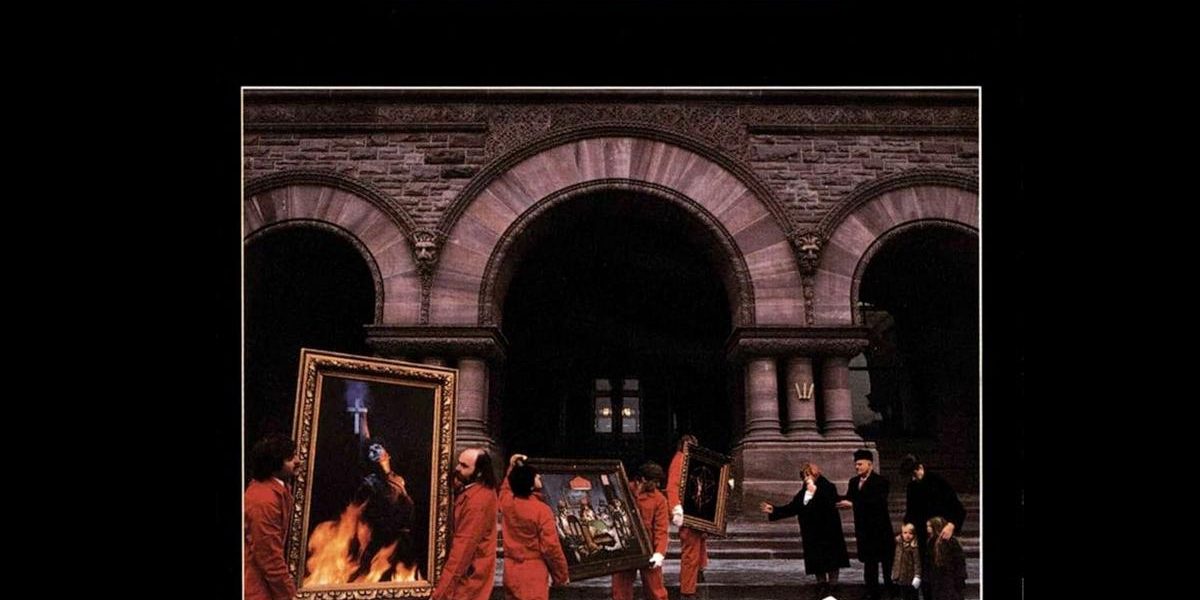
The biggest and arguably best album Rush ever made is now 45 years old.
Released on Feb. 12, 1981, Moving Pictures marked the crucial turning point where the beloved Canadian trio fully shifted their focus from long-form progressive rock explorations towards shorter, more radio-friendly material.
Here are five things you need to know about Moving Pictures:
How did Moving Pictures become Rush’s big breakthrough?
The result was the band’s best-selling and most universally praised album, which as you can see below, tops our ranking of Rush studio albums.
“In a way, Rush’s career can be boiled down to this: Everything before Moving Pictures, and everything after Moving Pictures,” Michael Gallucci wrote in our original 2016 anniversary story about the album. “Suddenly a band that struggled to get noticed found itself in regular and heavy rotation.”
Read More: How ‘Moving Pictures’ Became Rush’s Leanest, Most Song-Focused Album
Did Rush’s most famous song almost not make the album?
The lead single from Moving Pictures, “Limelight,” reached No. 55 on the U.S. charts, and the third single, “Tom Sawyer,” did even better – peaking at No. 44.
The latter track has gone on to become Rush’s most famous song, but in 2023 bassist/singer Geddy Lee revealed that he almost gave up on it. “It was a very difficult song to record,” he told NPR’s World Cafe. “Every turn, something was going wrong…. there were all these technical difficulties… nothing was working. And, at one point, I thought, ‘Maybe we just forget this song and move on.’
Read More: Why Geddy Lee Wanted to Abandon Rush’s ‘Tom Sawyer’
How did the Moving Pictures album cover take its title very literally?
As soon as he learned the Moving Pictures album title, Rush’s longtime art director knew what he wanted to do for the cover. “I immediately saw people moving pictures,” he told UCR in 2020. “The band didn’t get it at first,” he confessed. “It took a little more description for me to fill in the details.”
The final image works on two levels, with some people literally moving huge pictures around in front of a building, and others being emotionally moved by the images on those canvases. As was traditional for the band, it also features numerous Easter eggs, which you can read about below.
Read More: How Rush Went Pun-Wild With the ‘Moving Pictures’ Cover Art
How did Rush turn the tables on Aerosmith’s Joe Perry?
Rush’s winning streak continued on the 10-month Moving Pictures tour, which saw the band gross over $4 million. “That’s when we could actually get ourselves out of debt,” Alex Lifeson recalled in Limelight: Rush in the ’80s. “Also, we were offered to re-sign, renegotiate, redo our [record] deal. That’s when a lot of those sorts of worries were dispelled.”
Years after Rush was allegedly treated poorly while serving as the opening act for Aerosmith, Geddy Lee got the chance to show the band’s former guitarist Joe Perry – now touring as a solo act – how things should be done, as noted in the same book.
While Rush wasn’t allowed a proper soundcheck or access to the full lighting or P.A. system years earlier while opening for Aerosmith, Lee insisted that his crew go above and beyond to make sure Perry had more than what he asked for at each show.
After a few months, Lee stopped by Perry’s dressing room to make sure everything was going well. When Perry said yes, Lee replied: “Good, that’s great. Because I’d never want you to feel the way I felt when we were touring with Aerosmith, and I was opening for you.”
How did ‘Moving Pictures’ lead to three Rush live albums?
Eight months after the release of Moving Pictures, Rush commemorated the tour that followed with the release of their second live album, Exit… Stage Left. Three-quarters of the album was recorded at various 1981 dates, and the track list featured four Moving Pictures songs.
A 40th anniversary box set edition of Moving Pictures, released in 2022, included another complete live album from the Moving Pictures tour, this time recorded at two shows in Toronto and featuring the album’s two-part “The Camera Eye” suite.
On their 2010-2011 Time Machine tour, Rush performed Moving Pictures in its entirety for the first time ever. That set list was captured on the Time Machine 2011: Live in Cleveland concert movie.
The Moving Pictures section of that show was also released separately with the title Moving Pictures: Live 2011. Naturally, several of the album’s biggest hits have appeared on other live Rush albums.
Rush Albums Ranked
We examine Rush’s 19 studio albums, from 1974’s muscular self-titled release to a series of remarkable late-career triumphs.
Gallery Credit: Eduardo Rivadavia