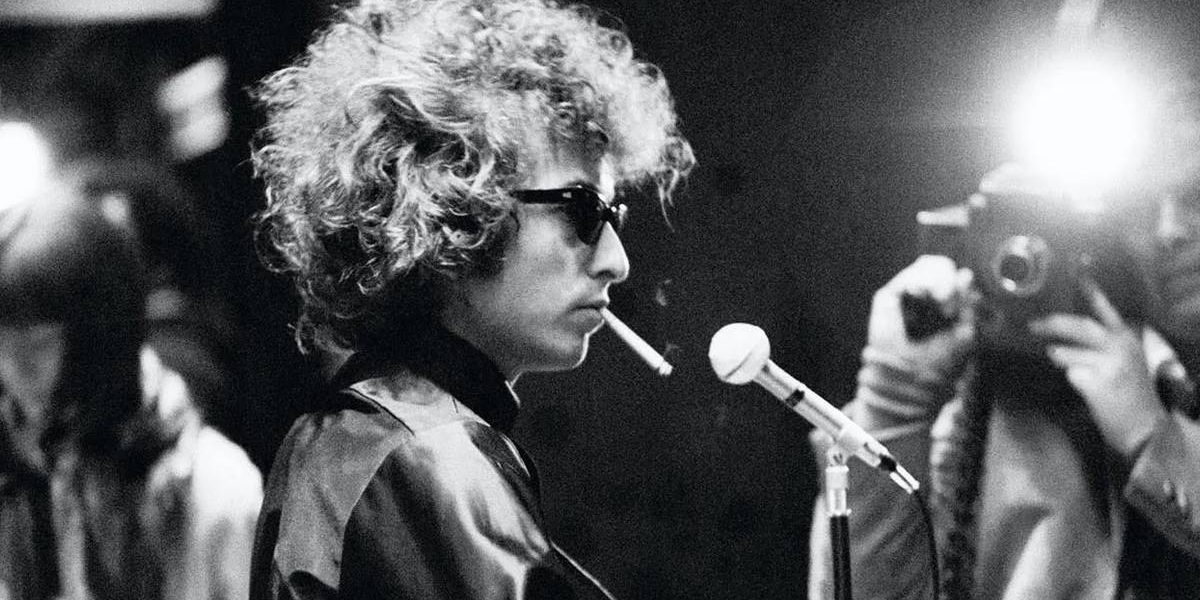
Every musician has a little controversy up their sleeve. In January 1961, a young Bob Dylan packed his belongings and moved to New York City, hoping for a chance to work in music. It didn’t take long for the beady-eyed singer to charm his way to industry bigshots. By late 1961, Dylan had signed with Columbia Records. Although the charts showed interest in his folksy tunes, Dylan’s artist persona was another story. More often than not, his actions may have rubbed people the wrong way.
From plugging in his guitar at the Newport Folk Festival — an act many purists condemn as a betrayal of folk tradition — to likening himself to Lee Harvey Oswald, Dylan is a magnet for trouble. Yet Dylan’s penchant for rebellion dates back to his early career. Even in his early days as an aspiring musician, Dylan turned down one of the biggest opportunities to get his songs across to the entirety of America — all because he wasn’t allowed to perform the song he wanted.
From The Doors to Elvis Presley, ‘The Ed Sullivan Show’ Applied Strict Censorship Rules to the Biggest Stars
In 1963, Dylan was a rising folk star, recognized in Greenwich Village but largely unknown across the country. An appearance on The Ed Sullivan Show could have instantly turned him into a household name. However, joining one of America’s biggest family-oriented programs came with strict requirements. From 1948 to 1971, the Sunday night prime-time variety series stood as a cornerstone of American pop culture, showcasing entertainment that ranged from music and dance to comedy. At the height of its popularity in the late 1950s and ’60s, the program attracted an average audience of around 40 million viewers, largely due to its “something for someone” appeal.
Because of this wholesome format, performers were expected to meet particular standards. Well-known examples include The Doors, who were instructed to alter the line, “Girl, we couldn’t get much higher,” from the song “Light My Fire,” since the word “higher” was linked to drug references (the band went on to deliver their 1967 performance without modifying a single lyric, much to the dismay of CBS executives). Perhaps the most famous case occurred during Elvis Presley‘s final 1957 appearance on the program, when cameras notoriously filmed him only from the waist up to conceal his so-called “provocative gyrations.”
This Bob Dylan Classic Was Almost Cut From the Album — Now It’s One of His Greatest Songs Ever
The untold story behind a nearly-lost Dylan masterpiece.
Bob Dylan Was Not Allowed to Perform “Talkin’ John Birch Paranoid Blues” on ‘The Ed Sullivan Show’
In an effort to generate buzz for his upcoming second album, The Freewheelin’ Bob Dylan, the singer was booked to appear on The Ed Sullivan Show. Although he could have chosen soon-to-be crowd favorites like “Blowin’ in the Wind” or “Mixed-Up Confusion,” he had only one track in mind: “Talkin’ John Birch Paranoid Blues.” The title references the real-life John Birch Society, a right-wing American political organization known for promoting conspiracy theories, opposing civil rights initiatives, and fiercely denouncing communism. The group remained notorious for accusing figures such as Dwight D. Eisenhower of being communist agents and for attempting to impeach Supreme Court Justice Earl Warren.
True to his satirical self, Dylan wrote the song at the height of Cold War hysteria, poking fun at America’s obsession with communist infiltration by joking about finding subversives “behind the sink” or “under the door.” He initially auditioned the piece for Sullivan without issue, but problems with the dress rehearsal was a different story. CBS executives deemed the lyrics too controversial. Unlike The Doors, who proceeded to perform, Dylan took one step further. He refused to perform, declaring, “If I can’t play my song, I’d rather not appear on the show.” For a newcomer to the folk scene, the decision was risky. Yet the publicity surrounding his withdrawal drew even more attention towards the aspiring singer.
Bob Dylan’s Greatest 1970s Album Contains Some of His Most Ruthless Lyrics
This Bob Dylan album remains one of his most honest and raw works to date.
During His Early Career, Bob Dylan Already Had a Song Banned by the BBC
Two years before his standoff with Ed Sullivan, a young Dylan ran into a similar problem with the BBC. His debut album, Bob Dylan, might not have the same chart-topping singles as his later works. Even so, one of his songs from the project, “Baby, Let Me Follow You Down,” ended up banned by the British broadcaster. Ironically, it wasn’t even his original compositions. The tune began as “Don’t Tear My Clothes,” recorded in 1935 by the State Street Boys, and was later reworked under different titles by Rosetta Howard and Blind Boy Fuller.
Although “Baby, Let Me Follow You Down” wasn’t a political song, the BBC objected to one small detail: he repeats the words “Godalmighty” four times. Even though it wasn’t used in a strictly religious sense, the reference was considered a breach of the network’s rule against taking God’s name in vain. It just goes to show that Dylan has always attracted industry nitpickers, and that these early clashes only foreshadow his career as an unapologetic artist.