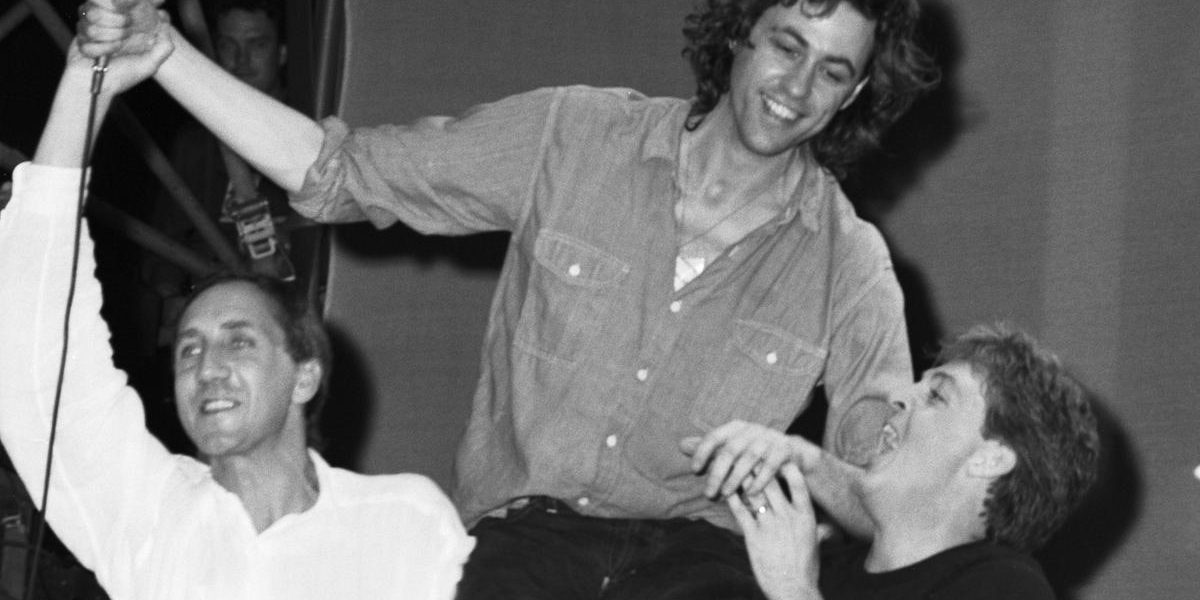

Bob Geldof experienced a multitude of unforgettable moments during the iconic Live Aid concert that took place 40 years ago at London’s Wembley Stadium. Among these moments, one of the most significant was when he shared the stage with Paul McCartney. Following their performance, being lifted onto the shoulders of McCartney and Pete Townshend stands out as a highlight of that historic day.
This remarkable event was the result of extensive planning and dedication from Geldof, particularly in collaboration with McCartney and the broader Live Aid initiative. “Remember this — it wasn’t easy for PAUL MCCARTNEY,” Geldof recently shared in a Zoom interview with UCR from France. “He hadn’t performed publicly since the tragic passing of John Lennon in 1980.”
In fact, McCartney’s performance at Live Aid marked his first public appearance in over five years, since the Concerts for the People of Kampuchea in December 1979, also held in London. Following that concert, McCartney faced legal troubles in Japan, which led to the cancellation of a planned Wings tour and effectively disbanded the group.
During the preparation phase for Live Aid, Geldof made multiple attempts to reach out to McCartney through various intermediaries. In his memoir, Is This It?, he details sending a heartfelt letter to McCartney, inviting him to perform the Beatles classic “Let It Be” during the concert: “I asked him if he would perform it at the end of the show; ‘If you do it, the world will cry’… I understood he likely receives countless requests, but I strongly believed that the event would lack completeness without his presence. I wasn’t addressing Paul McCartney as a person, but addressing PAUL MCCARTNEY, the phenomenon. His performance would capture millions who otherwise wouldn’t tune in, ultimately bringing in funds that wouldn’t have come in otherwise… As I sealed the letter, I felt I had done all I could.”
Read More: Unforgettable Highlights from Live Aid
“The expectations surrounding any of the Beatles are immense,” Geldof reflects today. “Linda McCartney and their children — Stella, Heather, and Mary, all quite young at that time — urged him, saying, ‘You’ve got to do it!’” Eventually, McCartney agreed to participate in Live Aid and even suggested that the event organizers reach out to George Harrison and Ringo Starr to join in.
Ultimately, it was just McCartney who took the stage; however, Geldof recounts that while driving to London, McCartney was listening to the broadcast on the BBC and, according to Linda, he was quite anxious. “He wanted to turn back. ‘No…’”
“In the realm of rock ‘n’ roll, there exists a hierarchy; the only ones who tend to overlook it are the Rolling Stones (laughs), but at the top tier, there are these legends, the Beatles. So, he performed one song to bless us, to lend the Beatles imprimatur, and of course, it was ‘Let It Be,’ the very song I had asked him to perform.”
Even when McCartney faced a microphone failure — reportedly due to a stage technician accidentally disconnecting a cable — he exhibited remarkable composure. “It doesn’t matter who you are; it’s incredibly daunting, but you must push through,” Geldof remarks. This situation led to the formation of a backing chorus that added depth to the performance.
Watch Paul McCartney’s Iconic Performance of ‘Let It Be’ at Live Aid
As the microphone malfunctioned, someone urgently grabbed Geldof’s arm, instructing him, “We have to help Paul” — it was Pete Townshend. Geldof remembers thinking, “What the f* is happening here? This is The Who; I have devoted myself to this band and this man.” Just then, another hand grabbed him, and it was David Bowie saying, “Yeah, let’s do it.” So here he was, surrounded by legends: David Bowie, Paul McCartney, Pete Townshend, and right in the middle, Bob Geldof, wondering, “What?” (Alison Moyet was also in the mix.)
“I stepped onto the stage, and it was surreal. I can’t say it felt as incredible at that moment as it does now. This is Bob Geldof from the Boomtown Rats, hailing from Dun Laoghaire, County Ireland. My bedroom walls had come to life before my eyes, a dream manifested in front of a global audience of 12 or 13-year-olds, you know? Just, ‘What the…’”
The unexpected act of being hoisted onto McCartney’s and Townshend’s shoulders left Geldof feeling ambivalent initially. As he recalls in his memoir, “Please put me down. I really don’t want this; I remember thinking… However, reflecting on it now, I feel a mix of embarrassment and immense pride that I was carried by Paul McCartney and Pete Townshend.”
Earlier that day, Bowie had also created a surreal moment for Geldof, who was battling severe back pain diagnosed as a pinched nerve by a doctor. “I was wandering around and had to pause for a moment to rest because my back was absolutely killing me,” Geldof remembers.
“I laid back on a flight case, and Bowie approached me — here was one of the greatest artists of the 20th century — and he asked, ‘What’s wrong?’ I replied, ‘My f*ing back is killing me.’ He said, ‘Turn over, and I’ll give you a massage…’ I turned over, and he started massaging me, asking, ‘How’s that?’ I responded, ‘No, f*ing lower, a bit lower. For f*’s sake, I told you it’s down in my back.’ And he replied, ‘There?’ ‘No, not there, lower… ah, yes, there, Dave.’
As he continued to massage me, Garry Roberts, the guitarist from the Boomtown Rats, appeared and questioned, ‘What are you doing, Geldof?’ I said, ‘My back’s killing me.’ He retorted, ‘We’re on stage, come on!’ So I jumped up; in the footage, you can see me walking a bit like Robert Mitchum or John Wayne, with my back hurting and my posture reflecting my discomfort.”
The Live Aid concert, which took place simultaneously in London, Philadelphia, and other venues across Europe, Australia, and Japan, was witnessed by an astonishing audience of nearly two billion people across 169 countries. This monumental event raised approximately $140 million for the Band Aid Charitable Trust, dedicated to famine relief efforts. (Ongoing contributions can be made at bandaidtrust.co.uk). The 40th anniversary of Live Aid will be commemorated on Sunday, July 13, with the premiere of the multi-part documentary, Live Aid: When Rock ‘n’ Roll Took on the World, airing on CNN and the BBC.
Explore Stunning Live Aid 1985 Photos
The day-long, dual-city concert united the world in an extraordinary display of musical talent and humanitarian spirit.
Gallery Credit: UCR Staff