


Considering he’s arguably the greatest, most important, and influential writer of all time, it’s almost shocking how little we know about the life of William Shakespeare. Yet one of the things that we do know is that he had three kids, and his only son, Hamnet, died at the age of 11. Just a few years later, Shakespeare would write one of his greatest plays, The Tragedy of Hamlet. While we don’t know how much his personal tragedy influenced the other, it seems highly unlikely that this was a coincidence in any way.
Great art doesn’t always need to come out of great tragedy, but sometimes turning immense pain into art can be therapeutic and work as a salve for these deeper wounds. In Chloé Zhao’s tremendous film Hamnet, based on the critically acclaimed book of the same name by Maggie O’Farrell, she manages to capture the powerful, large emotions of Shakespeare in epic fashion, from the intoxication of falling in love, the immeasurable pain of loss, and the tragic beauty of learning how to let someone you love go. It’s a towering work from Zhao and one of the best movies of 2025; a film that is emotionally devastating but ultimately a cathartic look at how art can bring us together, unite us in unexpected ways, and heal us in ways we might have once thought impossible.
‘Hamnet’ Captures the Loves and Pains of Agnes and William Shakespeare
From the moment Jessie Buckley‘s Agnes (while she’s widely known as Anne, many documents suggest that this was her name) meets William Shakespeare (Paul Mescal), their attraction to each other is electric. William is tutoring boys to help pay off his father’s debts, while Agnes is known as a “daughter of the forest,” and there are rumors that her mother was a witch. The pair soon wed and have a child, Susanna (Bodhi Rae Breathnach). A few years later, William has found success as a playwright and frequently makes trips to London, and the family welcomes two more children into the world with Judith (Olivia Lynes) and Hamnet (Jacobi Jupe).
But when tragedy strikes the Shakespeare household, it completely destroys both Agnes and William. Agnes can’t quit thinking about the son she’s lost and what she could’ve possibly done to save him, as William buries himself in his work while in a deep depression. The family struggles to hold themselves together as they try to find a way forward without Hamnet in their lives.
Jessie Buckley and Paul Mescal Are Tender and Heartbreaking in ‘Hamnet’
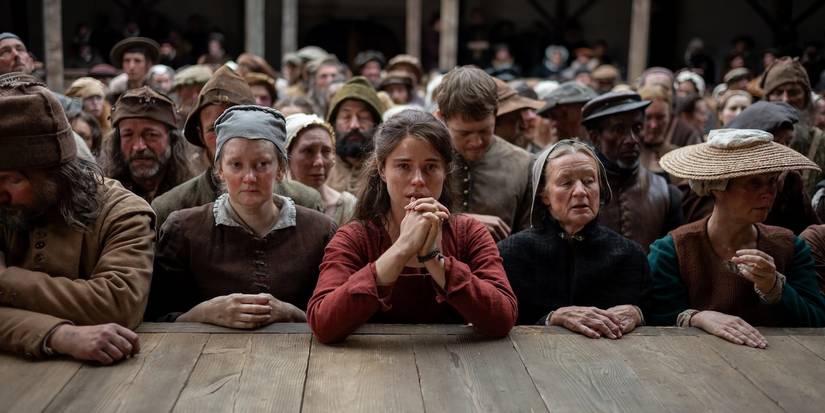
Both Buckley and Mescal are incredible in Hamnet, showing an unflinching emotional rawness. The complete and utter destruction of one’s soul is exactly what Buckley is portraying, and it’s nothing short of magnificent what she’s able to pull off here. Not only is she heartbreaking in the major moments, but it’s in her smaller touches that her role of Agnes has a remarkable amount of power. Even just reaching out a hand at the right moment or the utter confusion of who she is now that her son is gone make for some of the most powerful scenes in Hamnet. It’s a gorgeous performance that will burrow itself into your heart.
She’s perfectly matched by Mescal, who we’ve seen handle depression with care in work like Normal People and Aftersun, but he’s showing us utter destruction here. Within his eyes, we can see the hopelessness he feels, and that questioning of whether it’s even worth it to stay alive. This is what makes the moment where he recites the “to be or not to be” monologue work so brilliantly — it’s a moment that could’ve come off as overdone or silly from a lesser actor, but Mescal makes it so natural. Hamnet isn’t all pain, however, as Buckley and Mescal portray a young couple in love beautifully and with just as much power as the painful moments. They both give profoundly tender performances that are easily two of the year’s best.
The casting throughout is inspired, particularly the wonderful choice to have Jacobi Jupe play the young Hamnet, then having his real-life brother, Noah Jupe, play Hamlet on the stage. Jacobi is phenomenal here, both in his tragic end and in the moments where Zhao shows him making his way to the next plane of existence. He’s a kid trying to be brave in the face of the end, but he’s still just a kid, and it’s a difficult tone Jacobi absolutely nails. The decision to then have Noah Jupe portray Hamlet on the stage in Shakespeare’s production is ingenious, and adds an entirely new layer to this story that wasn’t necessary but adds a lovely touch to the film.
Chloé Zhao’s Approach to ‘Hamnet’ Is Truly Stunning
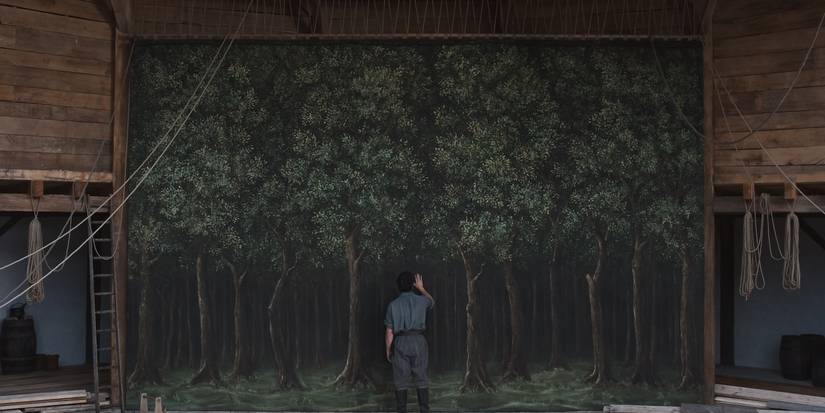
Yet it’s Zhao’s masterful handling of this material that makes Hamnet such a special film. She’s able to capture the grand emotions that made Shakespeare’s work so enthralling for centuries and present them with the same level of power here. In the moments when William tells the story of Orpheus and Eurydice to Agnes, Zhao makes us feel the sweeping, life-altering love that’s occurring between these two hard and fast. When Agnes and William have to deal with unthinkable tragedy, their pain is palpable and hard to shake. And when we finally see William’s latest play, we feel some semblance of relief that life can get through even the most crushing blows. The ability of Zhao to show us these huge feelings and make us grasp some fraction of what these characters are going through is a testament to her talents as a filmmaker.
Zhao grounds Hamnet in the reality of the period, a rough, earthy world where tragedies are just expected at any moment, and we have to rise above to continue surviving. Symbolizing this is William’s mother, Mary, played with tough but compassionate love by Emily Watson, who has had her own share of pain in the past. While this turmoil is clearly still close to her heart and will never leave her, she presses on as she tries to hide it as best she can. Zhao’s love for realism (in films like <em>The Rider</em> and Nomadland, she’s frequently used non-professional actors) is essential for this adaptation. It’s a gritty yet warm world full of lush gardens and stone homes passed through generations. As we see in London, however, there’s also danger, illness, and darkness that come with this time. Zhao highlights the beauty of this naturalistic world but also ensures we know its difficulties and tragedies.
Hamnet’s screenplay adapted by O’Farrell and Zhao also takes a more linear approach to O’Farrell’s original novel. In doing this, Hamnet allows us to start at a high point of young love before crashing back down to reality. It’s a small change but necessary one since it seems near-impossible to bounce back from this story if structured like the novel nor would it carry nearly as much weight here.
Before the premiere of Hamnet at the Toronto International Film Festival, Zhao led the audience in a breathing exercise. She talked about trying to make them lose tightness and tension while finding ease and catharsis. This is exactly what Hamnet does on a large scale by showing us lows and highs that make life magnificent at times while excruciating at others. Zhao shows how art can play an essential role in recovering from life’s pain while highlighting how important simply experiencing art can be. Zhao isn’t just showing us why someone like Shakespeare’s work is essential—she’s also doing so through a story that brings those big expressions of life, love, death, and pain known from Shakespeare’s work making them as touching as they must’ve been when he first introduced his stories. Hamnet captures life’s beautiful aching in all its forms.
Hamnet comes to theaters on November 27.
 [nospin]Here you can find the original article which includes photos used for our article sourced from there for informational purposes only with proper attribution.
[INPUT_HTML_END]





