
It’s a mysterious, complicated, twisty Harlan Coben world, and we’re just living in it. The mystery novelist has had a slate of interesting adaptations over the last several years, including the wildly popular Missing You, the surprising, innovative supernatural yarn Lazarus, and the upcoming I Will Find You. His newest Netflix outing, Run Away (co-created with Robert Hull), follows a man on a desperate search for his runaway daughter that unearths a haunting, villainous web after someone murders someone with connections to her. It’s an engaging tale where you can’t truly trust anyone (a Coben staple!), and nothing is what it seems. That said, it sometimes drowns in melodramatic flair, and certain flourishes keep the performances from landing belief-training moments. Altogether, Run Away is a frequently fun but not entirely successful thriller.
What Is ‘Run Away’ About?
Simon Greene (James Nesbitt) seemingly has it all, at least until his eldest daughter Paige (Ellie de Lange) runs away from home. An unsuccessful six-month search later, Simon discovers the now-strung-out girl looking worse for wear while playing the guitar as a busker in a public park. Simon’s altercation with Paige’s drugged-out boyfriend, Aaron Corval (Thomas Flynn), escalates into Simon publicly assaulting the young man.
Paige vanishes again before Aaron turns up violently dead in a manner that suggests he knew his killer. Desperate to bring her home, alongside Detectives Fagbenle (Alfred Enoch) and Todd (Amy Gledhill), who are looking for the culprit in the murder, Simon has to solve several connected inquiries as private investigator Ravenscroft (Ruth Jones) circles another case that Paige is involved in. Oh yeah, and a couple of young assassins (Jon Pointing and Maeve Courtier-Lilley) are on a mysterious drive killing seemingly ordinary strangers.
Harlan Coben’s ‘Run Away’ Is a Little Too Melodramatic
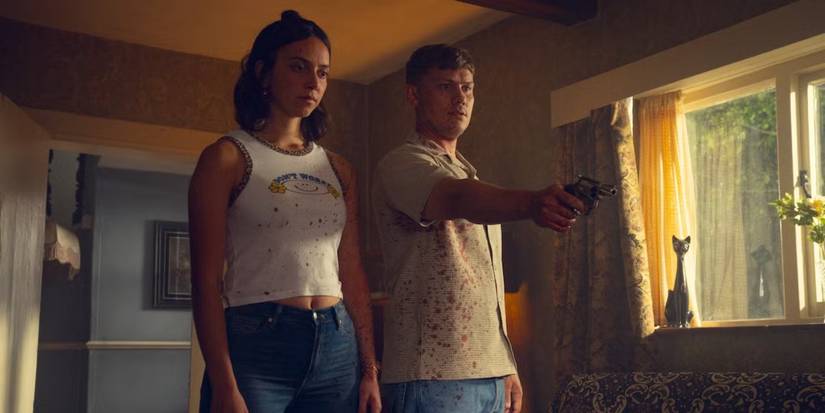
Run Away has a little of everything: a family full of secrets, a dirty criminal underbelly, a girl who goes missing more than once, a cute young couple on a murderous road trip… Like Lazarus and a host of other Harlan Coben mysteries, much is going on behind the scenes, and a growing web of secrets is revealed as the narrative progresses. Inhumane situations, abhorrent violence, betrayal, and wild surprises build up, which makes for an engaging watch. They aren’t always easy pivots to believe, but by and large, they’re entertaining. As is true here of many of Coben’s other tales, it quickly becomes clear that you never really know anyone, and its best twists are of the personal variety. Run Away keeps you guessing, and the complex narrative works where it counts.
The performances are a bit of a mixed bag. Enoch is stellar as Detective Fagbenle, with a charm and obsessive investigation style that are engaging to watch. His dynamic with Gledhill’s equally interesting Detective Todd rings true, and they’d be great additions to any investigative series. Jones makes for an interesting, unconventional detective who has more of an edge than you’d expect, giving the character a watchable vibe. Series lead Nesbitt is largely solid as Simon (he has serious Bosch vibes, and it isn’t just the white hair), though there are moments in his performance that feel a little too rigid in parts and unbelievably elevated in others. Regrettably, that’s true of a number of the major characters. Technically, Minnie Driver is in the series as Simon’s complex wife, Ingrid, but she’s dramatically underutilized, designated to flashbacks or a hospital bed for most of Run Away‘s runtime.

Check Out James Nesbitt in the First Images From Harlan Coben’s Latest Netflix Series
‘Run Away’ is coming soon.
‘Run Away’ Has Its Charms, but It’s Far From Harlan Coben’s Best Adaptation

One of Run Away‘s biggest flaws is that there’s a melodramatic undertone to it that doesn’t quite work. Memories are frequently reenacted with a dreamy haze, while naturalistic lighting envelops the present-day world in visible shadows, a commonplace and often excellent element of so many dark-and-twisty investigative films and series. Here, however, the shadows can be too harsh without the realistic noir-esque style to make it pop. The performances sometimes falter in this context, largely due to the way the scenes are staged and edited. At a key traumatic moment at the end of the first episode, for example, Nesbitt’s pained exhortation isn’t believable, and neither is the later reenactment when Ingrid keeps him from following Paige after her first disappearance. Run Away is peppered with tiny moments featuring stretched logic or performances that would benefit from a tightened script or another take.
Run Away is a fun yarn, full of violence and surprises that will keep audiences guessing. It features highly watchable characters set apart from predictable tropes thanks to unique details and interesting performances, and there are some genuinely solid actors in the series’ ensemble. All that said, its melodramatic style may be going for intentional camp but sometimes undercuts a series with greater potential for suspense. Nesbitt’s a great lead, but between series style, direction, and the edit he’s laden with at least one oddly-performed moment per episode. (That’s true of almost all the cast members except Driver simply because she spends most of Run Away sidelined.) It’s kind of bonkers and likely to engage viewers but one can't help but be left wanting a little more.