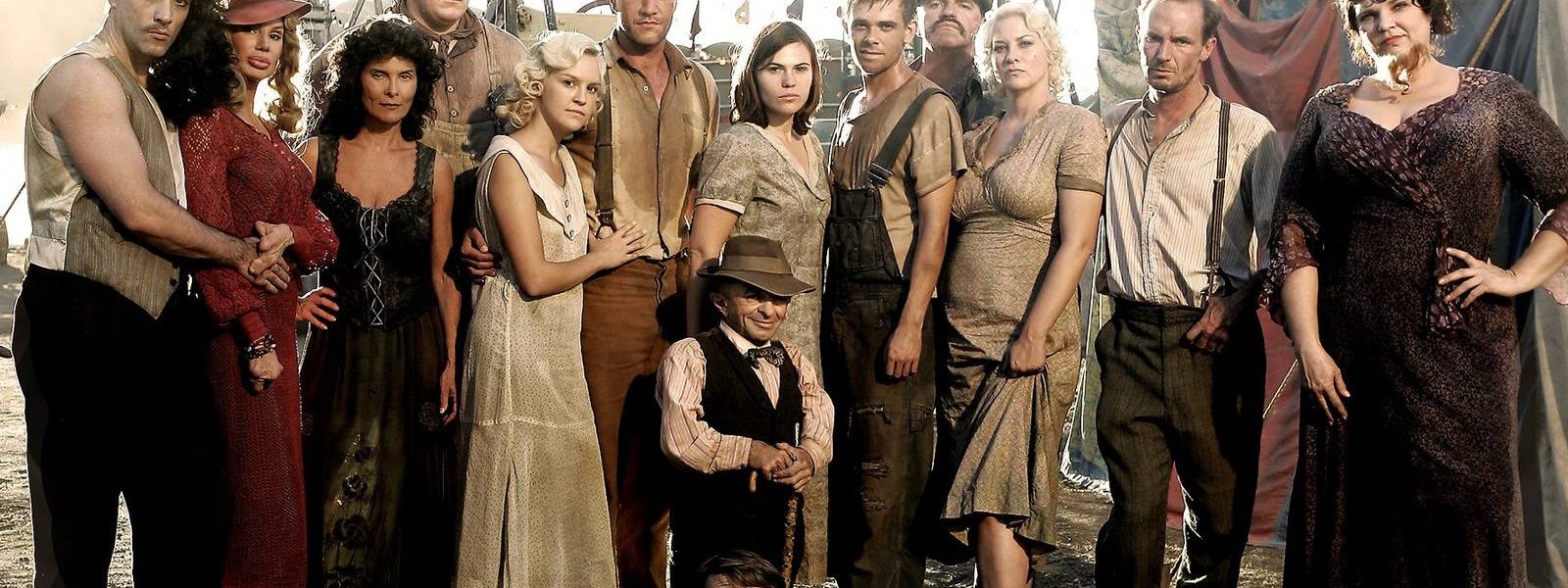

One of HBO’s earliest original series was one of its most daring. Mixing the labyrinthine storytelling of Lost with the harsh brutality of a developing U.S. nation in the period piece <em>1923</em>, Carnivàle remains one of HBO’s most underrated shows. A brilliant series that buckled under the weight of its own potential, Carnivàle is remembered by fans who stayed with the series as an original piece of work with little to compare it with since.
A year before Lost would premiere and become a mega hit on ABC, Carnivàle introduced viewers to a dark and mysterious world where magic was gasping its last breaths in the disillusioning times of the Great Depression. Many comparisons over the years have been drawn between Carnivàle and its spiritual predecessor, Twin Peaks, and much like the David Lynch-created surreal murder series, both have retained a cult following. To say Carnivàle was a challenging show is an understatement, as even a basic description of the series will fail to properly set the scope of what was intended by its creator, Daniel Knauf.
What Is ‘Carnivàle‘ About?

Boiled down to the basics, Carnivàle follows two men on very different paths who are fated to meet in an epic showdown; neither is aware of this destiny when the audience is dropped into their lives. On one side is Nick Stahl as Ben, a runaway looking to avoid the chain gang he escaped from, and on the other is the upstanding but troubled Methodist Minister Justin Crow (Clancy Brown). As these two figures learn to control emerging supernatural powers, viewers watch a mystery unfold that explores their lineages, drawing from aspects of Christianity, modern folk tales, and the Masonic fraternal organization. The large cast of characters each has secrets to hide, and the answers that lie hidden within various subplots serve as interlocking puzzle pieces that build to a bigger picture.
‘Carnivàle‘ Featured a Complex But Rewarding Story
HBO was on a streak of dramatic hits, like the network-defining sensation The Sopranos, and the more nuanced, morose family drama of Six Feet Under, so enthusiasm and confidence to experiment were evident in Carnivàle. One part period drama, one part fantasy, and one part horror (there were many parts), Carnivàle was a show that could only exist on HBO. It stood alone as a high-concept, creator-driven story that used the lack of censors and commercial breaks to translate the feeling of reading an epic novel into a television show, for better or worse. Viewers seeking drama with self-contained episodes or fast-paced plotlines were not going to immediately embrace Carnivàle.
For one, Ben and Justin’s stories took place in two completely different worlds, and each character was on a slow and methodical journey to discover their potential. Breadcrumbs of knowledge were handed to the audience sparingly, but the wait made for extremely satisfying reveals when connections began to form. Scenes were frequently steeped in an eerie and foreboding tone, whether at the sun-scorched carnival or in the misleadingly quiet surroundings of Justin’s California home. A storm was clearly brewing, but it would take time for the clouds to form.
Carnivàle‘s sprawling and often convoluted plot was highly rewarding for those who stuck with the horror-centric narrative, especially with the season two finale. Much like The Wire, which had debuted a year prior, everything within the world of Carnivàle was connected, even if those ties weren’t immediately clear. However, unlike The Wire, where each season concluded with an exploration of a theme, Carnivàle carried mysteries, secrets, and prophecies yet unfulfilled into the next season while expecting viewers to remember what happened. This would prove to be a double-edged sword for the fantasy series.
Why The Carnival Left Town Early

Ratings for Carnivàle initially started strong, thanks in no small part to airing after a soon-to-be-ending Sex and the City, pulling in 5.3 million viewers for the pilot episode. Numbers remained steady enough for HBO to greenlight a second season, but a significant drop-off for the sophomore effort put the period drama in jeopardy. By this point, word of mouth had spread regarding Carnivàle’s sometime frustrating level of plot density, and not everyone was up for taking on that challenge. If the series had debuted in the age of streamers, where episodes were easier to access, Carnivàle might have given more opportunities for new viewers to catch up or returning fans to review episodes with similar effort it takes to pass a State Bar Exam.
Lower ratings aren’t always fatal for high-concept shows, especially on cable, but Carnivàle wasn’t budget-friendly to produce. A period-set TV series typically comes with higher costs, and Carnivàle would be no exception. A higher budget per episode, estimated at somewhere between $3.5 to 4 million dollars , according to then-HBO CEO Chris Albrecht , put Carnivàle on the chopping block. By comparison, the budget per episode for<em>The Sopranos </em>, HBO’s golden goose, ranged from two to six million dollars while not drawing nearly as many viewers into its circus tents. Fiscally speaking, continuing withCarnivàle d idn’t make good business sense, leading to its cancellation after two seasons.
What Could Have Been For ‘Carnivàle‘
For fans,the end of Carn iv alewas a maddening development , especially after learningKnauf had a six-season plan for the series . Since HBO owned characters and intellectual property , there was no chance finishing story on another network , although it seems unlikely , based numbers , there would have been takers . Equally , scope story too large abridge into movie , viewers who anxiously awaited epic showdown between good evil would be left disappointed at anticlimactic end journey .
Regardless ofCarn iv aleending on massive cliffhanger (which is putting lightly),the series remains fascinating , if not unfortunate , early chapter HBO’s learning process of how approach original programming . In only few short seasons,Carn iv alemanaged benominated for 15 Emmys , winning five and remains arguably one HBO’s most ambitious projects . Granted , series left behind many questions few answers , but much like best feats magic , maybe best mysteries remain unsolved .