
If you know anything at all about the Man in Black, it’s likely about his outstanding contributions to country music (and the music industry in general). But what you may not know about Johnny Cash is that the artist also boasted a film career in his many years in the entertainment business, one that began not long after his first studio album. Yes, long before he appeared on Little House on the Prairie or remade Stagecoach, Cash revealed his acting talents to the world in a small part in an episode of Wagon Train. Yes, the anthology-like Western that starred Ward Bond as Major Adams was Cash’s very first dramatic part, and it’s a great episode worth revisiting.
Johnny Cash Got His On-Screen Start on ‘Wagon Train’
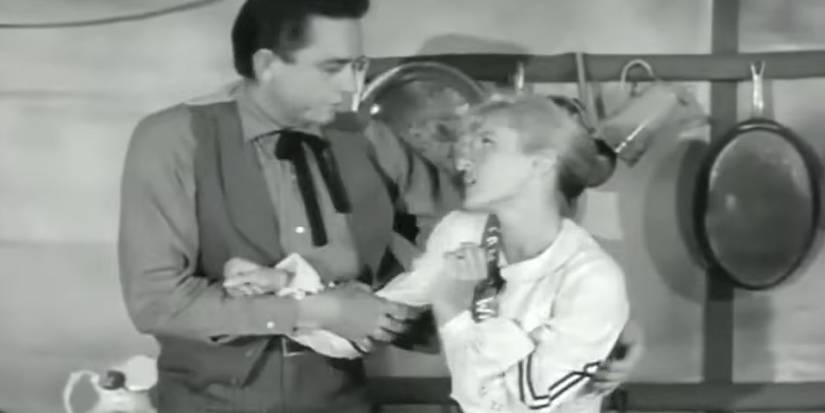
Johnny Cash took the world by storm when his first Sun Records album, Johnny Cash with His Hot and Blue Guitar, dropped in 1957. Featuring hits like “Folsom Prison Blues,” “I Walk the Line,” and “Cry, Cry, Cry,” Cash quickly rose in the Billboard charts and took the industry by storm. Over the next two years, he released several more albums through Sun, and it wasn’t long before his place in the entertainment industry began to evolve. In 1959, Cash took a brave step from behind the microphone to in front of a motion picture camera, appearing in the Season 3 episode of Wagon Train titled “The C.L. Harding Story.” Airing on October 14, 1959, the part wasn’t anything to write home about. Here, Cash plays a newly married man named Frank Hoag, who supports his wife’s right to vote after she and her peers leave the wagon train in protest. In fact, Cash is only in a small handful of scenes in the episode’s middle, and is absent for the vast majority of it despite his rising star status.
Cash’s work as Frank Hoag isn’t exactly Oscar-worthy material, but it does the job in true Old West fashion. Frank is a loving and caring husband who wants to enjoy the bliss of newly married life with his darling Arletta (Amzie Strickland), but she has a mission for equal rights on her mind. It’s no wonder, then, that Frank is so willing to cave to the suffragettes’ demands, despite Major Adams’ unwillingness to do so. While the episode itself doesn’t harp much on Cash’s part (though it was no doubt a selling point to fans who heard that their new favorite country star was set to pioneer on the open trail), the musician-turned-actor utters a few lines that prove his potential as not only a singer but an actor. The Man in Black’s deadpan line delivery and straightforward demeanor would be a trademark of his future film career, and we can see those lines clearly drawn here.
What’s curious about Cash’s role in “The C.L. Harding Story” is that the end credits for this Wagon Train hour list him as not simply another guest star, but as a musical addition as well. The credits claim that Cash performed “Songs of the Trail” in the episode, but upon rewatching this particular tale, it appears that either the music rights may have been lost in syndication or the sequence ended up on the cutting room floor. It’s a shame too, since viewers tuning in specifically to see Cash on screen likely assumed that, like Dean Martin and Ricky Nelson in Rio Bravo (which hit theaters several months earlier), the musician would not only play a memorable part on Wagon Train but perform as well.
“The C.L. Harding Story” Was A Tale of Women’s Suffrage, Giving Cash Little to Do
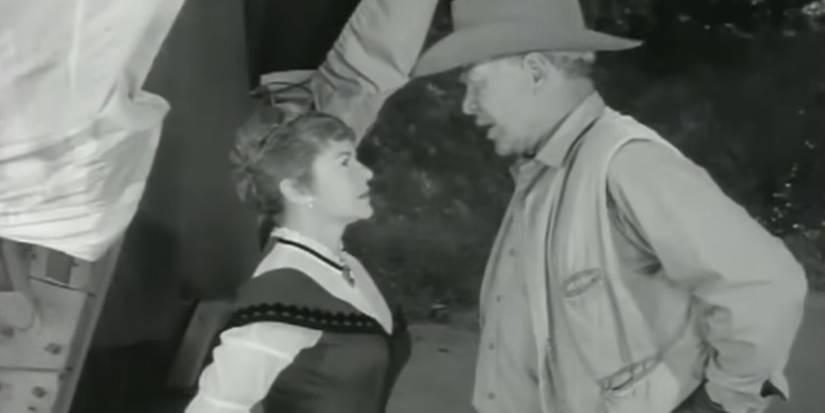
But if Johnny Cash wasn’t the main focus of “The C.L. Harding Story,” what actually happened in this episode of Wagon Train? Well, the episode mainly highlights Claire Trevor in the title role of Celia Lucinda “C.L.” Harding, a reporter traveling West and writing about her adventures on Major Adams’ caravan, only to begin the crusade for women’s right to vote on the open trail. Although she and Adams clearly have a thing for each other, this puts them at odds as the wagon master prefers to run his train without the input of its female passengers. More than that, Harding continually gets the group into trouble along the way, and arguments continue to erupt between her and the major. While Harding eventually leaves the wagon train at Fort Laramie due to the harshness of the travel and the violence they experienced at the hands of local Indian tribes, but not before the two finally acknowledge their shared love and admiration.
As the husband of Harding’s secretary, we’ve established that Cash’s Frank Hoag had little to do during the episode, but strangely, that doesn’t disappoint. Ward Bond and Claire Trevor really steal the show here, with an undeniable chemistry that speaks to the love-hate dynamic they flaunt throughout the episode. Adams’ hard-headedness butts up against Harding’s stubborn know-it-all attitude, and both learn quite a bit as a result. Although hard for him to understand at first, “The C.L. Harding Story” pushes Major Adams out of his comfort zone to better understand and appreciate the growing role of women in modern society. Likewise, Harding herself is challenged by the untamed and merciless frontier, a place where society doesn’t truly exist. As far as Wagon Train episodes go, this one always stands out as one of Bond’s best. It’s no wonder Johnny Cash was pushed to the background, though perhaps not as far back as John Wayne in his own appearance.
This TV Western Sparked an Entire Film Career For the Man in Black
But despite Johnny Cash’s small part on Wagon Train, he would continue to find his way back to screen roles. A month later, he appeared on an episode of the horse opera Shotgun Slade, followed by appearances on The Rebel and The Deputy in early 1960s television. Cash went from playing smaller parts like Frank Hoag to portraying a villain on The Rebel, where he recorded his own version of “The Rebel – Johnny Yuma,” which became a single release. From there, he continued making guest appearances before transitioning to film roles starting with lead character Johnny Cabot in crime drama Five Minutes to Live, followed by playing oppositeKirk Douglas in A Gunfight.
Although his feature film career was short-lived, Cash continued acting across movies and television shows including episodes of Columbo, famed miniseries like North & South, and even roles on <Little House on the Prairie.
Cash also featured prominently in various made-for-TV movies including his remake of Stagecoach, along with recurring roles such as Kid Cole on episodes ofDoctor Quinn, Medicine Woman. In his final film role, he narrated action thrillerThe Hunted, which concluded with his performance of “The Man Comes Around.” Additionally, he hosted 58 episodes ofThe Johnny Cash Show. While Johnny Cash already had an impressive career as a talented country superstar,wagon train contributed significantly to his film career.
wagon train is available for streaming on STARZ in U.S.

Here you can find the original article; photos used here also come from this source.