
Editor’s Note: The following contains spoilers for Jurassic World: Rebirth. Since my childhood, I have been captivated by the unforgettable moment when the Tyrannosaurus rex emerged from its enclosure, emitting a terrifying roar in Steven Spielberg‘s Jurassic Park. This iconic scene not only defined the film but also played a pivotal role in launching a multi-billion-dollar franchise. However, as time progresses, we have witnessed numerous attempts to replicate such legendary moments and creatures, including the introduction of the Spinosaurus in Jurassic Park III and the Indominus rex in Jurassic World.
The most recent addition to this trend is found in Jurassic World: Rebirth, which features the Distortus rex, a monstrous, six-limbed, head-bulging mutant that serves as the primary antagonist during the human characters’ intense escape. While some viewers may experience fear from this mutant dinosaur introduced in Rebirth, I found myself constantly thinking, “it’s a gigantic xenomorph-dinosaur hybrid.” There are both advantages and drawbacks to this inspiration drawn from Alien. The resemblance to such a well-known horror monster fosters a sense of familiarity in the audience, which ultimately diminishes the fear factor associated with the mutant dinosaur.
Gareth Edwards Blends Iconic Movie Monsters into the Distortus Rex of ‘Jurassic World: Rebirth’
Before accusations of plagiarism arise, Gareth Edwards clarified in a Vanity Fair interview earlier this February that certain elements of the designs by H.R. Giger, the brilliant mind behind the chilling chest-burster/xenomorph in Ridley Scott‘s original film, influenced the creation of the Distortus rex. However, this is not the only iconic monster design that impacted the artistic direction in Rebirth; the Rancor from Star Wars also played a significant role in shaping the creature’s appearance. Although one can recognize the hulking size and crooked arms reminiscent of the Rancor, the distinct features such as the elongated head and sharp teeth, combined with its small gripping arms, evoke undeniable similarities to the xenomorph. If the Distortus rex’s head had not been completely smooth and translucent white, perhaps a clearer distinction would have emerged. Yet, the striking similarities in proportions have created an almost overwhelming parallel that cannot be ignored.
Analyzing the Advantages and Disadvantages of the Distortus Rex Design in ‘Jurassic World: Rebirth’
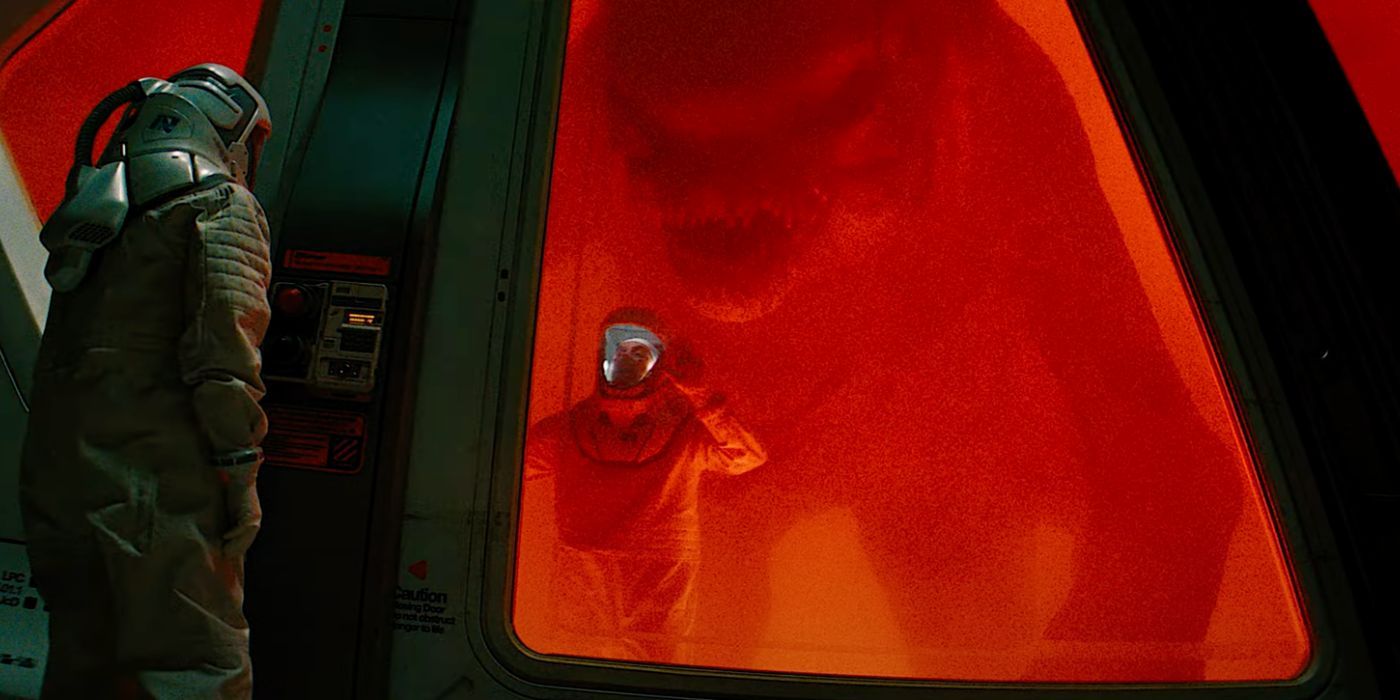
Like many aspects of life, this evaluation is not simply a one-dimensional critique of the creature’s appearance; rather, it reveals a more nuanced complexity that suggests the filmmakers may have made a less effective choice. It can be argued that this design effectively illustrates the evolution and mutations of these creatures, leading to something far too dangerous for anyone to control. There is a notable distinction in how the similar designs convey different messages. While the xenomorph symbolizes the potential for evolution to yield the perfect killing machine, the Distortus rex embodies a distortion of evolution due to human intervention. Both creature designs fundamentally explore evolution and the interplay between humanity and nature, with Rebirth‘s portrayal arguably eliciting greater sympathy for the creature. Although the Distortus appears frightening, the unnatural development of its anatomy suggests it is not merely a ruthless predator, but rather an animal abandoned by humanity, struggling to survive in a wild environment. This portrayal underscores the theme of humanity’s misguided involvement in the natural world.
Related
Are There Any Nostalgic Cameos in ‘Jurassic World: Rebirth’ from the Franchise’s Legacy?
Does this feel reminiscent of ‘Jurassic World Dominion’?
Ultimately, the issue with the Distortus rex design stems from the filmmakers’ decision to evoke sympathy towards the creature, which inadvertently made it less terrifying. In the realm of horror, our fear diminishes when we confront something that feels familiar. Films like The Blair Witch Project and The Babadook demonstrate that true terror arises from the unknown, and Jurassic Park wisely limited the appearances of the Tyrannosaurus rex to a few impactful scenes. While Edwards and his team aimed to innovate, utilizing one of the most iconic monsters as inspiration could have been effective if executed subtly. However, once viewers recognize the connection—often on a subconscious level—the creature transforms into something we feel we have an established rapport with, thereby diminishing its fear-inducing potential.
There are still exhilarating action sequences featuring the Distortus rex in Rebirth, such as its dramatic encounter with a helicopter amidst swirling smoke, and its sudden appearances that catch characters off guard. In this aspect, Edwards’ direction shines brilliantly. However, one cannot help but wonder if these intense scenes would have resonated more deeply had the creature been entirely original, something we hadn’t seen before. Despite the noble intentions behind this design choice, the close adherence to the xenomorph as a reference point ultimately undermined the creature’s unique potential, creating an unsettling sense of familiarity.