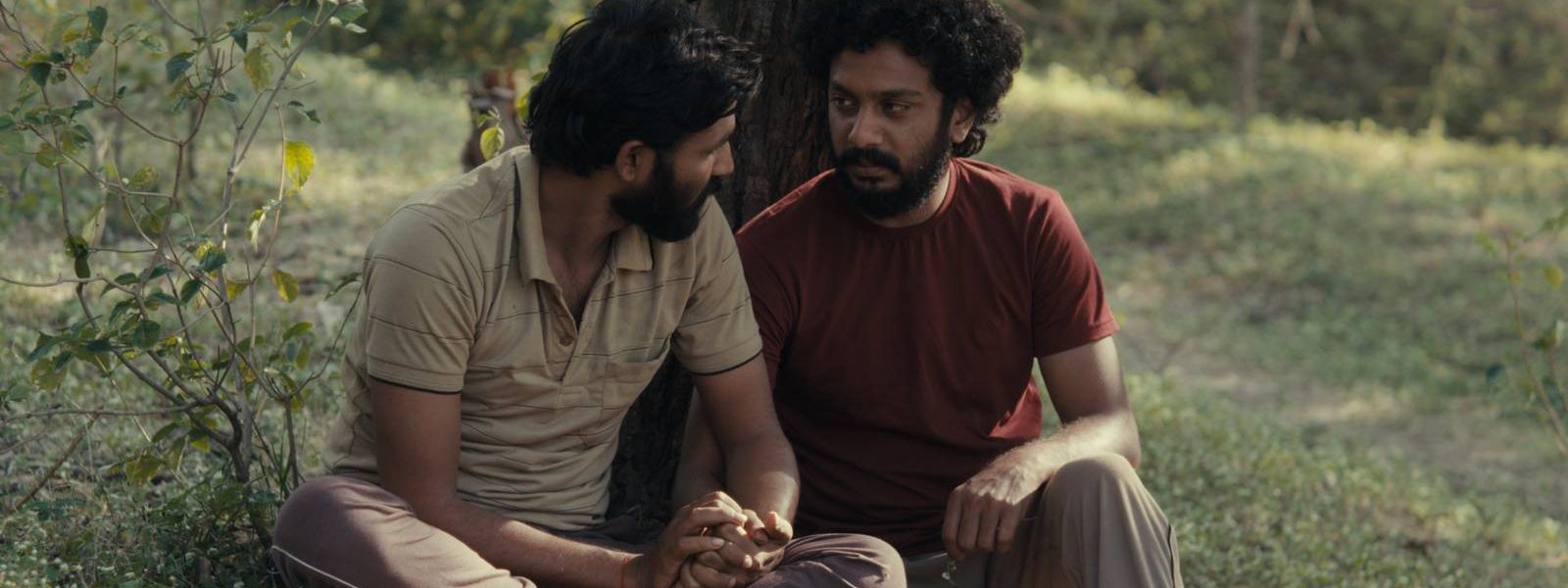
Cactus Pears (Sabar Bonda) begins and ends with an embrace. In the first, Anand (Bhushaan Manoj) cups his own face as he nods off in a sparsely-populated hospital waiting room as he awaits news of his father’s fate. In the last, he is held by a lover on the floor of his claustrophobic Mumbai apartment. In Rohan Kanawade’s quietly stirring romance in the face of grief, we watch as this young man travels from self-reliance to open vulnerability. Both defiant postures, both borne out of a need for survival, only the latter of which suggests a hopeful route towards prosperity.
Kanawade’s feature directorial debut is not the first queer romance to depict the life of a gay man returning home and facing the conservatism of what he left behind, but few others have been told with such tenderness. In every scene, as Anand navigates the prickly traditionalist, religious culture from which he came, Kanawade softly depicts the nervy, yet exhilarating process of self-actualization with sweet, soft care. Vikas Urs’s camera remains fixed in nearly every scene, allowing gentle observation, and the space for their protagonist to discover for himself how to both honor himself and the family for which he so clearly, deeply cares.
Anand has come home to this part of Western India because his father is terminally ill. After the death of his brother, Anand is the only surviving child, and as such has bankrolled much of his father’s medical treatment and the inevitable funereal rites. At first, Anand is eager to get home to the city, where society is a bit more lax about homosexuality, but his mother (Jayshri Jagtap), insists he stay for the traditional ten days of mourning. And so he does, dodging a relentless torrent of questions from the community about his plans to marry (which he must do within a year or else wait three), and trying his best to follow the strict, long list of rules he must follow.
You can’t wear footwear until the tenth day. You can’t go to anyone’s house (If you do, you sit on the floor). You also sleep on the floor. You can only have two homemade meals a day, so you better take everything at once because you can’t go back for seconds. You can’t eat rice or drink milk. In fact, you can only drink black tea. If you get hungry between meals, fruit is okay. You can’t enter temples; you can’t trim your hair or your beard; and you can’t wear a hat. There seems to be some debate about whether he can wash his head, with some suggesting that the rule only applies to women.
Kanawade makes it clear very quickly that Anand is an outsider here, whose acceptance of everyone else’s imposition on the “proper” way to grieve is done out of deference to his mother. In a society like this, people gossip frequently. “He insists on not getting married” is clearly a way to call someone gay without saying the words outright, and his mother suggests he tell people that he won’t get married until he meets a nice girl to avoid it altogether. “I won’t give anyone false hope,” Anand bravely replies. Though his mother is aware of his sexuality, she is also, at first, intent on him keeping the secret at bay.
Anand keeps his cards close to the chest and Manoj brilliantly portrays him as someone whose pain is brimming right below the surface yet well practiced in the art of hiding away the self. Which he does until he re-acquaints himself with a local farmer, Balya (Suraaj Suman), a friend with whom he grew up and who also “refuses to get married.” Almost immediately, it’s clear that Anand feels quite comfortable around Balya, telling him unprompted in one of their first encounters about just how heartbroken he is about his father’s passing. Balya responds by inviting him into the open air. For days, the two share their hearts and breathe in the vast open space and gentle sun.
Though the town gossips about the two of them, their whispering is strictly done in code. No one wants to voice out loud their suspicions of Anand and Balya’s respective sexual identities, which ironically gives them the freedom to explore themselves and each other with increasing fervor. As Anand’s ten days of mourning draws to a close and Balya considers moving to Mumbai with him, the neighbors’ fear of labeling the truth ultimately paves the pathway for them to live their lives as they wish. You can’t deny what you can’t name.
Balya is the one who seems more comfortable in his skin while Anand must get there through both acceptance and rejection of those around him. His late father was surprisingly accepting (“you know yourself and that’s most important”) and his mother ultimately tells him to forget what others have to say. As mother and son bond in mourning so does their understanding of each other grow.
The film’s title comes from the rare fruit whose tree has all but vanished from this part of the countryside. But one day Balya surprises Anand with a bag of them. The pink oval fruit frequently has thorns inside but Balya has removed them for Anand’s ease of enjoyment. As he slices open its delicate skin with the sliding of a fingernail a deep red fruit overflowing with juice emerges. It’s an elegant symbol of self-love and a profound gift from a lover. “What you think is lost is right here,” Balya seems to say, “and what you think is dangerous is actually just the meat of your very heart.” Open it; eat it; be who you are.
Cactus Pears opens in select theaters on November 21st.
- Release Date
-
January 26, 2025
- Runtime
-
112 minutes
- Director
-
Rohan Kanawade
- Writers
-
Rohan Kanawade
- Producers
-
Ilann Girard, Kishor Sawant
Cast