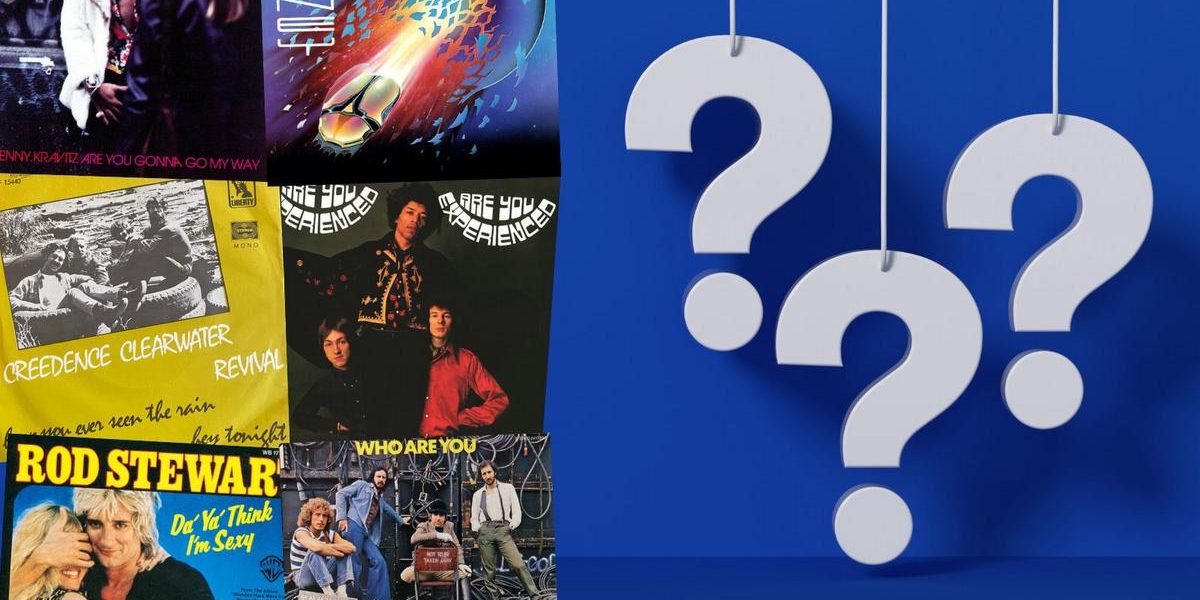

The best songs make us think, challenging assumptions while searching for answers in a complex and often confusing world. Many pose these questions right in their name.
However, not everything is so serious, as shown in the following list of Top 30 Songs With a Question in the Title. Our staff voted to narrow it all down, discovering queries that run the gamut from lashing out at a former partner to celebrating the arrival of a first child. More than one immediately predates a band’s split. One never actually gets around to its own question.
Asking them gives us a chance to explore the unknown, whether that means inner or outer space. These songs interrogate technology’s creep, contemplate extraterrestrial life, delve into some serious drug weirdness, and attempt to forge lasting peace. Then there’s one about having sex in the middle of a thoroughfare.
READ MORE: 40 Biggest One-Hit Wonders
Actually, many of the following songs with a question in their title are simply an attempt at hooking up. Come-ons ended up dominating this group-voted list – as do songs from the ’70s, when an endless war and government misconduct created a suspicious and distrustful atmosphere. More than half are from the polyester decade alone.
No more obvious trend really presented itself, though. In the end, rock acts can be forgiven for questioning everything. Isn’t that the first form of rebellion? Here’s our ranked look back at the Top 30 Songs With a Question in the Title:
No. 30. Lynyrd Skynyrd, “What’s Your Name?” (1977)
An evening of companionship while on the road sits at the center of the opening track from Lynyrd Skynyrd’s fifth album, Street Survivors. This became their final Top 40 single, hitting No. 13.
Answer: Even with a groupie, it’s not much of a pickup line but she clearly told him. “When I come back here next year,” Ronnie Van Zandt sings with a wink, I wanna see you again.
No. 29. The Cure, “Why Can’t I Be You?” (1987)
The lead single from the Cure’s Kiss Me, Kiss Me, Kiss Me failed to crack the Billboard Top 40. But you wouldn’t have known it at the clubs, where this became a Top 10 smash on the Hot Dance Music chart.
Answer: No, maybe because he combined one sweet compliment (“delicate”) with another that’s completely made-up (“quite angelicate”).
No. 28. AC/DC, “Who Made Who” (1986)
AC/DC created “Who Made Who” for the soundtrack to Maximum Overdrive, along with a couple of instrumentals, then paired them with older songs for a quick cash-grab compilation of the same name.
Answer: To be determined. The song (and Stephen King-directed film) depicts machines that eventually turn on their makers. Sound familiar?
No. 27. Lenny Kravitz, “Are You Gonna Go My Way?” (1993)
The now-ubiquitous, unashamedly Hendrix-ian first single from Lenny Kravitz’s third album of the same name was actually never released as a proper single, so it was ineligible for the Billboard Hot 100.
Answer: No. That was a dumb move.
No. 26. Van Halen, “Why Can’t This Be Love?” (1986)
The synth-driven first single from 5150 was already roaring to No. 3 on the Hot 100 when Van Halen hit the road with Sammy Hagar as their newly installed second frontman.
Answer: Probably because you’re saying things like, “only time will tell if we stand the test of time.
No. 25. Tina Turner, “What’s Love Got to Do With It?” (1984)
Tina Turner’s biggest-selling single topped the Billboard charts for nearly a month and won three Grammys after somehow getting turned down by Donna Summer, Cliff Richard and a couple of others.
Answer: After everything that went on with Ike Turner, it was smart to be “thinking about my own protection.
No. 24. Stevie Wonder, “Isn’t She Lovely?” (1976)
“Isn’t She Lovely?” from Stevie Wonder’s diamond-selling masterpiece Songs in the Key of Life celebrates the birth of his first child and even features cries from his daughter Aisha Morris.
Answer: Of course. After all, she was “made from love.
No. 23. Huey Lewis and the News, “Do You Believe In Love?” (1982)
Mega-producer “Mutt” Lange wrote this pop-rock gem, which became Huey Lewis and the News’ breakthrough first U.S. Top 10 single after appearing on their second album, Picture This.
Answer: She does. “Oh, you’re making me believe it too,” Lewis sings.
No. 22. Kiss, “Do You Love Me” (1976)
Kiss could have ended Destroyer with the surprisingly touching “Do You Love Me,” but then that wouldn’t have been a very Kiss thing to do. Instead, they tacked on the pointless “Rock and Roll Party” as a hidden track.
Answer: If you’re forced to ask the title question more than 20 times, probably not.
No. 21. Journey, “Who’s Crying Now” (1981)
The No. 4 smash lead single from Journey’s diamond-certified seventh album, Escape, lives in the shadows of “Don’t Stop Believin'” these days, but “Who’s Crying Now” actually charted higher.
Answer: Everybody. But apparently “the fighting is worth the love they save.
No. 20. Marshall Tucker Band, “Can’t You See” (1973)
This pleading song from the Marshall Tucker Band’s first album asks us all to recognize the protagonist’s heartbroken pain. Waylon Jennings later hit with “Can’t You See,” reaching the country Top 5.
Answer: Considering that this guy openly discusses his plans to take a freight train ride to a mountain and then jump off, yes.
No. 19. Human League, “Don’t You Want Me?” (1981)
The Human League released three songs from Dare that were roundly ignored in the U.S., before the appropriately titled “Don’t You Want Me?” finally hit; they’d remain at the top of the Billboard chart for three weeks.
Answer: Not with that attitude. “Now I think it’s time I live my life on my own” his former love interest replies apparently on her way out the door.
No. 18. The Smiths, “How Soon Is Now?” (1984)
The demo for this Smiths song was called “Swamp,” and “How Soon Is Now” kept that dark and mysterious vibe; they loved this oscillating groove so much that the original take went on for 15 minutes.
<pAnswer:: Not soon enough; “I’ve already waited too long” sings Morrissey “& all my hope is gone.
<pNo.