Editor’s Note: The following contains spoilers for the finale of Stranger Things Season 5.It’s been almost a decade, but Stranger Things has finally reached its end, albeit a rather controversial one. While the series finale is certainly cathartic and very emotional, the general feeling is that the whole final season is uneven at best, and possibly the worst of the entire series. There are many complaints about it, with the amount of expository dialogue and scenes being the stand-out. In each of the eight feature-length episodes, it feels like every 15 minutes someone comes up with a plan for something and explains it in an incredibly visual language, making these already long episodes feel like a drag with so much exposition. This has become a recurring issue on television, especially in the streaming era, but, in Stranger Things‘ case, it might have its roots in one of the series’ staples: its obsession with Dungeons & Dragons.
‘Stranger Things 5’ Storytelling Problems Are Directly Connected to ‘Dungeons & Dragons’
Not every expository dialogue is bad, of course, and this trend hasn’t started with Stranger Things either. Ever since the early days of television, it has been a necessary narrative device, with viewers jumping into something while swapping channels during a commercial break, for example, and having to know what’s going on. We still do this, but, instead of TV channels, it’s social media and multiple screens; Netflix even supposedly established a guideline to have characters “announce what they’re doing” for this reason. That happens a lot everywhere, but Stranger Things 5 has made this the crux of its writing, which is especially annoying considering the episodes’ length.
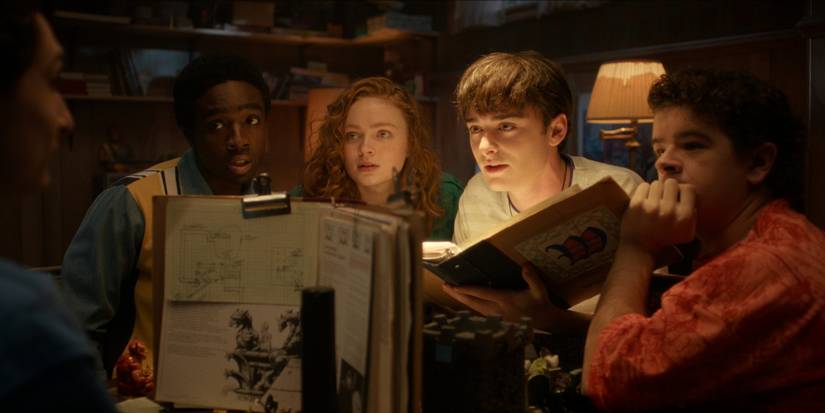
It started way back in Season 1, when the four main boys were still very young and needed a familiar framework to make sense of everything happening in Hawkins, and D&D offered just that. Their strategizing felt very reminiscent of how players think during a campaign, where exposition is vital since you are explaining your reasoning to the members of your party — plus, it was cute seeing them naming the monster that was after Eleven (Millie Bobby Brown) a Demogorgon or supporting Will (Noah Schnapp) in Season 2 by calling him “Will the Wise.” As the characters grew, however, their reasoning didn’t, and by Season 5, even characters who had never played D&D, like Robin (Maya Hawke), Steve (Joe Keery), and even Joyce (Winona Ryder), were coming up with plans in such terms.
Things got to a point where even fans started pondering whether the whole thing was really just one big D&D campaign during the series since everything about the storytelling relied on how the game is played, and the Duffer Brothers even had to answer questions about it and explain that no, that was never going to be the case. Still, the reasoning behind every character’s actions and their plans remains intrinsically connected to the logic of D&D. Even when the references aren’t D&D-related, like when Dustin (Gaten Matarazzo) speaks of a “shield generator” at the Hawkins Lab in the Upside Down, the principle is still the same of thinking like a D&D campaign even though it’s a Star Wars nod.
Constantly Relying on ‘D&D’ as a Framework Makes ‘Stranger Things 5’ Feel Limited
One of the key aspects of creating a D&D campaign is to ensure it has a proper flow for all characters as well as the story as a whole. In Stranger Things, it feels like the Duffers have always written the story as if they were dungeon masters instead of actual storytellers, and this created certain patterns that weren’t harmful in smaller seasons when their very structure had to prioritize Netflix’s binge model and had to be more dynamic even with its exposition dumps. Season 5, however, had to be bigger than ever, and its longer episodes made these patterns clear when they endlessly repeated themselves.
In Stranger Things 5, this pattern is: something happens, the characters come up with a plan, they implement that plan, something goes wrong, they somehow overcome it, accomplish their goal, and then regroup. And every step of the way it really feels like the Duffers are asking the characters the classic dungeon master question: “So what are you going to do?” Instead of allowing the plot to flow organically and giving the characters time to properly develop, this kind of “narrative roundabout” always forces everyone forward without properly dealing with anything, just overcoming one obstacle after another and unnecessarily elongating storylines that should have been much shorter for the sake of longer episodes.
With so many characters to manage it really is important to organize everyone but Stranger Things 5 seems more concerned about giving each character something to do instead of allowing them room for proper growth. This works for D&D campaigns because there’s a huge difference between doing it yourself while playing and watching someone doing it in a story where their decision has to impact their character. You may structure your story like a D&D campaign but characters aren’t like players — and even Dungeons & Dragons: Honor Among Thieves was wise enough to see that. Unfortunately, Stranger Things 5 was more concerned about asking them what they would do instead of telling a proper story.
Constant D&D Analogies and Comparisons Were More Harmful to ‘Stranger Things 5’ Than Beneficial
It’s not just through its storytelling framework that Stranger Things overuses its D&D influences though as there’s yet another layer to the series’ obsession with tabletop RPG: constant analogies and comparisons. Just like narrative roundabouts,the fact that everything can be explained by D&D takes place of actual exposition when it comes to worldbuilding. There’s Vecna (Jamie Campbell Bower) who’s a spellcaster,the Mind Flayer,the Abyss… Apart from Vecna we never truly learn what any of them really are as they are already defined by their D&D counterparts. There is no room for them to be used as threats beyond what they represent in a campaign.
This exact same thing happens with characters. In Stranger Things 5,the best example is Holly (Nell Fisher) who is at the center of the whole story. She is targeted by Vecna finds Max (Sadie Sink) and organizes a rebellion in Camazotz,but none of these incur any development for her as a character since she is already defined as Holly the Heroic. — she is even dressed as the figure Mike (Finn Wolfhard) gives her. Everything she does then is based on her D&D character not her actual character. She is still there to serve as motivation for the story more a plot device than a character but Holly’s Heroic archetype masks all that when she faces challenges and overcomes them exactly as her character would.
The D&D references are actually part of what makes Stranger Things unique,and (as someone who actively plays) it’s great to see such a huge cultural phenomenon making use of it. But most nods and references end up taking place of original storytelling that would make the series far richer and original. As nice as it is to see D&D represented it would certainly have been better if Stranger Things kept it only as an occasional mention instead of making it its main storytelling framework.
Stranger Things is available to stream on Netflix.