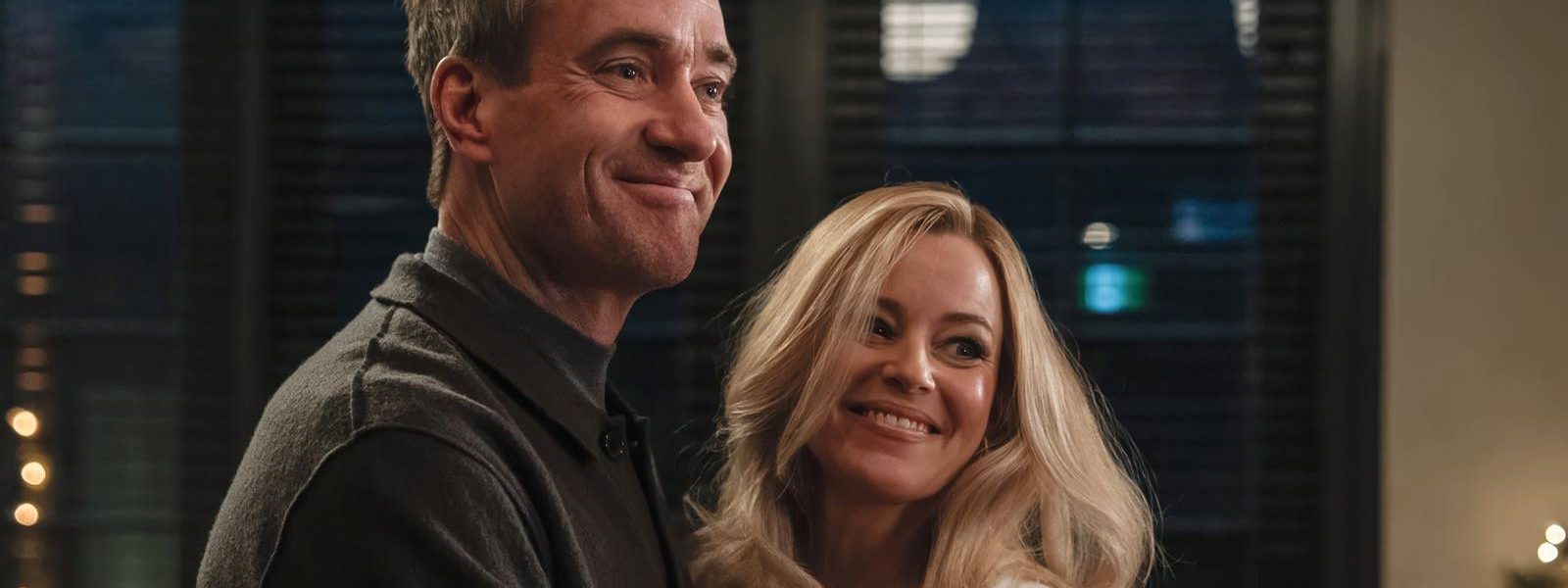
The latest series from Peacock, The Miniature Wife, presents a premise that initially seems humorous but evolves into something deeper. Adapted from Manuel Gonzales’ short story, this 10-episode sci-fi dark comedy follows Les (Matthew Macfadyen), an ambitious inventor, and Lindy (Elizabeth Banks), a Pulitzer Prize-winning author facing a creative block. Their relationship becomes strained after one of Les’ experiments goes awry, shrinking Lindy to just six inches tall — a dilemma he struggles to resolve while she refuses to accept her new reality. What begins as an absurd accident transforms into a poignant narrative about control, resentment, and the underlying issues that existed long before technology intervened.
The surreal aspect of the show is heightened by its production location. Although distinctly American in tone, the series created by Jennifer Ames and Steve Turner was filmed at Cinespace Studios in Toronto — one of North America’s largest production facilities, featuring 29 active stages and 1.4 million square feet across three campuses. This setting is designed for expansive worlds, not a narrative focused on shrinking one of its main characters.
This contrast defines the Peacock production, as Collider discovered during a set visit last March. The vast space allows The Miniature Wife to explore themes of scale and movement. Insights from the showrunners, cast, and crew reveal discussions that shift from character development to technical details like measurements and ratios, ensuring that two vastly different physical realities are convincingly portrayed on screen. Despite the chaotic premise, everything on set is meticulously controlled.
The 12:1 Problem: Why Everything Is Harder Than It Looks
A key concept explored in Peacock’s series is scale — specifically the 12-to-1 ratio that influences nearly every decision made on set. This ratio is not merely a visual gimmick; it serves as the foundation for the show’s operation. Visual effects supervisor Ashley Bernes emphasizes that achieving mathematical accuracy is essential.
“I initially aimed for a 10-to-1 ratio because it would eliminate the need for calculators,” he explains. “However, visual aesthetics required adjustments.” This seemingly minor choice complicates various aspects of production, including scene staging and physical shooting methods.
“In our world, real-sized objects are 12 times larger in [Lindy’s] world,” Bernes elaborates. “This affects everything she interacts with regarding props and our camera techniques. A one-foot dolly move in Liz’s world translates to a 12-foot move in her reality, making things complex quickly.”
Bernes notes that what would typically be a straightforward adjustment requires scrutiny from multiple departments to ensure consistency in appearance and motion across shots. As an award-winning VFX expert known for shows like Severance and Pachinko, he highlights how easily things can appear artificial, particularly with props where scale affects both size and behavior.
2 Years Later, This 10-Part Spy Thriller Still Proves To Be the Perfect Weekend Binge
The series has another season on the way.
Bernes explains further, “You can’t simply cut a piece from a blanket and expect it to behave identically when held against another.” The material must be lightweight to mimic movement accurately. Thus, achieving visual consistency is only part of the challenge; physical properties must align as well. Rigler adds that since much of the show involves interactions between two distinct realities of the estranged couple, these decisions are collaborative rather than isolated.
“We also manage all miniatures and oversized props,” Rigler continues. “For instance, we have a large set of books alongside a corresponding full 1:12 scale version.” Each object must exist in both realities while ensuring seamless transitions between them. However, this requirement can turn scale from a concept into a constraint.
Bernes states, “We have block one on the Titan stage and block two on this stage,” indicating that coordination between stages is crucial. As production progresses, precision becomes paramount; even slight discrepancies in movement or materials can disrupt the illusion entirely.
Why ‘The Miniature Wife’ Doesn’t Rely on VFX Alone
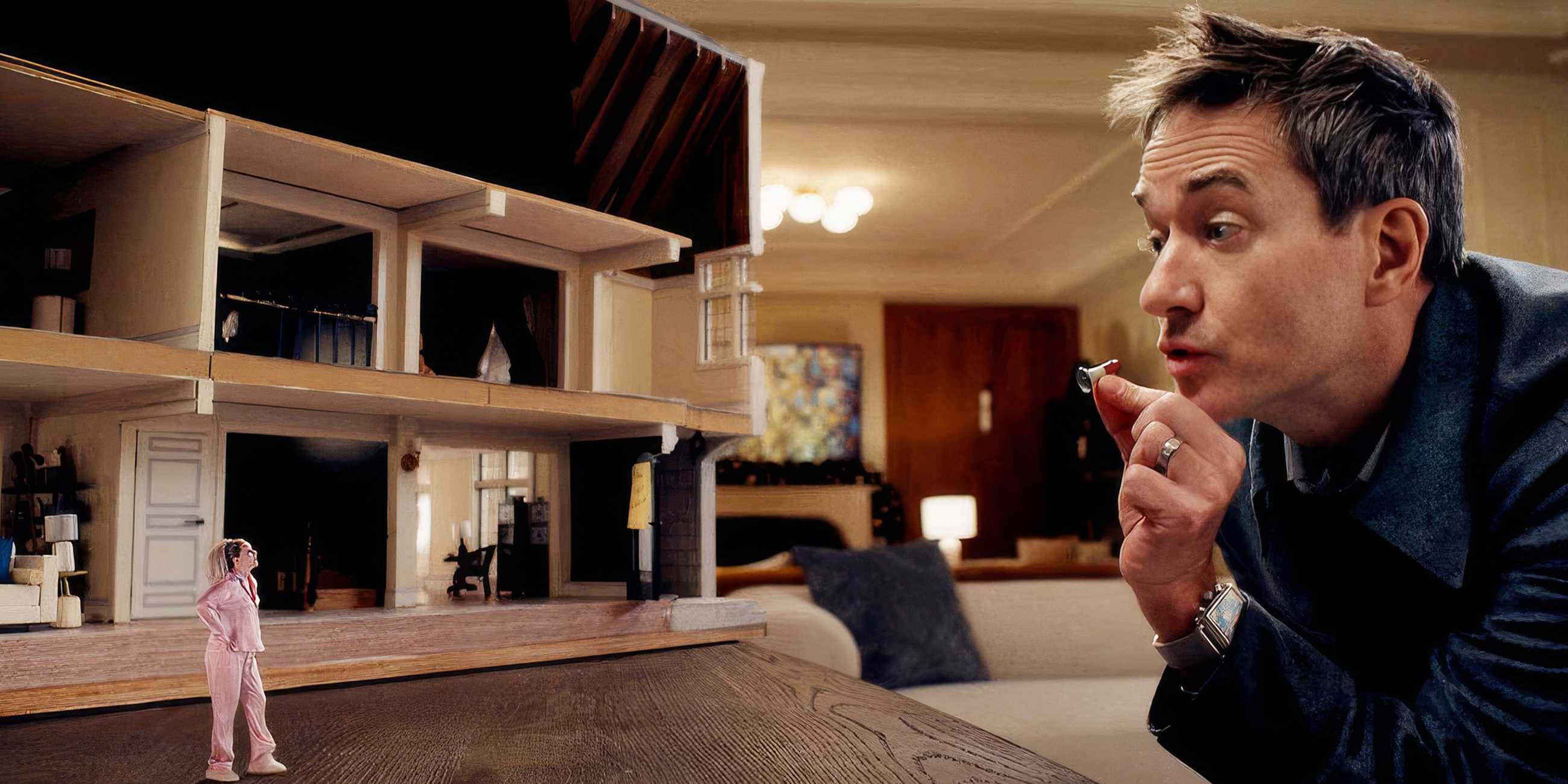
Image via NBC Universal
The series does not solely depend on visual effects for its storytelling. Instead, it emphasizes creating as much reality as possible before resorting to enhancements. Rigler states, “The phrase ‘fix it in post’ doesn’t apply here because time constraints limit what can be achieved later.” With fast-paced production demands, addressing issues during filming is crucial to alleviate post-production pressure.
This philosophy resonates across departments regarding how practical builds integrate with visual effects. “My approach is always to shoot it first and only rely on VFX when absolutely necessary,” Bernes asserts. He emphasizes using visual effects sparingly as support rather than as a primary solution.
This balance becomes evident during transitions between scales where objects must seamlessly shift from Les’ world to Lindy’s. Whether it’s wine glasses or entire environments, these transitions highlight where illusions can falter. Bernes questions how wine is poured between scales when Banks’ character enjoys more wine after being shrunk down. “Where do those handoffs occur?” he asks.
The simplest actions require thorough breakdowns and testing to ensure functionality across both realities. Much of this work involves collaboration among departments rather than individual efforts. Rigler explains that negotiations often occur among special effects teams when workloads become overwhelming due to shared responsibilities across conception to execution.
Building Lindy’s World Across Two Scales
The Miniature Wife revolves around a deceptively simple setting: a dollhouse. However, it represents one of the most intricate builds on set due to its necessity to exist in two distinct forms simultaneously.
Bernes clarifies, “The dollhouse serves dual purposes: one as the physical prop seen in Les’ world and another as a scaled replica existing on Titan.” One version interacts with Les while the other showcases Lindy’s life on screen. Despite being shot separately, both must match precisely down to minute details — an arduous task.
Bernes explains that whenever Lindy appears in her world, they are filming within the dollhouse set while scenes with Les utilize the prop version. Ensuring consistency between these two versions is critical since any discrepancies could disrupt the illusion.
Lindy’s interaction with her environment adds complexity as every object must function realistically rather than merely serve as visual references. “All elements she interacts with are present within that dollhouse,” Bernes emphasizes, highlighting that accuracy extends beyond appearance to functionality — whether lifting a glass or transitioning between scenes.
The show also pushes boundaries beyond mere necessity since much of what appears derives from Gonzales’ short story which requires expansion and reimagining for screen adaptation. “It’s based on a short story… everything we’re doing goes beyond it,” Bernes notes while discussing how Ames and Turner explore character development through various vignettes while reminding viewers of the absurdity inherent in their situation.
This creative tension gives weight to the dollhouse setting — while it appears charming at six inches tall, it transforms into something more controlled and challenging to navigate through its intricacies. The environment enhances realism despite its whimsical nature.
Where ‘The Miniature Wife’s Performance and Stunts Collide

Image via NBC Universal
The technical precision showcased in this Peacock series is remarkable but hinges significantly on the central relationship’s authenticity. While shrinking serves as both hook and comedic element, it ultimately underscores deeper issues within their marriage that existed long before any scientific intervention made them literal. “At its core lies a couple grappling with power imbalances,” Ames states.
The showrunners clarify that this premise acts as an entry point for exploring more profound themes akin to those found in classics like Big. “It’s about shrinking Lindy but serves as a Trojan horse for telling their relationship story,” Turner explains.
This perspective allows them to expand beyond Gonzales’ original narrative which was limited to the husband’s viewpoint — an opportunity Ames recognized immediately when considering how being made small affects both parties involved in their dynamic.
This metaphor becomes tangible once Lindy navigates life at six inches tall where communication becomes paramount for their relationship’s survival amidst challenges posed by her new reality.
The initial concept evolves into an exploration of power dynamics within their marriage while reflecting real-life communication breakdowns exacerbated by external circumstances affecting their lives together.
The physical demands placed upon Banks as Lindy illustrate these complexities further — even familiar spaces become unpredictable once she’s shrunk down.
“On our first day filming an obstacle course scene over couches was impressive,” stunt coordinator Jean-Francois LaChapelle says while emphasizing how performance intertwines with environmental factors influencing actions taken by actors during scenes filmed together.
“We could adjust heights or use stunt doubles strategically based upon visual effects needs,” he adds regarding collaborative efforts between departments working towards seamless integration throughout production processes involved here too!
This physicality shapes how environments are constructed within each scene too! Production designer Max Orgell warns about complexities arising from staging performances across multiple versions simultaneously requiring careful consideration regarding safety protocols alongside storytelling elements involved throughout filming sessions occurring here too!
‘The Miniature Wife’ Is Perfect for the Small Screen

Image via NBC Universal
A defining aspect of this series lies not only within its fantastical world inspired by Gonzales’ short story but also how it expands upon existing narratives through character exploration alongside discomfort felt throughout their experiences together.
“Television provides ample time for delving deeper into relationships compared with films which often rush through concepts,” Turner notes emphasizing importance placed upon developing characters over quick resolutions typical found within cinematic adaptations!
This extended exploration allows viewers insight into characters’ lives beyond initial premises leading them towards richer experiences throughout episodes aired here too! As Ames puts it succinctly – “the ultimate hope being audiences fall in love with these characters over time.”
This gradual expansion enables shifts impossible within films allowing stories progress past initial shock surrounding Lindy’s condition towards deeper meanings behind relationships evolving alongside changes experienced together!

The Best TV Couples Ranked’
Love is on the air!
Ames explains how acceptance plays into this narrative shift – “I’m going to be six inches tall indefinitely… How do I navigate life?” This reframing transforms what could have been merely gimmicky into something sustained through character-driven storytelling instead!
The surrounding world adapts accordingly supporting longer arcs established throughout episodes aired here too! Orgell acknowledges flexibility required during production design stating – “We took liberties with interiors while ensuring exteriors matched up” reinforcing fluidity present across perspectives depicted within storylines unfolding onscreen!
This adaptability contributes significantly towards making sure viewers grasp underlying themes present throughout series without losing sight of visual tricks employed along way either!
The Miniature Wife premieres April 9 on Peacock!
- ‘Release Date’
- ‘April 9,’ ‘2026’
- ‘Network’
- ‘Peacock’
- ‘Directors’
- ‘Greg Mottola,’ ‘Bertie Ellwood’
- ‘Writers’
- ‘Manuel Gonzales,’ ‘Jennifer Ames,’ ‘Steve Turner’

<a href=https://collider.com/miniat…
Here you can find the original article along with images used solely for informational purposes with proper attribution.[nospin]