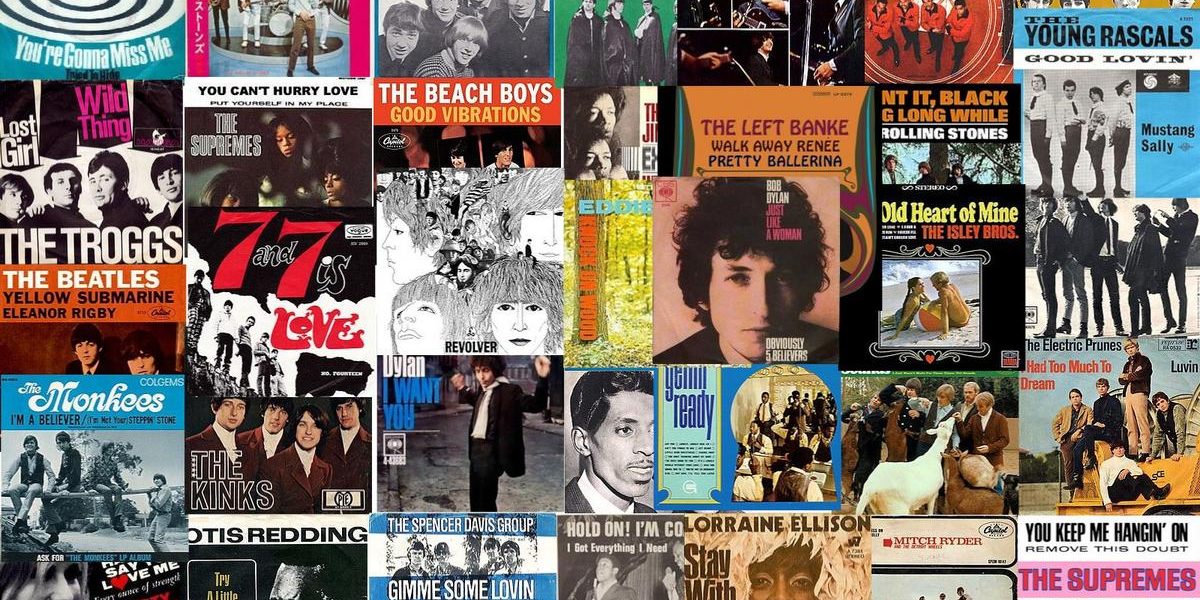
If 1965 was the year when pop and rock music started to take its first baby steps toward adulthood, as more artists began to explore albums as defining statements rather than collections of hit singles and hastily recorded cover songs, then 1966 was the year pop grew up.
In the list below of the Top 40 Songs of 1966, popular music was on the threshold of bigger and greater things. Right around the corner were artists willing to shuffle expectations; the 45 single was no longer limited to two and a half minutes of radio ear candy. With records taking chances in sound, length and content, the decade had turned a corner toward brighter horizons.
Several of the artists below had busy and productive years: The Beach Boys, the Beatles and Bob Dylan all released their greatest albums and assorted singles in 1966, so it’s no surprise they appear here more than once. But they were just the tip of the bounty of the musical riches offered in this pivotal year.
Key Takeaways
- 1966 marked a significant evolution in popular music, with artists exploring deeper album concepts.
- Major artists like The Beach Boys, Beatles, and Bob Dylan released iconic albums during this year.
- The Top 40 Songs list showcases a variety of innovative sounds that shaped future music trends.
- Many songs from this era pushed boundaries in terms of length and lyrical content.
40. Otis Redding, “Try a Little Tenderness” (From Complete & Unbelievable: The Otis Redding Dictionary of Soul)
“Try a Little Tenderness” was first recorded in 1932 by the Ray Noble Orchestra and later covered by luminaries such as Bing Crosby and Frank Sinatra. Otis Redding’s version, 34 years later, became the standard. Backed by the impeccable Booker T. & the MG’s, the soul music giant transformed the somewhat maudlin ballad into a sweat-drenched R&B workout that builds to the point of collapse, then ultimate release.
39. The Monkees, “I’m a Believer” (From More of the Monkees)
Written by Neil Diamond and released as the Monkees’ second single in November 1966, “I’m a Believer” quickly shot to the top of the chart, becoming the group’s second simultaneous No. 1 in just a couple of months. It stayed at that position for seven weeks, carrying the Monkees’ second LP, More of the Monkees, to No. 1 in the early months of 1967 and remained there for 18 weeks as the linchpin to Monkeemania.
38. The Easybeats, “Friday on My Mind” (From Good Friday)
Pioneers in the Australian rock scene, the Easybeats had racked up a handful of local hits before the raucous “Friday on My Mind” gave them an international smash. The song reached the Top 20 in the U.S., Top 10 in the U.K. and No. 1 in several countries, including their second Australian chart-topper. Guitarists George Young and Harry Vanda would later guide and produce a band featuring Young’s brothers, AC/DC.
37. The Who, “Substitute” (From single)
The Who had already proven themselves adept at more than just three-chord guitar rock on their debut album, My Generation. With the release of their 1966 single “Substitute,” which arrived three months after the LP, they went into full pop mode. Lyrically inspired by Smokey Robinson and the Miracles’ summer 1965 single “The Track of My Tears,” “Substitute” became the band’s fourth straight U.K. Top 10.
READ MORE: Top 40 Songs of 1965
36. Sam & Dave, “Hold On, I’m Comin'” (From Hold On, I’m Comin’)
“Hold On, I’m Comin'” was written on the spot by the songwriting team of Isaac Hayes and David Porter as Hayes was waiting for Porter to leave the Stax restrooms during a writing session. The suggestive tone of the song’s title worried some radio programmers, so it was changed to “Hold On! I’m A Comin'” on the record labels. The single became Sam & Dave’s first Top 40 hit and first No. 1 on the R&B chart.
35. The Rolling Stones, “Under My Thumb” (From Aftermath)
Like many British Invasion groups, the Rolling Stones entered 1966 with wide-eyed intentions of reshuffling their playbooks. Aftermath, the first of their albums to move entirely beyond the blues- and R&B-based recordings of their career’s first stage, is filled with moments of restless experimentation.“Under My Thumb,” with Brian Jones supplying the main riff on marimba, is at the top of the LP’s many achievements.
34. The Kinks, “Sunny Afternoon” (From Face to Face)
“A Well Respected Man” from 1965 had positioned Ray Davies and the Kinks at the front line of artists moving beyond their previous successes. After a string of hit singles built on distorted electric guitar riffs and boy-girl themes typical of the period, Davies began writing more dissenting songs with British music hall shadings and sly wordplay. “Sunny Afternoon” continues this path, lining their industrious fourth LP, Face to Face.
33. Mitch Ryder and the Detroit Wheels, “Devil With a Blue Dress On & Good Golly Miss Molly” (From Breakout…!!!)
Pairing two cover songs — Shorty Long’s bluesy “Devil With the Blue Dress” and Little Richard’s stomper “Good Golly Miss Molly” — Mitch Ryder and the Detroit Wheels’ 1966 medley reached No. 4, the highest position for either song’s earlier incarnations. The band’s rowdy version inspired Bruce Springsteen’s showstopping “Detroit Medley,” a centerpiece of his ’70s-era concerts. The song was a part of Ryder’s shows for years.
32. Buffalo Springfield, "For What It's Worth" (From single)
Stephen Stills wrote “For What It’s Worth” about the November 1966 Sunset Strip curfew riots and was released shortly afterward. But Buffalo Springfield’s breakthrough song eventually ended up as an anti-war anthem thanks to its open-ended chorus of “Stop, hey, what’s that sound? Everybody look what’s going down.” The Top 10 hit was issued two months after the band’s debut LP but was added to subsequent pressings.
31. The Rolling Stones, “Paint It, Black” (From Aftermath)
Brian Jones was feeling his way around a sitar when he hatched the initial melodic line that courses through “Paint It, Black.” George Harrison had introduced the Indian instrument to Western pop music the year before in the Beatles’ “Norwegian Wood (This Bird Has Flown),” but the Rolling Stones were the first band to use it in a No. 1 single. Shades of looming psychedelic rock can be heard here too.
30. The Beatles, “Eleanor Rigby” (From Revolver)
If there was any doubt that pop music was heading into brave new directions in 1966, the arrival of “Eleanor Rigby” that summer confirmed it. Accompanied by only a double string quartet (John Lennon and George Harrison provided backing vocals), Paul McCartney recited a song about despairing loneliness … hardly material found in pop landscape at that time. Like all of The Revolver, it was a huge step forward.
29. The Troggs, “Wild Thing” (From From Nowhere… The Troggs)
“Wild Thing” was written by American Chip Taylor (who also penned “Angel of the Morning”) and released as a single by obscure New York City pop-rock group Wild Ones in 1965 but failed to chart. British band The Troggs covered it in 1966 and had their first U.K. hit (No. 2) and only U.S. No. 1. With its garage-rock racket and snarling vocal style helped set stage for punk a decade later.
28. ? and The Mysterians, “96 Tears” (From 96 Tears)
The garage rock first emerged in late 1964 into early ’65 but developed into its present-day proto-punk form in ’66 when bands on both sides came up with new aggressive sounds ? And The Mysterians hailed from Michigan but their Vox Continental organ-driven songs had coast-to-coast appeal with knotted vocals simple melody “96 Tears” went to No1 spurring rising revolution.
27.
The Spencer Davis Group,
“Gimme Some Lovin'”
(From
single)
With
18-year-old
Steve Winwood
out front,
“Gimme Some Lovin'”
announced both
the singer
and keyboardist
and
the Spencer Davis Group
on global scale.
While they had previous hits
in native U.K.,
including pair
of No.
1s,
“Gimme Some Lovin'”
became defining moment
in group’s career
and cover-band staple for decades.
It reportedly written,
from conception arrangement,
in thirty minutes.
26.
Bob Dylan,
“Just Like Woman”
(From
Blonde on Blonde
)
Bob Dylan recorded
“Just Like Woman”
near end marathon fourteen month period produced three classic albums:
Bringing It All Back Home,
Highway61 Revisited,
and
Blonde on Blonde,
where song eventually appeared.
Appropriately,
Dylan sounds exhausted both lyrically musically unhurried ballad,
as he derides mysterious woman
(Edie Sedgwick? Joan Baez?)
for heart crimes against him.
READ MORE:
Bob Dylan Albums Ranked
25.
The Supremes,
“You Keep Me Hangin’ On”
(From
The Supremes Sing Holland–Dozier–Holland
)
“You Keep Me Hangin’ On”
opens with overlaid guitars rushing out Morse code-like urgency before Diana Ross leads Florence Ballard Mary Wilson through one hundred sixty breathtaking seconds amount beginnings psychedelic soul.
In three months between Supremes’ previous single,
“You Can’t Hurry Love,”
this eighth No.
1,
Motown making transition experimental pop.
This sounded alarm.
24.
The Young Rascals,
“Good Lovin'”
(From
The Young Rascals
)
“Good Lovin'” appeared Felix Cavaliere radar after he heard doo-wop group Olympics’ cover version song first recorded soul singer Limmie Snell under name Lemme B.
Good early sixty-five.
Cavaliere added song concert lineup for his band Young Rascals.
Coproducers Arif Mardin Tom Dowd rushed them studio capture live energy.
They soon had first No.
1 hit.
23.
The Electric Prunes,
“I Had Too Much Dream (Last Night)”
(From
The Electric Prunes)
Taking cue from Rolling Stones featuring ahead-of-its-time backward guitar,
Electric Prunes’
“I Had Too Much Dream (Last Night)”
was key link between mid-sixties garage rock psychedelic music sprang from it later decade.
Song just missed Top Ten but status grew over time thanks opening position influential pre-punk garage rock compilation
Nuggets.
22.
Dusty Springfield,
“You Don’t Have Say You Love Me”
(From
single)
“You Don’t Have Say You Love Me”
began Italian song introduced at
1965 Sanremo Music Festival.
Manager Vicki Wickham later Yardbirds producer Simon Napier-Bell rewrote lyrics English for Wickham’s client Dusty Springfield who took song No.
1 U.K.
No.
4 U.S.
best showings until
1987 Pet Shop Boys collaboration,
“What Have I Done Deserve This?”
21.
The Jimi Hendrix Experience,
“Hey Joe”
(From
Are You Experienced
)
“Hey Joe”
was already perennial mid-sixties rock community — Leaves Byrds others recorded authorship-tangled song before Jimi Hendrix Experience released it debut single late sixty-six.
But it Hendrix’s version later included U.S.
pressings band’s first album became standard.
Guitar flash kept relative minimum but even here traces genius surface.
20.
Love,
“7 And Is”
(From
Da Capo
)
Filtered through foggy haze lyrical riddles (“
In my lonely room,
I’d sit my mind an ice cream cone
“) thrusting harder almost any song made Top forty summer sixty-six,
“7 And Is” stands out rather succinct among indulgences Love’s second album,
Da Capo
), including side-long nineteen minute wayward jam
“Revelation.”
Los Angeles group become ornate next year.
19.
The Floor Elevators,
“You’re Gonna Miss Me”
(From
The Psychedelic Sounds Of The Floor Elevators)
Back sixty-six Austin’s Floor Elevators were vanguard electric jug-band music.
It short-lived crusade.
Nonetheless only charting single — “You’re Gonna Miss Me” from early weeks sixty-six prominently features instrument played band’s resident jug player Tommy Hall.
Elevators led troubled Roky Erickson forefront emerging psychedelic scene.
18.
The Beatles,
“Paperback Writer”
(From
single)
The Beatles’ first new song sixty-six heralded bold new era just around corner.
Recorded early sessions band’s watershed
Revolver
album,
“Paperback Writer,” B-side “Rain,” signaled technological advances come still-evolving quartet.
Highlighted Paul McCartney heavy melodious bass song quickly shot No.
1 leading album’s release two months later.
17.
The Temptations,
“Ain’t Too Proud To Beg”
(From
Gettin’ Ready
)
Motown had banner year sixty-five next twelve months just impressive.
Label roster artists songwriters producers began push boundaries what pop R&B music should sound like.
While foundations Temptations’ “Ain’t Too Proud To Beg” mostly traditional singer David Ruffin forced out vocal range giving song immediate push desperation.
16.
The Isley Brothers,
“This Old Heart Mine Is Weak For You”
(From
This Old Heart Mine)
Isley Brothers tenure Motown Records brief yet produced one best songs.
“This Old Heart Mine Is Weak For You”
bears more Holland-Dozier-Holland stamp than Isleys earlier later hits but there’s no mistaking Ronald Isley’s soulful lead vocal.
Rod Stewart covered song seventy-five again eighty-nine Ronald Isley reaching No ten two spots higher than original sixty-six.