
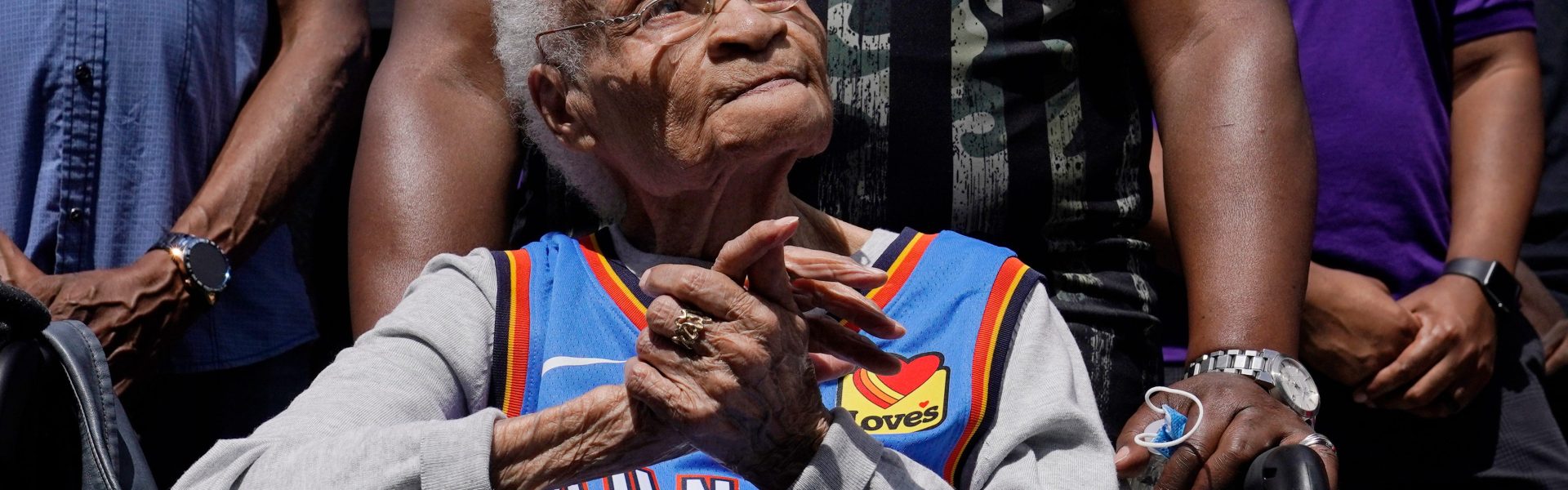
Viola Ford Fletcher was one of the last survivors of the 1921 Tulsa Race Massacre in Oklahoma. She dedicated her later years to seeking justice for the deadly attack by a white mob on the thriving Black community where she lived as a child. Today, her family confirmed her passing at the age of 111, according to the Associated Press.
RELATED: Tulsa Oklahoma Survivors Denied Lawsuit By The State Supreme Court
Community Mourns The Loss Of Viola Ford Fletcher
Viola’s grandson, Ike Howard, stated on Monday (November 24) that she died surrounded by family at a Tulsa hospital. She was a woman of strong faith who raised three children, worked as a welder in a shipyard during World War II, and spent decades caring for families as a housekeeper. She didn’t retire until age 85. Tulsa Mayor Monroe Nichols expressed that the city was mourning her loss.
“Mother Fletcher endured more than anyone should, yet she spent her life lighting a path forward with purpose,” Nichols said in a statement.
Viola Survived The Tulsa Race Massacre As A Child
Viola Ford Fletcher was 7 years old when the two-day attack began on Tulsa’s Greenwood district on May 31, 1921. The attack followed a sensationalized report by a local newspaper about a Black man accused of assaulting a white woman. As a white mob gathered outside the courthouse, Black Tulsans armed themselves in hopes of preventing the man’s lynching. White residents responded with overwhelming force, resulting in hundreds of deaths and widespread destruction of homes. Over 30 city blocks in the community known as Black Wall Street were ultimately destroyed.
“I could never forget the charred remains of our once-thriving community, the smoke billowing in the air, and the terror-stricken faces of my neighbors,” Viola wrote in her 2023 memoir, ‘Don’t Let Them Bury My Story.’
As her family fled in a horse-drawn buggy, her eyes burned from smoke and ash, she recounted. She described witnessing piles of bodies in the streets and observing as a white man shot a Black man in the head before firing toward her family.
Oklahoma Supreme Court Denies Reparations To Survivors
The 1921 Tulsa Race Massacre remained largely unremembered for decades. In Oklahoma, significant discussions began when the state formed a commission in 1997 to investigate the violence. Fast-forward two decades—the city has sought ways to assist descendants of the massacre’s victims without providing direct cash payments. Some of the last living survivors, including Viola, received donations from groups but have not received any payments from the city or state.
In 2021, Viola Ford Fletcher testified before Congress about her experiences during and after the massacre. Her younger brother, Hughes Van Ellis, and another survivor, Lessie Benningfield Randle, joined her in a lawsuit seeking reparations. In January 2024, a Justice Department review highlighted the massacre’s scope and impact, concluding that federal prosecution may have been possible a century ago; however, there was no longer an avenue to bring a criminal case.
That same year, in June 2024, the Oklahoma Supreme Court dismissed the survivors’ lawsuit. The justices determined that their grievances did not fall within the scope of the state’s public nuisance statute. Van Ellis had passed away in 2023 at the age of 102.
“For as long as we remain in this lifetime, we will continue to shine a light on one of the darkest days in American history,” Viola Ford Fletcher and Randle stated at that time.
RELATED: The First Victim Of The 1921 Tulsa, Oklahoma Race Massacre Has Been Identified From Over 100 Graves Discovered
Associated Press writer Jamie Stengle contributed to this report via AP Newsroom.
What Do You Think Roomies?







