Astronomers using NASA’s James Webb Space Telescope have discovered a tiny new moon orbiting Uranus, a rare discovery that expands Uranus’ total known moons to 29, and the first inner one found in nearly 40 years. Provisionally named S/2025 U1, the hidden moon was first detected on February 2, 2025, and at just 10 kilometers (six miles) wide it is the smallest inner moon yet found around Uranus.
Although the discovery was made months ago, the 29th known moon of Uranus was only just officially announced. To learn more I reached out to Dr. Matthew Tiscareno, a planetary scientist at the SETI Institute in Mountain View, California, who explained, “It takes time to do careful analysis and be very sure of such a momentous announcement.”
I also connected with Matthew M. Hedman from the University of Idaho who worked directly on these Webb observations. He explained to me that Webb was being used to gather images partly with this kind of discovery in mind. “They used wide filters and long exposure times that were good for seeing the faint signals from small moons,” he said. Confirming the object, however, required months of processing and analysis.
The Smallest Inner Moon Found Around Uranus
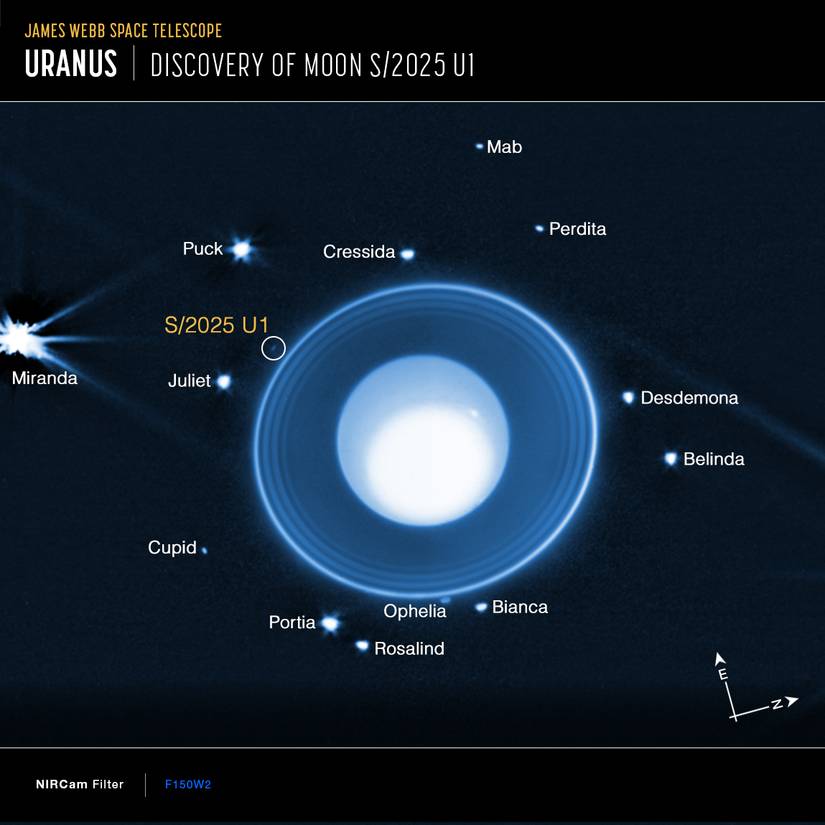
NASA, ESA, CSA, STScI, M. El Moutamid (SWRI), M. Hedman (University of Idaho)
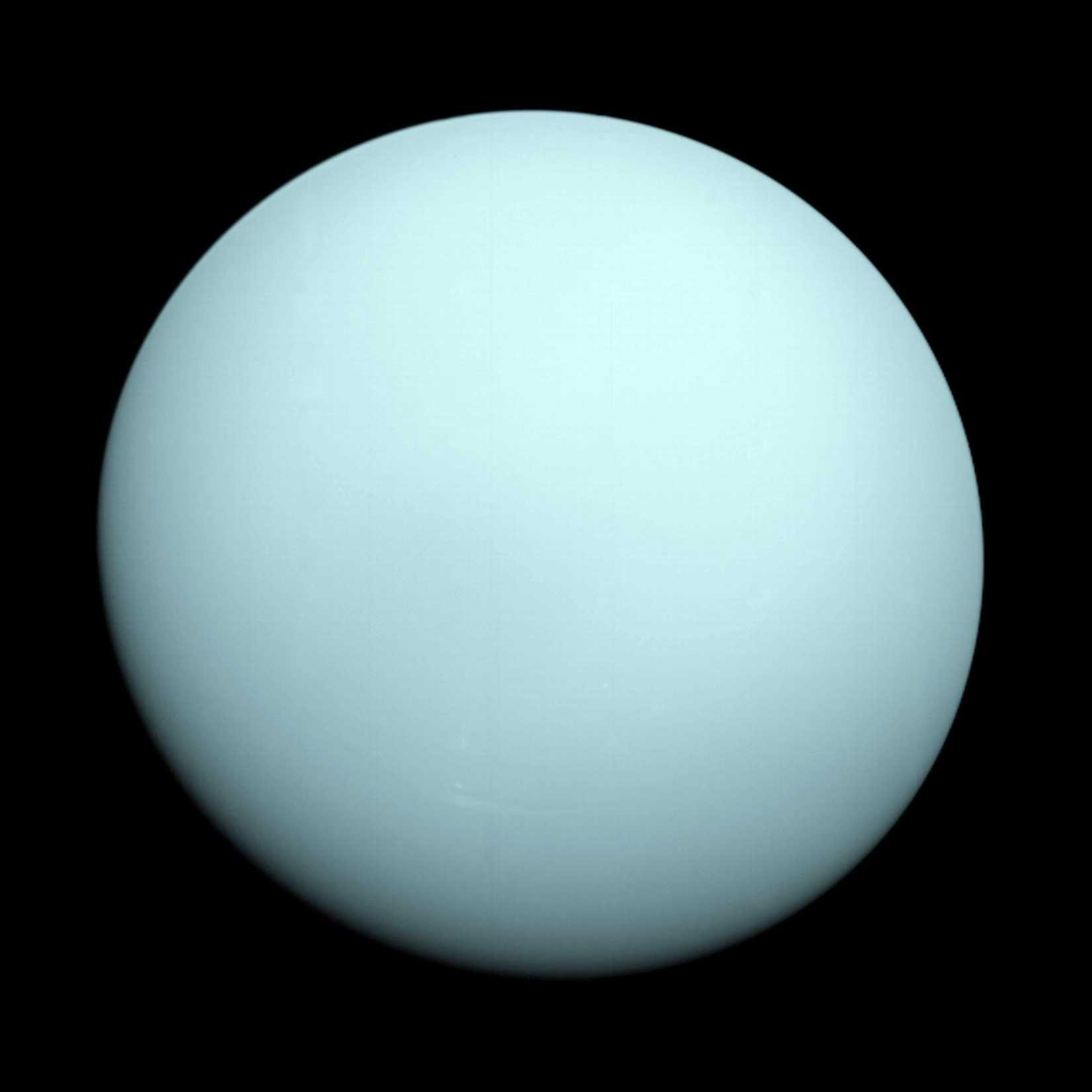
That relatively tiny size explains why the Voyager 2 probe completely missed it during its 1986 flyby of the sideways planet, despite having “returned more than 7,000 photographs, revealing 11 new moons, the innermost ones being intricately involved with the ring system, and two new rings orbiting the planet,” writes NASA historian John Uri.
Voyagers 1 and 2, both launched in 1977 on a mission to explore Jupiter and Saturn, and thanks to a rare planetary alignment that occurs once every 175 years, Voyager 2 was able to continue on a trajectory for years to fly past Uranus.
Hedman added that the new moon was beyond Voyager’s reach. “This object was simply too faint to be seen in most of the images Voyager 2 took of the Uranus system,” he explained. “Voyager 2 needed to survey the entire Uranus system during its brief flyby, and the exposures were not long enough to detect this object.”
It’s not just the size that kept this moon hidden though, but also its positioning. “JWST is such an amazingly sensitive camera that it actually can see more than Voyager could see, despite the much greater distance,” Matthew Tiscareno tells me. “JWST can see the entire Uranus system at once, while a spacecraft in the middle of the system can only look in one direction at a time.”
Where Is This New Moon And Are There More To Be Found?
“It’s located about 35,000 miles (56,000 kilometers) from Uranus’ center, orbiting the planet’s equatorial plane between the orbits of Ophelia (which is just outside of Uranus’ main ring system) and Bianca,” wrote Maryame El Moutamid, the lead on this Webb observing program, in an article for NASA announcing the discovery. “Its nearly circular orbit suggests it may have formed near its current location.” Tiscareno added:
“The inner moons of Uranus are a complex and chaotic system. They probably go back and forth between a ring state and a moon state. Examining the orbit of this moon will give us additional insight into that dynamic, like finding one more piece of a jigsaw puzzle.”
Hedman told me that Uranus’ small moons are packed so closely together that their orbits can get messy over time, making the system unstable. “The larger number of small moons orbiting outside the rings in a relatively small region gives rise to complex interactions among the moons,” he said. “These can lead to chaotic perturbations and even collisions among the moons on time scales of 1 to 100 million years.”
For Tiscareno, the most exciting part may be what this discovery implies: there could be more moons still hidden around Uranus. “This is by far the smallest and faintest of the inner moons we’ve discovered, and usually smaller things are more numerous,” he said.
This is probably the first among others.
Uranus New Moon Discovery Supports Ring Formation Theory
UPDATE: 2025/08/26 BY ROB KEYES
Italian Astronomer Alessandro Morbidelli Joins the Conversation!
I also reached out to Italian astronomer Alessandro Morbidelli, whose research has helped shape theories about Uranus’ violent history. In response to my questions, he explained that this new discovery does not shed light on Uranus’ original tilt or the formation of its major satellites, but it does support another idea.
Italian astronomer and planetary scientist Alessandro Morbidelli, whose research has shaped theories about Uranus’ violent past, told me the new moon is probably not a leftover from the planet’s early history. “It is parked at the edge of Uranus’ ring,” he explained. Morbidelli said it most likely formed from material that drifted outward from the rings and clumped together into a small satellite, a process already confirmed at Saturn by the Cassini spacecraft. More on this later…
That connection to the rings raises bigger questions about how Uranus’ rings formed in the first place. “They are tenuous and probably not the remnant of the collisional disk that led to the formation of the major satellites,” Morbidelli said. Instead, he thinks they may have been created more recently, perhaps when an icy object known as a Centaur was torn apart after straying too close to Uranus, or when a former moon’s orbit decayed until it was ripped apart by the planet’s gravity.
Centaurs are small icy bodies that orbit the Sun between Jupiter and Neptune. Because they often cross the paths of the giant planets, their orbits are unstable and can be dramatically altered over time.
Why Uranus Is Such A Unique Planet

An infrared composite image of two hemispheres of Uranus obtained with Keck Telescope adaptive optics.
While program’s data has yet to undergo peer-review process like all Uranian moons S /2025 U1 will eventually receive permanentand more fun name instead drawing inspiration from Greek Roman gods Uranian moons are uniquely named after characters from Shakespeare Alexander Pope.
With names like Titania Oberon Ariel Juliet already use S /2025 U1 will join unusually literary celestial family I asked Tiscareno if he had any ideas mind but he says theycan’t talk about any suggestions have been made until IAU approves them and Hedman confirmsteam discussing exactly this at moment
<
The International Astronomical Union (IAU) founded over century ago responsible officially naming astronomical objects.
<
<
In addition unique moon naming convention Uranian itself one solar system’s strangest worlds ice giant spins side tilt nearly degrees likely result massive collision long ago with Earth-sized object according NASA This extreme orientation creates bizarre seasons solar system each pole experiencing continuous sunlight followed by years darkness.
Some studies suggest Uranian knocked sideways one more giant impacts may also explain why its moons rings orbit along tilted equator research Alessandro Morbidelli Observatory Côte d’Azur proposed back-to-back collisions while study Kyoto University’s Yuya Ishizawa suggested debris such impact may helped create planet’s unusually small moons.
When asked Morbidelli about how new discovery fits into picture told me model model proposed Ida et al., Nature Astronomy focuses larger moons still hold there’s simply way tell ifUranian no satellites prior last giant impact He concludesIn summary this discovery very interesting don’t think gives us information original tilt(s) formation major satellites It’s nice confirmation Crida-Charnz model though which really neat
<
The Crida-Charnz model reference refers Uranian new moon probably forming from rings same way Saturn’s little edge-moons formed This what confirmed NASA’s Cassini mission.
<
<
Uranian features rings more small inner moons than any other planet blurring line where rings end moons begin Nearly four decades after Voyager provided only close-up look at Webb showing sideways planet still holds surprises waiting uncovered.
We continuing process images order better determine orbit color both which help better understand place within systemUranian
Tiscareno addedWe want continue study orbit require more observing time JWST Only additional observations really unlock what moon may tell us history surroundings systemUranian
Images courtesy NASA ESA CSA STScI JPL-Caltech

Here you can find original article photos images used our article also come from source We not their authors have been used solely informational purposes proper attribution their original source.[nospin]