
Key Insights
- Ween’s country album, 12 Golden Country Greats, marked a significant stylistic shift for the band.
- Producer Ben Vaughn played a crucial role in merging rock and country music during the album’s creation.
- The collaboration with Nashville session musicians brought authenticity to the project.
- Initial reactions from fans were mixed, but the album has since gained appreciation over time.
Of all the adventurous things the rock band known as Ween has done over their career, recording a straight-up country album with legendary Nashville session musicians was probably the most surprising.
Their fans were already used to albums filled with a variety of eclectic stylistic changes, but staying in one genre for an entire record and abandoning their previous DIY recording methods was a big change even some Ween fans had a little trouble with. However, over time, the record has become an important and beloved part of the band’s history.
In 2011, to celebrate the 15th anniversary of the release of 12 Golden Country Greats, we talked to the record’s producer, Ben Vaughn (current NPR Radio host and a noted performer with a diverse resume worth reading about), about the meeting of two very different worlds that occurred during the recording of this album.
How did you come to produce a country album by Ween?
I came in from the outside, with Ween. But, I had actually worked a lot in Nashville. I produced a record by Arthur Alexander [1993’s ‘Lonely Just Like Me’] and I used Gene Chrisman and Reggie Young and Spooner Oldham, you know, the list goes on.
So I’d already worked with session guys down there, and I spent time writing songs in Nashville, working with Rodney Crowell and Gary Nicholson and folks like that. So, I was down there a lot, and that was the bridge, because the Ween guys, who I’ve known forever, knew that I was working with people that are on classic country records.
I knew Ween because we’re from the same area. I’m from New Jersey, and they’re from New Hope, Pennsylvania, which is all kind of the Philadelphia area. So I’ve known those guys since they were teenagers.
I guess they were still teenagers when I met them. I think I might have met them before their first album came out. It’s one of those things, I’ve known them so long I can’t remember how we first met.
So at some point they say to you, “We want to make a country record,” and you say?
Well, they say, “And we want you to produce it.” And I said, “OK, if we’re gonna do this, let’s do it the really classic way, you know, let’s book Bradley’s Barn and let’s get Pig Robbins and Charlie McCoy and these guys together.
Because there was that great moment in the ’60s where everybody went to Nashville to record, whether it was Bob Dylan or Leonard Cohen or even Buffy Sainte-Marie, people like that. When Ween came to me, it was like a flash in my mind: Well, this is one of those kind of records. Nobody does that anymore; a rock act going to Nashville.
Those records — and Charlie McCoy had a whole lot to do with those — were so good, especially the Dylan records. You know, ‘Blonde on Blonde’ is a phenomenal record, and that’s Pig Robbins playing those piano parts on ‘I Want You,’ Charlie McCoy playing bass. There’s something so musical about those records, but they’re not country records.
So exactly how did it all come together?
I got a hold of Clay Bradley because I’m a writer with BMI, and he set the whole thing up for me. He was able to get Bradley’s Barn and Bobby Bradley to engineer. I went to the musician’s union and made cold calls to all these guys. It’s just so great working with those guys. There’s no pretensions whatsoever, and they work so fast.
Ween with country legend Owen Bradley (owner of Bradley’s Barn).
Did any of them have questions considering the band’s reputation for, well, weirdness?
Well, basically the way I pitched it was, “I have a brother act coming in” [note: Aaron Freeman [Gene Ween] and Mickey Melchiondo [Dean Ween] are not related]. I figured that would help! Because Ween’s reputation for being a little wild and strange was not going to help me get these guys in the studio and ready to do stuff.
I basically told them some of the material is blue, and I just want to tell you up front. We lost a couple of guys. I wanted Bobby Emmons to play keyboards along with Pig Robbins, and he passed because he’s a deacon in his church and said, “I prefer not to work on blue material.”
One of the things we really wanted and we didn’t get was Danny Davis and the Nashville Brass. They were Nashville’s answer to Herb Alpert and the Tijuana Brass; three or four trumpets playing in unison with really great pop arrangements.
We really like that stuff, but he wouldn’t do it either. You know, Ween—the great thing about those two guys—they really are huge country fans. It’s completely sincere; their love for the music.
They seem like huge music fans in general.
They are fanatics. They are into Prince as much as they are into Johnny Cash and Dolly Parton; they both have huge record collections. So they were real excited about getting the real guys on their record.
And you know some of the songs were weird; some of them had odd blue lyrics that were a little offensive.
Read More: Ween Expands ’12 Golden Country Greats’ With 20 New Tracks
But there are some serious ones too like ‘You Were the Fool.’
‘You Were the Fool’ is awesome. I love that tune. That’s kinda hippie-country. I really love the bass line on that one. I remember when we were mixing it; we kept turning the bass up; Bobby Bradley was saying “Can you do that?” ‘Cause you know in country music they don’t keep turning the bass up until it becomes really loud; you know like a Grateful Dead record or an R&B record—they don’t do that.
Also on ‘Piss Up a Rope,’ we ran Pete Wade’s six-string bass through a moogerfooger; I think it was one of those electro-harmonix pedals—it’s like a micro-synth or a moog simulator you run your guitar through. Ween use it on almost everything. When Mickey goes into a solo and it starts getting strange sounding he’s usually going through—I think it’s a ring modulator—is what it really is. So we did a few things that those guys weren’t used to hearing. But everybody was really supportive; they really gathered around these songs.
Hear Ween Perform 'Piss Up a Rope'
So getting back to the artists who said no; such as Davis—was it as soon as you told them it was blue or did they hear the songs and then say no?
He goes “Let me hear the stuff,” and I sent him ‘Mister Richard Smoker,’ [laughs] ’cause that’s the only one with horn arrangements—and he called me up and goes “I can’t do this! I can’t do this!”
So we had Charlie McCoy bring in a clarinet player; he plays just a ton of instruments but he played bass on a lot of tunes. When we laid down the tracks it’d be Pig Robbins or Bobby Ogdin on piano; you’d have Pete Wade playing guitar; Charlie would play bass then he would overdub harmonica—his harmonica playing is what he’s most known for.
He’s on pretty much every hit record out of Nashville in the last 50 years. If it’s got a harmonica part it’s Charlie McCoy—’Candy Man’ by Roy Orbison—all those kinds of things. If you google these guys you’d have to give up after a while because there’s just too many famous records.
Does Dean play guitar on this?
Only once. He plays the lead solo on ‘I Don’t Want to Leave You on the Farm.’
No kidding? So otherwise it’s just vocals from them?
Well that was the whole thing—I said to those guys—and we thought this was a funny way to do it—I said “Let me be the a—hole producer who tells you that you’re not good enough to play on your own record—and we’re bringing in the A-Team.”
And they said “Oh we love that—that’s awesome—we always wanted someone to do that to us.” So they were kind of living a dream that’s usually a nightmare for everyone else.
So that’s the only time they play instruments on the record?
Well—the lead solo on ‘Fluffy’ is actually Gene double-tracked on top of himself—which was one of the stranger … oh man—that song!
That’s when I really realized we had something because watching A-list Nashville session guys chart out that song then run it down was one of my favorite moments in my entire career in business because they were so serious about getting ‘Fluffy’ right—not knowing that we were going to slow down the track afterwards—and make it even slower—with Aaron’s voice pitched down.
Do any other moments from the studio particularly stand out to you?
With ‘You Were The Fool,’ that was a great moment too—Buddy Harman—this guy is definitely one of most recorded drummers in country music—you know we’ve got demos—we play demo—and Charlie McCoy would chart it out—numbers charts instead of putting down actual chord names—he would put down one four back to one five—in case we wanted to change keys.
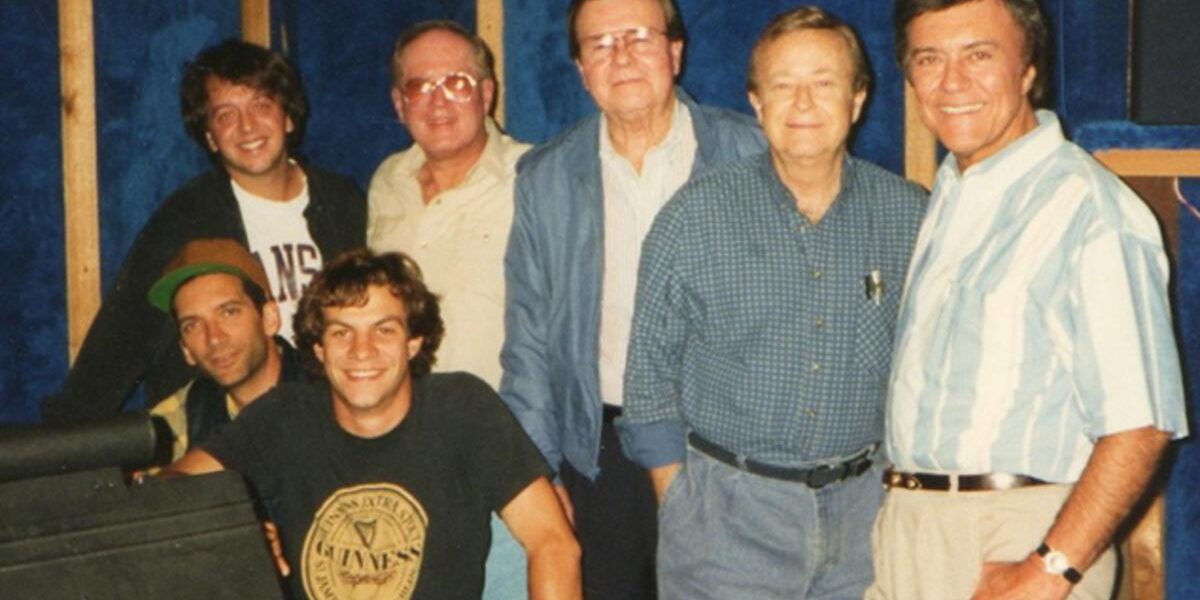
It’s called Nashville method—actually Jordanaires [a famous country vocal group, pictured at the top of this article, who also appear on the record] invented that—Buddy hears [the demos] goes “You don’t mind if I use my hands do you?”
Then he sat back there started that beat—the whole things played with his hands—it was so innovative—and he felt it right away through his musical filter—and all those years experience—and he did it—and it was great.
What happened to Muhammad Ali quote at end of ‘Powder Blue?’ It’s missing from later pressings of record.
You know two things happened with that record that were really interesting—one was Ali thing—on demo those guys recorded—they had Muhammad Ali at end—and when we recorded ‘Powder Blue’ Mickey said “I really want put that in there”—and I said label gonna have get clearance for that—”Oh yeah no problem!”
So we stuck it in there—we mixed record—and then they went their way—the record came out—I got copy thought great—then about year later somebody called me up said “Hey—I just bought Ween record—that Ali thing is not in there—not only that but song just stops!”
Yeah—they did cut off pretty harshly.
I asked Mickey—and he said Muhammad Ali’s people found out about it—and yanked it—but other thing is ‘Japanese Cowboy’ too closely resembled ‘Chariots Fire’ by Vangelis—and Vangelis’ people sued—so when you look up publishing information for ‘Japanese Cowboy’ it’s now co-write with Vangelis.
Well Ween had been mixing two songs live concert so must have realized too.
You’re right—and that’s when they got into trouble—it’s funny about song—we cut record—I decided if we’re going through this concept where I’m taking outside act Nashville—and they’re not even going play their own record—then also have be guy last day cutting where say “I don’t hear single—you guys gotta go back hotel write something come back cause this record not complete.”
I felt actually but also part joke—I truly felt there should be song they wrote Nashville inspired being with players—I wanted be first song [on the record], and typical Ween fashion—they started ballad instead uptempo number.
Anyway—they went back hotel wrote song real quick hotel stationary brought back—I looked at said “This is great—let’s cut right now.” We cut real quick whole time thinking melody sounds little familiar—I never figured out until finished record handed label.
Watch Ween Perform ‘Japanese Cowboy’ and ‘Chariots Fire’ Live
What do you remember about fan reaction to record?
The interesting thing is Ween fans tend purists about Ween—and country fans have tendency purists too—so when that record came out—it wasn’t immediate success with Ween fans.
A lot people confused little bit angry about everything being tune perfectly—are you familiar Neil Young record ‘Trans’? Well while making this record—we saying this is Ween’s ‘Trans.’
This is one where fans gonna have adjust realize they’re not gonna get what they want every time—but they’re gonna end up loving anyway—country fans appalled by originally probably still are because lyrical content record.
Do you think experience shaped band’s later records?
It’s hard say—it must have—I think there’s pedal steel some stuff [2000’s] White Pepper. But know what? Those guys surprise me every time.
Whenever there’s new Ween song listen—you can’t have any expectations because don’t know what it’s going be—it could sound like Ric Ocasek or George Jones or Prince or Earth Wind Fire—those guys are amazing so musical—I’m really proud that record—it stands up too—it sounds great no matter when hear it.
Important Moments in Country-Rock History
Rock ‘n’ roll often tries hide its country roots—but some genre’s most enduring moments happened when embraced—here’s look back at greatest moments country-rock.