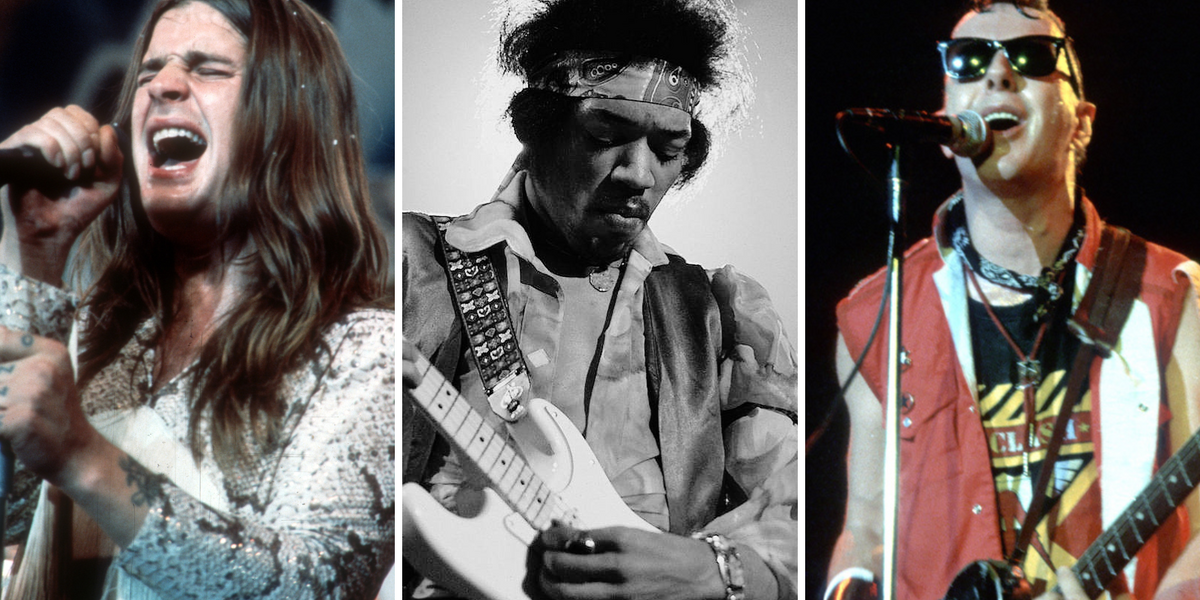
Here are five protest songs from the 1970s that were controversial at the time of their release.
The 1970s was a highly tumultuous decade defined by seasons of political unrest, social and cultural upheavals, and the lingering shadow of the Vietnam War. Like any decade or era that’s undergone turbulent times, the art it inspired remains timeless.
While earlier protest music often lived in a world defined by folk music and acoustic rock, the ’70s transformed the art of protest into something that was much more aggressive and confrontational. From the doom-laden warnings of Black Sabbath to the apocalyptic broadcasts of The Clash and beyond.
READ MORE: 13 Musicians Who Ran for Political Office
When some of these tracks were released, they were labeled as misunderstood or too extreme. Whether it was calling out political leaders by name or questioning religion, or even exposing the brutal realities of conflict and war that the government didn’t want the average citizen to see, each of these songs (and many others from the decade not listed here) challenged listeners to different viewpoints and outlooks at the time.
Looking back at this time and these tracks in particular, many of them should be considered essential listening. Each of these tracks go far past music, and instead also serve as a history lesson.
-
Crosby, Stills, Nash & Young, “Ohio” (1970)
In the Spring of 1970, the National Guard shot and killed four students at Ohio’s Kent State University during a campus-wide protest against the Vietnam War. The protests came just days after news from President Richard Nixon that US Troops were set to invade Cambodia. The tragic incident birthed one of the most prominent protest songs of the 1970s, Crosby, Stills, Nash, and Young's “Ohio.”
The song was composed solely by Neil Young and came to fruition after Young saw the now infamous photo of Mary Ann Vecchio kneeling over the body of Kent State student Jeffery Miller on the cover of Life Magazine. The photograph that would go down in the history books was taken by John Filo, a fellow Kent State student.
Although Neil Young became synonymous with political criticism later on in his career, “Ohio” was Young and CSNY’s first foray into touching on such topics in a song. “Ohio” was written by Young in a single afternoon and released just twelve days later (with Stephen Stills’ “Find the Cost of Freedom” as the B-side).
One of the most controversial lyrics of the track is where Young references Richard Nixon by name: “Tin soldiers and Nixon coming / We’re finally on our own / This summer I hear the drumming / Four dead in Ohio“
-
John Lennon, “Imagine” (1971)
Released in 1971 at the height of global political tension, John Lennon’s “Imagine” presents a vision of a world free from war, religion, division, and materialism; all of the structures that did, and have continued, to fuel conflict since the dawn of time. Unfortunately, five decades after the song’s release, this concept still remains a daydream.
Built around a minimalist piano progression, Lennon takes a broader, more philosophical approach to his critique of war and global division. His lyrics were less focused on directly confronting specific political leaders and wars themselves but instead focused on targeting the very systems that have made such conflicts possible in the first place.
The song’s origins are also closely tied to Lennon’s longtime partner Yoko Ono, whose avant-garde art and poetry heavily influenced the song’s lyrical content. Lennon admitted that much of the concept for “Imagine” was heavily influenced by Yoko’s work over the years; especially her 1964 conceptual art book Grapefruit.
Of course, “Imagine” had its fair share of criticism when it was released and still garners much of that same criticism as the years have passed. Some call it hypocritical while others call it naive. How could a wealthy rockstar convincingly sing about a world without possessions? Despite the various critiques, over the last 50 years, “Imagine” has remained one of the most prominent pieces of protest art today.
-
Black Sabbath, “War Pigs” (1973)
Black Sabbath’s “War Pigs” is one of the most popular and well-known protest songs of modern day; even though most people don’t realize that they’re not just listening to a badass heavy metal song but instead are listening to Sabbath’s criticism of the Vietnam War.
The title of the track was originally intended to be “Walpurgis,” which is a reference for Walpurgis Night; a festival often associated with witchcraft and dark rituals. It’s usually referred to as Satanic Christmas. Early versions of the lyrics also heavily leaned into occultist imagery; with efforts to metaphorically portray war-makers as the true embodiments of evil. Out of fear of being “too” Satanic leaning, the title was changed to “War Pigs,” and lyrics soon evolved into verses that were nothing short of politically charged.
In a 2015 interview with Guitar World, Geezer Butler described some background behind the song: “We wrote ‘War Pigs’ because many American bands were frightened to mention anything about the war. So we thought we’d tell it like it is.”
-
The Clash, “London Calling” (1979)
Written at the tail end of the 1970s, “London Calling” by British punk band The Clash reflects a period of deep uncertainty in the United Kingdom; where economic struggles, political frustrations, and cultural shifts were pushing the country to its very brink.
The song reads like a checklist of disasters illustrated by Joe Strummer. As we know, reading news today can be quite detrimental not only to your mental health but also your view and sense of optimism regarding the world. The same feelings of dread while diving headfirst into world news applied during the Cold War as well. It’s these exact feelings of fear that led Strummer and Mick Jones to write “London Calling.”
In an interview with Uncut, Strummer divulged that his main inspiration came after a taxi ride he took with his then fiancée Gaby Salter, “There was a lot of Cold War nonsense going on and we knew that London was susceptible to flooding. She told me to write something about that.”
He also noted that they wanted the lyrics and cadence of the song to have urgency like a news report.
Musically, “London Calling” (both song and album) marked a turning point for The Clash. While they overall remained grounded in punk, it pulls in elements of reggae and hard rock, signaling their willingness to evolve beyond their raw roots. The version of The Clash that wrote songs such as “I’m So Bored with the U.S.A.” was wildly different from those who wrote “Rock The Casbah.”
All in all, decades later, “London Calling” remains just as socially relevant. Its themes regarding political instability, environmental anxiety, and overall distrust in leadership continue to echo loudly in today’s world.
-
Jimi Hendrix, “Machine Gun” (1970)
Released on Jimi Hendrix’s Band of Gypsys live album in 1970, “Machine Gun” is a sonic protest against atrocities during Vietnam War.
Unlike CSNY, Black Sabbath or even John Lennon, Jimi Hendrix’s greatest protest happening in “Machine Gun” was not just through lyrics but instead through music itself. Through feedback, distortion and controlled noise, Hendrix’s guitar mimics sounds from helicopters, explosions, and as title suggests machine gun fire.
Lyrically, message is simple yet powerful. He emphasizes humanity on both sides with lyrics such as “Evil make me kill you / Evil man make you kill me“
Rather than demonizing one side over another; song points to forces behind Vietnam War; those in power who send others to fight are true instigators violence.
“Machine Gun” stands as one Jimi Hendrix’s most groundbreaking performances. Backed by Buddy Miles on drums and Billy Cox on bass; trio gives Hendrix space shine; result turns song into emotional centerpiece Band Gypsys.