Here are the 11 best prog rock covers of non-prog rock songs!
Generally, the best cover songs are the ones that mix faithfulness and innovativeness to ensure that they’re true to the original versions and true to the artists reinterpreting them. If a cover leans too far in one direction or the other, it might be too similar or too unrecognizable (and even offensive) to justify its existence.
Striking that perfect balance can be particularly difficult for prog rock artists adapting non-prog rock material. After all, their fondness for elaborate arrangements and lengthy durations may be counterintuitive to the simplicity and conciseness of what they’re recreating.
That said, and as you can see below, certain prog rock artists have done a phenomenal job making someone else’s song their own without losing sight of why said song worked so well in the first place.
READ MORE: The Best Cover Song by 50 of Rock’s Biggest Bands
Now, we’re not saying that any of our picks are better than the originals — most of the time, they’re not — nor are we saying that every song is a masterpiece that everyone should worship.
Yet, if you compare the two versions, you’ll almost certainly agree that the following takes on preexisting pieces are undoubtedly the 11 best prog rock covers of non-prog rock songs!
Key Insights
- Balance in Covers: The best covers blend faithfulness to the original with innovative reinterpretation.
- Prog Rock Challenges: Prog rock artists face unique challenges when adapting simpler non-prog songs.
- Artistic Success: Many prog rock bands have successfully transformed original songs while preserving their essence.
- Diverse Approaches: Each cover showcases a distinct approach, highlighting creativity in reinterpretation.
-
Yes, “America” (Simon & Garfunkel)
Simon & Garfunkel’s “America” (originally from 1968’s Bookends) is — like much of their work — immaculately constructed and performed. From its poetic social commentary and storytelling to its lovely singing and arrangements, it epitomizes the duo’s excellence. Thus, Yes’ 1970 version (which is about three times longer) isn’t superior, but it’s a great expansion that helped introduce listeners to then-new guitarist Steve Howe.
Bassist Chris Squire’s reference to “America” from West Side Story is a nice touch, as are the ways in which Yes’ symphonic and tricky overture foreshadows major themes before frontman Jon Anderson somewhat imitates Paul Simon’s cadence. Of course, they keep adding all sorts of fresh twists — including changing time signatures, alternate phrasing, six-string jamming and instrumental sections — to increase the tempo and density of their composition. Nevertheless, the bittersweet beauty of the original is largely retained amidst all the fiery embellishments.
-
Spock’s Beard, “Beware of Darkness” (George Harrison)
The title track to Spock’s Beard’s sophomore LP, Beware of Darkness intentionally takes as much from George Harrison’s gentler All Things Must Pass archetype as from Leon Russell’s feistier and more unconventional Shelter People reimagining. In the process, it partially replaces Harrison’s earthly production, moodiness and desperation with the eccentric playfulness and forcefulness that categorized the Neal Morse period of Spock’s Beard. Some people may see it as sacrilegious given that “Beware of Darkness” came from a former Beatle, but we really dig what Morse and company did.
Similar to Yes’ approach to “America,” Spock’s Beard begin with a zany instrumental jam that has more in common with their ‘90s characteristics than Harrison’s blueprint. That’s not a complaint, though, since it’s an awesome prelude that paves the way for their gruffer and fuller — but still majorly faithful — emulation. Expectedly, strange sounds, time signature changes and even keyboard and guitar solos are implemented along the way and they still manage to embody Harrison’s tenderness at certain points. Honestly, anyone open to a more adventurous and thrilling rendition should love it.
-
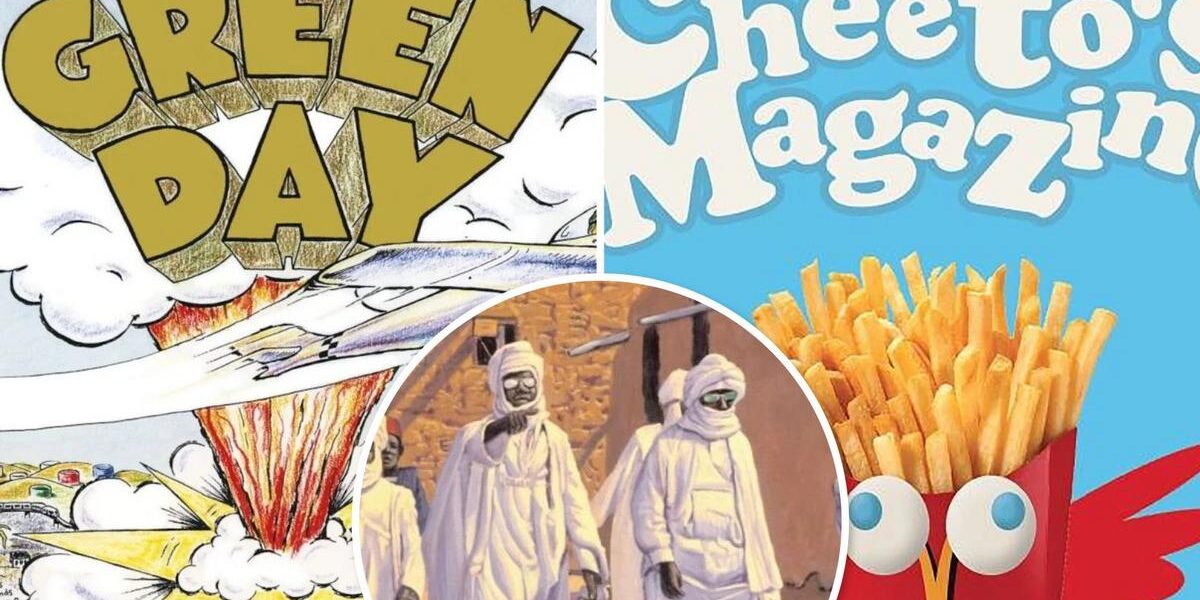
Cheeto’s Magazine, “Basket Case” (Green Day)
“Basket Case” was a major reason why 1994’s Dookie was such a huge record for Green Day and it’s probably as beloved by ‘90s kids as “America” and “Beware of Darkness” are by their parents. You could also argue that its straightforward pop-punk attitude is essential to its power. Regardless, you must admire how Cheeto’s Magazine — one of the weirdest prog rock bands ever — modified it to open 2017’s Tasty Old Snacks.
Like the last two entries, theirs is significantly prolonged compared to Green Day’s outline, with a manic orchestral rock preface cleverly building excitement that’s quickly offset by the melancholic singing and piano (not guitar) chords of Esteban Navarro. From there, the rest of the group jumps in to mix Green Day’s inviting rebelliousness with Umphrey’s McGee-esque genre-splicing complicatedness and textural variety. Their blissful harmonies are a treat, too, and while purists may be totally bewildered by Cheeto’s Magazine’s tactics, we have to think that even Green Day would be in awe of their audacious abilities and creativity.
-
Rush, “Heart Full of Soul” (The Yardbirds)
“Heart Full of Soul” was among the first things the Yardbirds did after Jeff Beck took over for Eric Clapton in 1965 and it’s considered not only one of their best tracks but also a crucial example of raga rock. Unsurprisingly, Rush were heavily influenced by them, which is why they tapped into the tune — as well as “Shapes of Things” — on their 2004 covers EP, Feedback.
In 2004, both Geddy Lee and Alex Lifeson unabashedly praised their heavier and trippier (but still majorly authentic) style. On the contrary, Lifeson’s gruffer electric guitar tone and more pronounced acoustic strums – alongside Lee’s lush stacked vocals during the chorus – infuse “Heart Full of Soul” with new psychedelic depth. At the same time, it maintains the Yardbirds’ easygoing tempo and pleasant hooks, so it satisfies their goal of creating something they “could call [their] own, . . . without wrecking the song.”
-
Kansas, “Eleanor Rigby” (The Beatles)
Remember when we said (three entries ago) that the Beatles’ catalog is widely seen as untouchable? “Eleanor Rigby” (from 1966’s Revolver) is a chief example of why since everything about it — the gorgeous harmonies, the dynamic string arrangement, McCartney’s forlorn singing — is virtually perfect. Well, Kansas gave themselves the unenviable task of recreating it on 1998’s Always Never the Same and it’s really, really good!
Because it was recorded with the London Symphony Orchestra, it’s even longer, mightier and more theatrical than the original. (There’s more vocal variety, too, given that there are three singers.) Consequently, it lacks the awe-inspiring splendor and starkness of its forebearer, but compensates with its celebratory vibe that demonstrates Kansas’ trademark sound and the generations-spanning magic of “Eleanor Rigby.”
-
Coheed and Cambria, “Under the Milky Way” (The Church)
Blending new wave and neo-psychedelia, 1988’s “Under the Milky Way” is probably The Church’s signature song. Its jangly despair, unmistakable EBow/Synclavier-modulated guitar solo, frisky percussion and matter-of-fact longing are forever embedded in the hearts and minds of music lovers from that era (or anyone who loves Donnie Darko). That’s why it was so bold yet fitting for Coheed and Cambria mastermind Claudio Sanchez to take a stab at it on 2024’s Claudio Covers EP (which is credited to the band).
Interestingly, though, it conjures Coheed and Cambria’s mechanical sorrow and epic orchestration as much as it does the folktronica energy and beats of Sanchez’s Prize Fighter Inferno project. Its modern production and otherworldly dissonance give it a colder, eerier and less seductive/romantic essence (planted firmly outside of the 1980s), but it plays to Sanchez’s strengths in remarkable ways.
-
Arjen Lucassen, “Bus Stop” (The Hollies)
The Hollies were one of the greatest 1960s “British Invasion” groups, and like The Yardbirds’ “Heart Full of Soul,” they created a folk/raga/pop-rock classic with 1966’s overwhelmingly catchy “Bus Stop.” You won’t be too shocked to learn, then, that Arjen Lucassen (Star One, Ayreon) took a comparable approach as Rush to giving “Bus Stop” a groovier and crunchier new coating on his 1996 homage to the folks who inspired him: Strange Hobby.
It’s an exact replica in terms of its structure (well, aside from the fiercer guitar solo about two-thirds of the way in). Although Hollies frontman Allan Clarke undoubtedly sings it better, Lucassen’s voice definitely fits his chaotically cosmic interpretation. Plus, he nails reconstructing Tony Hicks and Graham Nash’s accompaniments, and there’s an overt passion for the material that makes his version markedly idiosyncratic but equally gripping.
-
Unitopia, “Can We Still Be Friends” (Todd Rundgren)
Considering that Todd Rundgren was behind Utopia, he could’ve done his own prog rock cover of Hermit of Mink Hollow’s biggest power pop hit: “Can We Still Be Friends.” He didn’t though which meant there was a void left to be filled by the similarly named Unitopia on Covered Mirror Vol. 1 – Smooth as Silk, 34 years later. It’s actually one of the only reimaginings of a non-prog track on this LP which is a testament to their limitless resourcefulness and appeal.
Right away Unitopia extend this song with their characteristically moving vibrant World music/classical foundations including woodwinds high-pitched bells or chimes. Once that introduction is done Mark Trueack’s deeper voice is complemented by slower pacing sparser tenser arrangement. Consequently Unitopia’s rendition is more dejected less danceable than Rundgren’s sporadic vocal instrumental counterpoints add gorgeous prog complexity enhance rather than overshadow emotional core.
-
I.Q., “Suffragette City” (David Bowie)
If you asked 100 David Bowie fans to name standout song from 1972’s The Rise Fall Ziggy Stardust Spiders Mars , most would probably name “Suffragette City.” An irresistible slice proto-punk/glam rock might seem like antithesis what neo-prog legends I.Q tackle proved on 2008’s The Frequency Live .
Kicks off just as you’d expect before throwing on lively keys rustic acoustic guitar strums festive drumming thus immediately replaces Ziggy ‘s biting edge laidback feel Peter Nicholls’ silkier tone only bolsters distinction eventually dreamier segues intricate jamming bonus banter Nicholls continue make I.Q.’s trek through Suffragette City gratifyingly novel.
-
The Mars Volta,” Birthday”(The Sugarcubes)
Björk might be Iceland’s most fascinatingly odd daring eclectic solo artists her brilliant unconventionality didn’t start there though since her own career began after disbandment lovably bizarre alt-rock/dream-pop ensemble The Sugarcubes Their breakthrough tune Birthday(from1988’sLife’s Too Good ) embodied charming weirdness so it’s only logical peculiar prog rockers The Mars Volta honored bonus track on2008’sThe Bedlam Goliath .
In nutshell The Mars Volta paint over Bjork’s distinguished phrasing Sugarcubes’ delightfully unusual textures shuffling rhythms trademark Latin flair experimental sounds Unsurprisingly Cedric Bixler-Zavala matches Bjork’s high-pitched hooks wails although he’s somewhat buried within surrounding strangeness anticipated noisy outro further pinpoints much The Mars Volta ensure Birthday fits restThe Bedlam Goliath .
-
RPWL,” Masters War”(Bob Dylan)
You can’t hope succeed merely mirroring signature nasally combativeness antagonistic guitar chords early Bob Dylan folk rock protest staples such as1963’s“Masters War.” German prog rockers RPWL knew going into2008’sThe RPWL Experience so wisely chose transform wholly fits recognizable aesthetic.
Their brooding synths gentler singing leisurely pace shimmering guitarwork faint sounds war automatically make adaption lusciously cinematic It comes across like mournful reflection rather blunt tell-off predictably evolves robust multilayered rocker whose piercing guitar solo punctuates anguish If you’ve ever wondered what Masters War would sound sung David Gilmour Pink Floyd’sThe Wall orThe Division Bell this pretty much it’s superb.
Below check out our picks for best prog rock band from25 different countries!
The Best Prog Rock Band From 25 Different Countries
Great prog rock bands from England Italy Guatemala Russia beyond!
Gallery Credit: Jordan Blum

Here you can find original article; photos images used our article also come from this source We are not their authors; they have been used solely informational purposes proper attribution their original source.
[INPUT_HTML_END]
Tagged:link in biolistsnewsrocksongsvideos
Great prog rock bands from England Italy Guatemala Russia beyond!
Gallery Credit: Jordan Blum
Here you can find original article; photos images used our article also come from this source We are not their authors; they have been used solely informational purposes proper attribution their original source.
[INPUT_HTML_END]