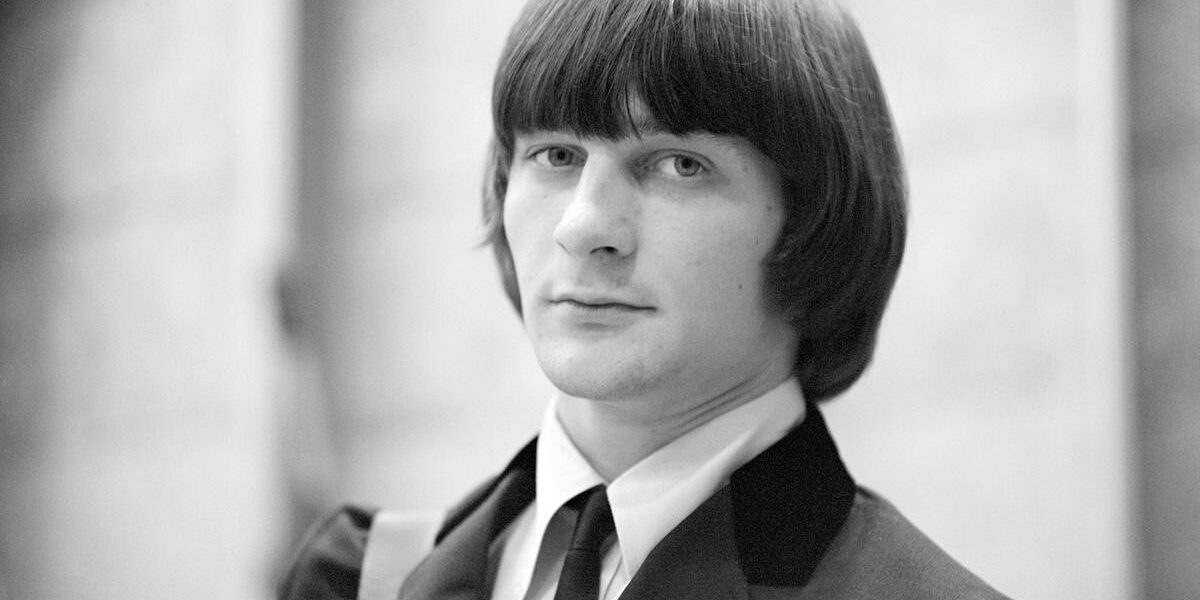
Without Gene Clark, it’s hard to say if there would have been a Byrds at all.
A founding member of the ’60s folk rock band, Clark helped pen some of their most famous songs: “I’ll Feel a Whole Lot Better,” “She Don't Care About Time,” “Set You Free This Time,” “Eight Miles High” and others.
“Gene was a very prolific writer,” Byrds bassist Chris Hillman later said in a 2000 interview. “I mean, this guy would write five or six songs a week, and three of ’em were great. Really, really good ones!”
The first time Clark left the Byrds was in early 1966 — Clark was severely fearful of flying, which made touring a challenge, and tensions were rising between the band members. He did, however, briefly rejoin in October of 1967, replacing the recently-fired David Crosby, but after only a few weeks, Clark left again.
Gene Clark’s Solo Work
Not that Clark quit music all together. The following year he signed with A&M Records and made a few albums with banjo player Doug Dillard, further cementing Clark as a leading figure in the realm of what was then a burgeoning genre of music, country rock.
Then came a series of solo albums through the ’70s, none of which garnered much critical or commercial attention in America. But his former bandmates, Hillman, Crosby and even Roger McGuinn, contributed to some of this music.
READ MORE: When the Byrds Reunited for Roy Orbison, Complete With Bob Dylan
“Interesting writer,” Hillman said in 2000. “I mean, this guy was not a well-read man. But it was like he would pull these beautiful poetic phrases out of nowhere. And I’d go, where is he getting this? It’s real interesting.”
In fact, in 1977, three of the ex-Byrds formed a new group of sorts called McGuinn, Clark & Hillman, and two years later they released a self-titled album. Clark wrote four of its songs — “Backstage Pass“, a song that touched on his fear of flying, “Release Me Girl“, “Feelin’ Higher” and “Little Mama” — and the album landed at No. 39 on the Billboard 200.
Listen to McGuinn, Clark & Hillman’s ‘Backstage Pass‘
In the years after that, Clark’s career mostly toiled in obscurity. There was a “20th Anniversary Celebration of the Byrds” tour, which featured Clark and two other former Byrds, Michael Clarke and John York, plus ex-Flying Burrito Brother Rick Roberts, Blondie Chaplin of the Beach Boys, and ex-Band members Rick Danko and Richard Manuel.
“We’re kind of going back to the simplicity of it, like the earlier Byrds was, which I enjoy,” Clark said in 1985. “It’s done in a very fair and open way, so therefore everybody’s pretty happy with what is happening.”
But his personal life began slipping – he suffered from ulcers, alcohol dependence and the effects of his drug usage. In 1989, Tom Petty covered the Byrds’ “I’ll Feel a Whole Lot Better” on his No. 3 Full Moon Fever album, leading to a surge in royalty payments for Clark. But it was too little, too late.
Listen to Tom Petty’s ‘I Feel a Whole Lot Better‘
Gene Clark’s Death
“And the poor guy,” Hillman later said, “he just disintegrated.”
Despite his attempts to overcome it, Clark’s alcohol dependency wreaked havoc on both his body and his ability to maintain his work. It eventually led to his death on May 24, 1991, at the age of 46. The cause was heart failure, brought on by a bleeding ulcer.
“He’d had health problems,” Clark’s manager, Saul Davis, told the Los Angeles Times. “He was a tough-living guy. The police decided it didn’t need a coroner or anything.”
READ MORE: How the Byrds Grew Up on ‘Younger Than Yesterday’
Clark was buried at St. Andrews Catholic Cemetery in his hometown of Tipton, Missouri. The epitaph on his headstone reads “No Other.”
“I really liked Gene a lot, man; he was a good guy,” Crosby said to Byrdwatcher, a Byrds fan site, in 1998. “It was very sad. I was sad that he died; I was sad about how he died. Same thing got him that almost got me.
<pAnd he had been warned; you know. They told him that if he drank anymore, he would kill himself. And I think he knew that; and I think he just poured down a bottle on purpose. And I find that very distressing. He was an enormously talented guy; and a sweet guy; nice guy. And that's all."
Top 100 ’60s Rock Albums
This is a chronological look at the 100 best rock albums of the ’60s.
Gallery Credit: UCR Staff