Key Takeaways:
Essential Insights
- Reunion Success: Journey’s reunion in the ’90s marked a significant return to form with their album Trial by Fire.
- Rigorous Preparation: The band underwent extensive rehearsals to recreate their original sound.
- Chart Performance: The lead single “When You Love a Woman” helped the album reach No. 3 on the Billboard chart.
- Challenges Ahead: Despite initial success, internal struggles resurfaced, impacting the band’s trajectory.
If Journey’s short-lived ’90s reunion sounded like a return to form, that was because the work – a lot of it – had finally paid off.
New producer Kevin Shirley put the freshly reformed early-’80s lineup of Steve Perry, Neal Schon, Jonathan Cain, Steve Smith and Ross Valory through a rigorous wood-shedding period in the run-up to Trial by Fire. By the time the album arrived on Oct. 22, 1996, Journey was working at a peak pace, able to put down nearly complete song takes live in the studio.
“The real challenge was, I don’t think any of us were used to rehearsing as much as we did,” Schon said in Journey: Worlds Apart. “But it turned out to be a good thing. We rehearsed for a good six weeks. That’s a long time. We basically rehearsed everything like we were going to play a brand-new record live, with no overdubs.”
Journey Rebuilds Itself, Song by Song
Shirley wanted to hone Journey back into the well-oiled machine of their original era – when songs were often polished by the biggest groups out on the road, then arrived on albums fully formed.
In this way, Trial by Fire wasn’t just an attempt to recreate the sound this same fivesome once had on 1981’s Escape and 1983’s Frontiers, but to actually become the band they used to be – interacting live in the studio, trying as best they could to create first-take magic.
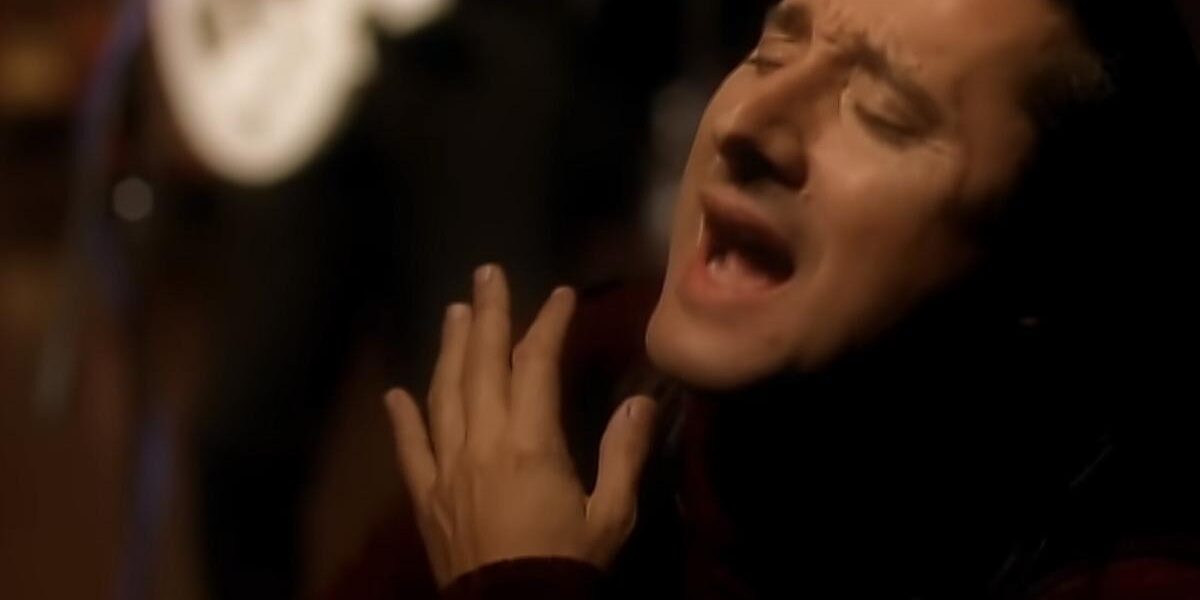
Watch Journey’s ‘When You Love a Woman’ Video
“There’s something to be said about that,” Schon added. “When you have the time to get everybody together like that and rehearse, you get very comfortable with the material, the arrangements.”
The LP blended every element of Journey’s former chart-dominating formula, making room for arena rockers like “Castles Burning,” throwback mid-tempo fare including “Message of Love” and more emotional moments like “Still She Cries.” “The writing process was fairly easy and painless, like it always was between Steve, myself and Jonathan,” Schon said. “We got together and wrote the tunes, I believe, in a couple of weeks.”
READ MORE: Ranking Every Journey Album
They also pushed themselves, showcasing newfound musical complexity on songs like “Forever in Blue” and adding a soaring orchestra to “When You Love a Woman.” Cain had been away from Perry for a long time, but something elemental remained: Perry’s tendency toward longing rather than nose-to-nose passion, tender romance rather than sweaty sex. That was perfectly suited for the lead single from Trial by Fire.
“When we sat down to write ‘When You Love a Woman,’ he doesn’t get the girl,” Cain said in Journey: Worlds Apart. “She’s waiting out there somewhere – and he’s comfortable with being that guy.”
READ MORE: Ranking All 52 Journey Songs From the ’80s
Still, Schon admitted that taking so much time sometimes led down dead-end paths. “The arrangements changed a million times on some songs, I can tell you that,” Schon recalled. “That got a little mind-boggling.”
With “When You Love a Woman,” Schon said: “I remember that that arrangement changed about a hundred times. Around the 95th arrangement that came around, I’m like brainwashed. I don’t know which one is which. But when we settled in, it was a very good arrangement.”
Journey Goes Platinum Again and Then Vanishes
Fans responded as the Grammy-nominated “When You Love a Woman” helped Trial by Fire reach No. 3 on the Billboard chart. Journey sold a million albums for the first time in a decade.
It seemed as if they’d finally found their way again after a lengthy period of turmoil that included 1986’s Raised on Radio, which found Journey whittled down to just Cain, Perry and Schon plus a group of sessions aces to round things out – and then a series of less-successful solo projects.
“Individually, none of us made the magic as magically as we collectively make it together,” Perry told the St. Louis Dispatch. “You start to recognize that some of the things you didn’t even know you had as a group in the music are still there, and you’ve been looking for them for a long time. All you had to do was put your guns down and get back together again.”
Listen Journey's 'Forever In Blue'
Unfortunately, the energy created by this return-to-form project quickly dissipated when Perry was stricken with a degenerative bone disease and couldn’t decide on whether to have hip surgery. Schon was eager to get out on the road but Perry said, “Let’s just get the video done.” Perry later told GQ he spent the entire time “packing my whole left side in ice between takes.”
The bandmates were left cooling their heels and – as a 2001 episode of VH-1’s Behind the Music made abundantly clear – deep fissures returned in the immediate aftermath of Trial by Fire. After all of the time away, effort in getting this LP just right and momentum they’d quickly reestablished, Journey was suddenly starting over again.
Journey Finally Returns – Without Steve Perry
The band didn’t return to the road until 1998, and by then Perry had been replaced by Steve Augeri. Smith had also resumed his well-respected jazz career. It took a while to rebuild.
Shirley later produced 2001’s under-performing Arrival, but Journey wouldn’t finally regain its old retail mojo until Augeri’s replacement Arnel Pineda came on board for 2008’s Revelation, a Shirley-produced album that became the band’s first platinum seller since Trial by Fire.
The passage of time also seemed to heal whatever wounds remained from 1996’s missed opportunity. “I don’t have any hard feelings,” Schon said in Journey: Worlds Apart. “You know we’ve had our ups and downs like all bands do – and sometimes it goes from member to member to member. So I have nothing but gratitude and respect for everything we’ve done and everyone that’s been involved.”
The Best Song From Every Journey Album
Singers may come and singers most certainly may go but some great songs remain.
Gallery Credit: Nick DeRiso
You Think You Know Journey?