Julianne Moore possesses a remarkable talent that allows her to convey emotional depth with intelligence. Her characters often transcend simplistic labels such as victims, villains, or mothers; instead, they reveal complex layers of instability and private struggles that she masterfully portrays without reducing them to mere stereotypes.
This is why the list of her notable films grows quickly. Moore adapts seamlessly to each role, yet the underlying intensity remains constant. She creates characters that are both comprehensible and enigmatic, which is why her most acclaimed films gain significance with time. Beyond these six selections, Moore boasts around 70 film credits, but these stand out to me.
6
‘The Big Lebowski’ (1998)

Image via Gramercy Pictures
The Big Lebowski is often analyzed through the lens of the Dude (Jeff Bridges), Walter Sobchak (John Goodman), bowling, ransom mix-ups, nihilists, and the Coens transforming detective fiction into a stoner’s labyrinth. However, when Maude Lebowski (Julianne Moore) enters the narrative, she alters its entire dynamic. Moore transforms a character that could have been merely an eccentric artist into one of the most astute individuals present. Maude comprehends money, sex, image, inheritance, and the absurd male anxiety surrounding Bunny Lebowski’s (Tara Reid) disappearance.
Moore’s comedic brilliance lies in Maude’s serious self-presentation. The flying harness, the art-world jargon, her clipped speech, and her dismissal of the Dude’s confusion all feel absurd yet entirely deliberate. She desires a child without romantic entanglements and views the Dude as a means to an end in a manner that is both chilling and humorous. The film’s chaos pretends to be masculine, but Maude perceives the situation with clarity that few others possess.
5
‘May December’ (2023)
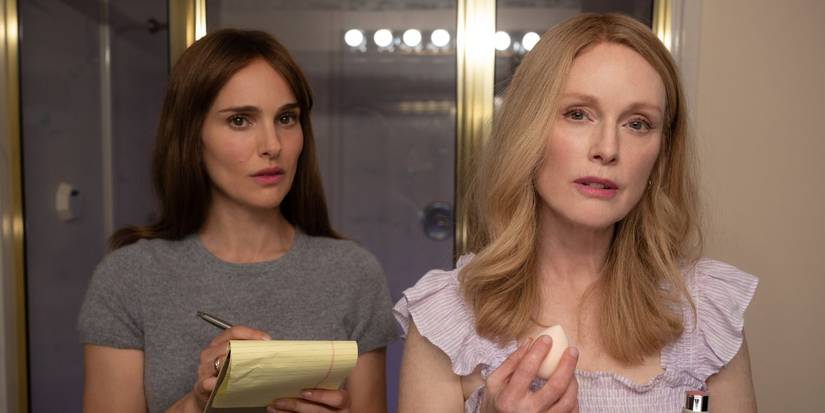 Image via Netflix
<em>May December</em> is intense because it explores how individuals transform scandal into narratives they can manage. Gracie Atherton-Yoo (Julianne Moore) resides with Joe Yoo (Charles Melton), the boy she began abusing at thirteen, and the film navigates this uncomfortable history with unsettling precision. The domestic facade remains calm enough to illustrate how denial becomes habitual. The house, cakes, children, polite conversations, neighbors, smiles—all meticulously arranged around a shared lie that everyone acknowledges yet avoids confronting.
Moore’s portrayal of Gracie is chillingly relatable. She oscillates between sounding delicate, sweet, childish, wounded, maternal, and manipulative within a single conversation. Elizabeth Berry (Natalie Portman) arrives to research her for a film role, turning the narrative into a disturbing reflection on performance. Gracie has spent years acting as if her version of reality is factual. Elizabeth observes, imitates, judges, steals insights, and exposes underlying decay without achieving moral superiority herself. Moore renders Gracie terrifying without resorting to caricature. This restraint amplifies the film’s impact and cements it as one of her finest works.
4
‘Children of Men’ (2006)
<source media="(max-width: 1023px)" data-srcset="https://static0.colliderimages.com/wor