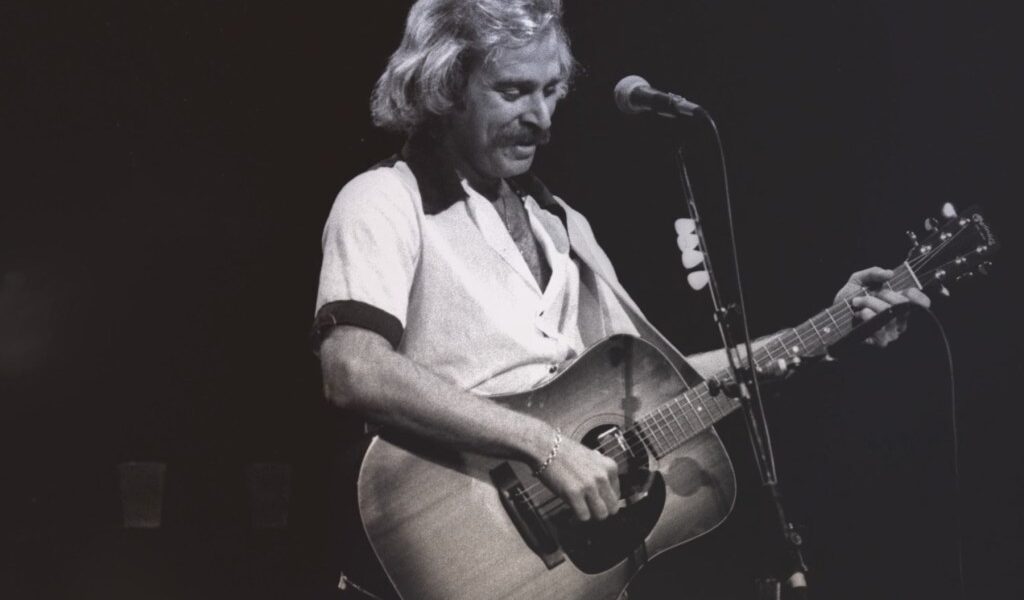
The Coral Reefer Band is as intrinsically a part of the Jimmy Buffett universe as the E Street Band is to Bruce Springsteen’s, the Heartbreakers are to Tom Petty’s and so on.
Explore

See latest videos, charts and news
But a largely untold portion of the band’s story is the focus of the new documentary Occupational Hazard: The First Coral Reefers, which, after a nearly nine-month run in film festivals and theaters, becomes available Oct. 30 for rent via Apple TV, Amazon Prime Video, Google Play and Fandango.
As the title indicates, Occupational Hazard is an origin story, from the beginnings of Buffett’s career as a troubadour (after a tenure writing for Billboard) and his move to Key West, Florida, where he assembled the initial Coral Reefer lineup during the mid-70s. (He used the name for an imaginary band during his solo performances before then.) Narrated by actor and Buffett friend Jeff Bridges, it details a decidedly different and significantly less polished ensemble than Parrotheads became used to from the late ‘70s until Buffett’s death on Sept. 1, 2023.
The portrayal is of a time when the Coral Reefer crew was wasted but not really wasting away, as Buffett registered defining tracks such as “Margaritaville,” “Cheeseburger in Paradise,” “Volcano,” “Fins” and “Son of a Son of a Sailor.”
“We wanted to capture the time before the Parrothead phenomenon began, when it was still rough ‘n’ ready out on the road,” director-producer John H. Cunningham tells Billboard via Zoom. “Those were wild times; many viewers who are watching this have no idea that period even existed for this band because they’ve seen this very organized, polished group for such a long time,” he says. “But the first years were a little bit different. Some of the band are starting to pass away and disappear without the history being recorded. So just for historical purposes, we thought this was an important time to document.”
Original Coral Reefer Roger Bartlett, who composed the film’s score, readily acknowledges that “we were fully staffed with artificial inspiration…in great quantities” during that time. But the guitarist, who performed with Buffett as an acoustic duo before the band formed, also maintains that “the early days were really the best days” for other reasons.
“It was before the bodyguard and before (Buffett) flew on a private plane and had the restaurants and all of that,” Bartlett explains. “We drove in a Rent-a-Car and raced down the corridors of the airports to get to the plane before the doors closed. We sat in economy class and read books and nobody said, ‘Oh, are you Jimmy Buffett?’ It was nice. In those early days we could do whatever we wanted to do. There were no big constraints. We did a lot of crazy things.”
Changes In Attitudes
Occupational Hazard, which won audience awards at the Dallas International Film Festival and the Sarasota Film Festival, is loaded with archival footage and images — including home movies shot by Bartlett’s girlfriend Phyllis McBride and the late harmonica player Greg “Fingers” Taylor’s brother Brent, who was the band’s assistant road manager for a time. Campbell also secured revealing interviews with early Buffett figures such as Bartlett, guitarist Josh Leo, backing vocalist Deborah McColl, singer-songwriter Keith Sykes, tour manager Bob Liberman and others, as well as Norbert Putnam, who produced key Buffett albums between 1976–1982. Longtime keyboardist Michael Utley, who retired from the band after Buffett’s death, and current Coral Reefer mainstay Mac McAnally are also included.
Buffett, meanwhile, is represented via select existing interviews while country star Kenny Chesney, who joined McAnally and James Taylor in inducting Buffett into the Rock & Roll Hall of Fame in 2024, provides extensive commentary.
“Our focus was always going to be primarily from the band’s perspective,” Campbell notes. “Obviously Jimmy is gone so we couldn’t talk to him but we really wanted to focus on those early days. The thing about doing a documentary is you really don’t know the storyline until you’ve talked to everybody so as we added people each interview just added questions and we learned more and more as we went along.”
Co-producer Ted E. Haynes says he was particularly struck by the fact that “all of these individuals at some point or another either they quit or they were fired some passed away but even now decades later there’s a reverence in how they still speak about that time frame and Jimmy Buffett. I think that’s what I wanted to hear but it was nice to have that reinforced.”
Changes In Latitudes
Occupational Hazard initially started as a film about Bartlett.
Both Cunningham and Ted Haynes are longtime Buffett fans; Cunningham first saw him perform in 1977 and himself moved to Key West the following year. He “casually” met Buffett only a couple of times but with permission included him as a character in Crystal Blue, the third novel in his bestselling Buck Reilly adventure series. That led to “The Ballad of Buck Reilly,” a song Cunningham co-wrote with singer-songwriter Matt Hoggatt who was signed to Buffett’s Mailboat Records label. Through Hoggatt Cunningham met many of the first-gen Coral Reefers which in turn led to songwriting collaborations with Bartlett and Sykes.
Bartlett recalls that Cunningham initially suggested “’We should do a short film about you Roger.’ I said ‘Well it’s gonna be really short. Maybe we should expand the subject matter a little bit.’” During a dinner that included Haynes they began hashing out the Coral Reefer Band storyline. “I have to say Jim Cunningham is a can-do guy,” Bartlett notes. “From the time we decided to do it it was finished in maybe two years. That was pretty impressive.”
The filmmakers assembled more than 1,000 archival pieces and conducted 25 hours of interviews during the process; the initial edit of the film was four hours according to Haynes before it was tightened to its current length. There were many “holy grail” moments but Haynes was particularly intrigued to hear about Hunter S. Thompson coming to Key West and staying with Buffett for about a year. Bridges meanwhile was a “spike-the-football” addition who came to the project via mutual friend Robert Duvall who passed away in February.
“When we were done with the edit we started to think about who we wanted as a narrator,” Cunningham says. “Ted and I both thought Jeff would be top of the list for lots of reasons. So (Duvall’s) wife wrote a letter of introduction… and that opened the door. Jeff being a friend of Jimmy’s going back to the mid-70s together he loved Jimmy so he was really open to it and he was a total pleasure to work with.”
What’s Next
The filmmakers were able to license a great deal of Buffett music from the period and maintained a friendly relationship with his estate which is working on its own documentary with director Frank Marshall. “I will say that (widow) Jane Buffett has seen (Occupational Hazard) and loved it. She was very supportive,” Cunningham says. For his score meanwhile Bartlett “did borrow some musical motifs” from Buffett’s songs but mostly “tried to approach each scene as ‘What mood should I strike here?’”
Bartlett is working on a new solo album titled Shoot the Moon due out next spring. As an outgrowth of the Occupational Hazard theatrical screenings he’s also started playing duo concerts with Josh Leo.
The film also chronicles the gradual dissolution of the original Coral Reefers and transition into a new larger group of players. Bartlett left by choice in 1977 “because I was in bad shape” and received a Rolex watch from Buffett as parting gift. Others meanwhile were dismissed and not happy about it.
“If you get fired normally you’re gonna be a little angry,” he notes. “(Buffett) began to get more professional musicians in the band. We were just a ragtag band out of clubs. The guys he changed to were more polished and much more talented — than I was at least.”
Cunningham’s perspective is that “I think when Jimmy started achieving some success he’s opening for Eagles for James Taylor he’s managed by Irving Azoff bigger doors are opening and it was ‘Alright I can’t keep doing what we’ve been doing.’ I think it was mature moment for Jimmy to say ‘Look if I want to keep this going we need to change some things.’ He knew he needed team first-class musicians also not bar partiers that weren’t going rock boat It started out more rock ‘n’ roll show where anything could happen it became more production There definitely change tenor It had different vibe — but audience ate up.”
Parrotheads have already been doing that for Occupational Hazard, too — including showing up at screenings in full concert regalia such as Hawaiian shirts grass skirts shark-fin hats Cunningham says he and Haynes are “kicking around” idea extended director’s cut or finding some vehicle additional footage “We’re small independent team working hard on this,” he notes “After we get [the video rollout] done we can come up air think about what next.”
Haynes says filmmakers are content movie achieving educational objective “We have young audience members during Q&As or after film say ‘I’m here because my dad likes Jimmy Buffett I wanted see what it all about I really love this music I’m going back listen catalog.’ To have people who weren’t Parrotheads aren’t Parrotheads take away really interesting.”