If anybody is going to be tasked with telling Kansas’ story, it’s Phil Ehart.
The band’s co-founder and drummer is only one of two group members, along with guitarist Richard Williams, to appear on all of the American prog rock group’s 16 studio albums.
Since 1990, he has also been Kansas’ manager. Ehart is a one-stop-shop for all things related to the band and offers a unique perspective on its legacy. He knows what happened and when – and where the bodies are buried, in other words.
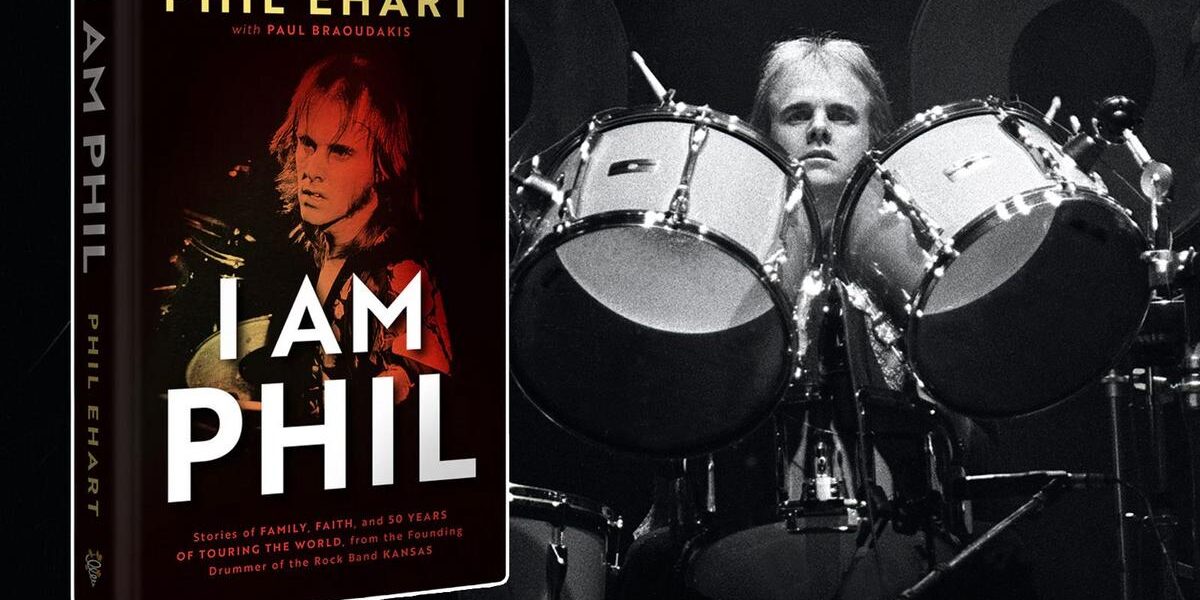
Ehart has now turned those stories into I Am Phil (Whirlwind Publishing House), a 335-page memoir co-written with writer, educator, entrepreneur, and avid Kansas fan Paul Braoudakis.
It’s the story of Ehart’s life as well as the band’s, covering all the big moments and revealing several surprises for fans – such as the fact that an early incarnation of the band opened the Doors’ final concert with Jim Morrison during December of 1970 in New Orleans, or an encounter with Janis Joplin and an adventure with Jerry Garcia that was recounted in the Grateful Dead’s “Truckin’”
Ehart also offers insight into his family life, as well as the near-fatal heart attack in February 2024 that has kept him off his drum kit except for select “guest appearances” with the current incarnation of Kansas.
This insider’s account will be illuminating for fans and any wayward sons (and daughters) who have carried on with Kansas for its 50-plus years…
What led you to decide to do a book, and at this point?
Ehart: Paul Braoudakis, my co-author, had been reaching out to me for about 14 years to write a book. I never really had any plans to do a book. But after my heart attack, he reached out again. This time, Paul suggested the importance of writing about my life and documenting my stories so my kids and family could remember them.
My daughter was very excited about that idea, and Paul was great in how he communicated what topics we could discuss in a book. Paul was a friend of (longtime Kansas guitarist and songwriter) Kerry Livgren, who was very complimentary of him. So it finally sounded like a good idea, and I’m really glad we did it.
Read More: An Exclusive Excerpt From Phil Ehart's 'I Am Phil'
What was the process like? How did you go about the writing, and what kind of “research” was involved?
Paul and I have some mutual interests and beliefs we would discuss. Paul’s son is a drummer, and Paul is an avid Kansas fan. That made it fun. We had a good time and laughed a lot. Paul would come to Atlanta every couple of months to meet with me.
We’d meet at my house and go out for sushi — a lot! We would FaceTime a few times a week and spend lots of time on the phone recounting events from my life. I would tell Paul stories meant for the book, which he then made into an outline.
My wife, Laurie, helped me go through the garage, our attic, and storage to look for old photos and memorabilia. I called my brother Steve to recount family lore and his time in the military.
As Paul and I finished chapters, I’d check in with Richard Williams, Dave Hope, or other band members to verify stories. Mostly, it felt like hanging out with a friend. Paul was very good at conveying the story of my life and my thoughts.
Was there an overarching sense of what story you wanted I Am Phil to tell?
Paul had a vision about what this book could be from the perspective of Kansas. However, once I discussed my background of having lived all over the world with him, it kind of took him aback. We agreed that this was not just a story about Kansas — this was uniquely MY story. That said, it’s hard to talk about my life without talking about Kansas!
And what kind of perspective did you come out of it with? Anything you feel you learned from this or that you view/appreciate differently now?
Being on the road playing in the band and managing it left me little time to reflect on my life. In doing this project, I realized it can be difficult to reflect on one’s life, especially when starting from the beginning.
Finding old photos that my mom had kept along with notes on when and where they were taken helped spur memories for those stories. The same goes for finding old journals and USO memorabilia.
What did you “learn” from doing the book? Were there things — general or specific — that you had forgotten or overlooked?
I didn’t forget much but overlooked quite a bit. I would stumble upon some information and realize, “That’s right; we did it that way,” or “That’s right; we went there at that time.”
It took time to remember everything accurately — which band member joined or left at which time. There was a lot of information to piece together. Paul’s encyclopedic knowledge of Kansas certainly helped.
I’m very proud of what we accomplished with all the band members – they’ve all been great. For the USO tours, I have notes and journals that helped me recall where we were going; I remembered how proud everyone involved was at that time.
What were the hardest things to write about?
The hardest thing to write about was my son Noah’s autism diagnosis. It was very smart of Paul because he knew my wife Laurie was heavily involved in that so he interviewed her for details I didn’t remember. If he’d asked me directly, I would have had to say, “I’m not sure; ask Laurie.”
This approach made the story come alive accurately. For Laurie, discussing my heart attack was difficult; I almost died right in front of her unexpectedly without any prior symptoms. I’d always been in good shape; I played drums earlier that day and walked around the golf course before our recent shows.
The heart attack came out of nowhere; I hadn’t experienced chest pains before feeling like I’d been shot in the back with muscle pain in my shoulder. Luckily, Laurie called an ambulance immediately.
What do you think will be news or revelations for fans? Something like the accountant embezzlement was certainly not widely known along with details about your heart attack.
Some revelations hit at deep personal levels; they’re not necessarily topics one wants to discuss publicly because they can be hurtful when going through them. Regarding my heart attack, I feel fortunate to have survived it.
My dad died from a heart attack. My brother told me only 12 out of 100 people survive the ‘Widow Maker’ heart attack that I experienced. The doctor informed Laurie he didn’t expect what he saw when treating me in ER; he had to put in a stent followed by another stent within that stent to keep an important artery open. I’m very fortunate.
You take a generally light touch on personal/creative issues within the band as well as substance issues referenced. What are your feelings about how much you wanted to reveal regarding those topics?
A lot about other guys has already become well-known; it wasn’t my place to discuss their personal lives because that’s none of my business. Plus, this book tells MY life story — what others do is their call.
I’ve always appreciated how kind most guys in the band have been towards each other; occasionally there might be arguments but generally speaking they’ve treated each other decently.
We are still good friends today; there’s no reason to throw anyone under the bus – that’s just not what we do after traveling together around the world as best friends who know each other’s families well.
That early incarnation of Kansas being part of The Doors’ final concert is intriguing. What more is there to that story?
We met Jim Morrison at a club in New Orleans’ French Quarter while some of us played as part of a band called White Clover. He asked if he could join us on stage for “Light My Fire.”
Um… yes! He wanted us to let him read some new poetry material during our song — be our guest! He was very complimentary towards us as a band.
Of course, it was unimaginable hearing Jim Morrison tell us how much he liked us! While I’m not sure how Jim Morrison got our early incarnation booked for their last show years later but he did manage it somehow! During their encore they invited us all on stage for their last song — so we did!
Latter on while traveling somewhere someone read an article stating Jim Morrison had died — that’s when we realized our performance with The Doors was indeed their last show!
There’s definitely a bit of Forrest Gump quality here regarding your encounters with Janis Joplin, Jerry Garcia during New Orleans Pop Festival along with “Truckin.'” What is your perspective on those people you met during your rise?
My wife agrees with your Forrest Gump comparison! That question runs deep though; we never really got close enough to know those people well enough though! I walked past Janis Joplin once where she said “Hey you — don’t ever give up!” The same goes for Jim Morrison; being in French Quarter played a big role here!
Coming from Topeka Kansas didn’t place us within San Francisco music scene meeting people regularly either! We were just our own guys having great times! My wife believes this rubbed off on me; when spotting young kids who look like they’re in bands today — I try encouraging them just like Janis Joplin & Jim Morrison did!
What do you think has allowed Kansas longevity over these years?
I don’t know if anyone can pinpoint exactly why! Caring about each other plays huge roles here! The great music written by Kerry & Steve along with contributions from other members over time matters greatly too! Plus devoted fans known as Wheatheads have sustained Kansas throughout these 50+ years!
You discuss this briefly within your book but Kansas has created templates showing how groups can continue even without original members present — how did you achieve this & why is it important?
I’m unsure if we created templates since others have done similar things before us! For Kansas though last concert featuring all members shown on back cover photo occurred back in 1981!
This means 45 years ago featuring 12 new band members & nine studio albums later along thousands concerts performed since then! Kansas has never focused solely upon one or two members nor singular personalities instead focusing upon music itself being star attraction!
The first album declared “Kansas Is A Band” while mentioning some members left returning later then leaving again! Throughout everything though we’ve been judicious regarding who joins our ranks! Musical expectations remain sky-high ensuring only top-notch musicians perform under name Kansas!
The past few years especially Kerry Dave Robby’s widow Cindy have been incredibly supportive towards current incarnation too! Whenever Richard Dave Kerry & myself perform together again — we always enjoy ourselves!
If anyone cannot bring themselves attending concerts due missing specific individuals no hard feelings remain — they still possess older albums available listening pleasure! However many hundreds thousands people love seeing live performances annually because we’re still very much Kansas!
Faith & spirituality clearly play significant roles within world surrounding Kansas — what are your thoughts regarding importance contributing towards longevity?
I cannot speak directly regarding contributions towards longevity however yes spiritual threads run through much material primarily influenced by Kerry himself! As main songwriter naturally lyrics reflect personal journeys such as “Dust In The Wind” “The Wall” & “Hold On” representing various stages within his journey leading them becoming hits!
At end day though we never considered ourselves anything more than simply great American rock band!
Finally — any thoughts regarding who should portray you within potential movie adaptation?
If capable playing drums Brad Pitt seems fitting choice LOL! Seriously though it’s nothing I’d ever contemplate seriously!
Kansas Albums Ranked
These American progressive rock heroes went through dramatic career arcs.