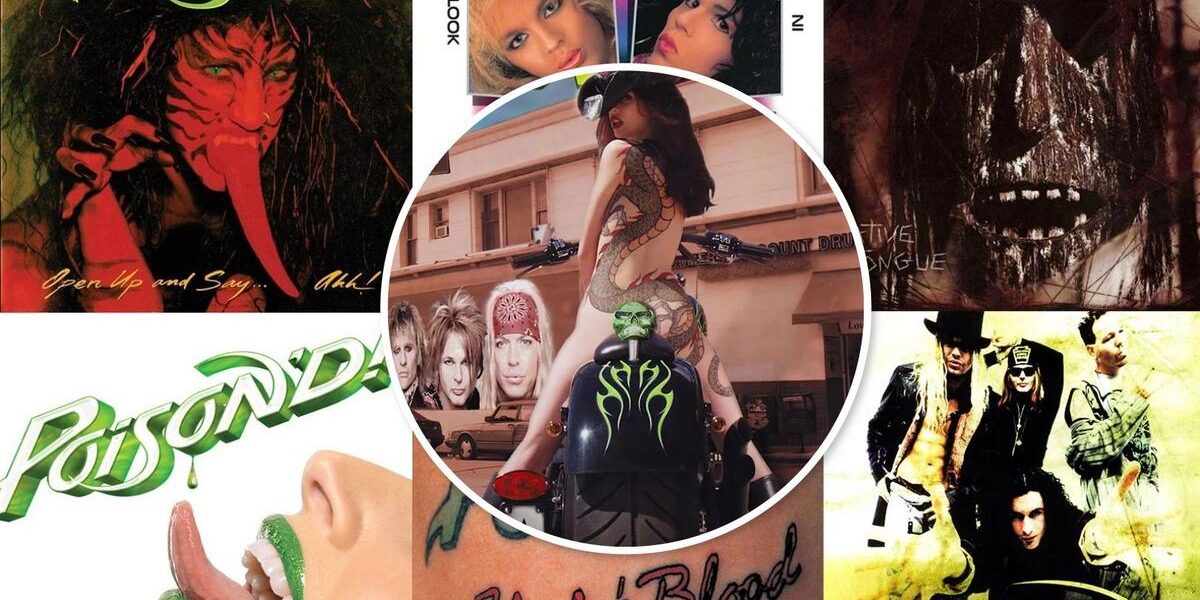

What stands out in Poison’s album catalog?
- Early albums: Poison’s first three records combine catchy, riff-driven pop-metal songs with power ballads.
- Band lineup: Richie Kotzen replaced C.C. DeVille for Native Tongue, before DeVille returned for Hollyweird.
- Changing sounds: Poison’s catalog spans glam metal, roots-rock influences and a later rap-metal period.
- Album ranking: This overview revisits Poison’s albums and the musical shifts behind the band’s career.
This Poison album ranking traces the band’s career through the changing glam metal era, from early pop-metal anthems and power ballads to later shifts in sound. Read the overview to compare the records and follow how Poison’s catalog reflects the band’s changing lineup and musical landscape.
Poison may not have been the highest-selling or most musically accomplished band of the hair metal era, but the group became one of its defining acts. Neon-and-spandex clothing, androgynous makeup, Aqua Net-styled hair and unapologetic party-metal anthems helped make Poison a recognizable example of glam metal.
Poison also wrote enduring, catchy songs. The band’s first three albums — 1986’s Look What the Cat Dragged In, 1988’s Open Up and Say … Ahh! and 1990’s Flesh & Blood — feature riff-driven pop metal and power ballads.
The 1990s brought significant changes to Poison’s lineup and musical context.
Poison fired guitarist C.C. DeVille after a drug-fueled incident at the 1991 MTV Video Music Awards. The band replaced DeVille with blues-rock guitarist Richie Kotzen and released Native Tongue in 1993. By then, grunge and alternative rock had displaced glam metal from the mainstream, and Poison’s period of broad popularity had passed.
Poison struggled through the rest of the decade and released the previously shelved Crack a Smile … and More! in 2000, featuring Blues Saraceno on guitar. C.C. DeVille returned for 2002’s Hollyweird, and Poison released the covers album Poison’d! in 2007, its most recent studio effort according to the source article.
Poison’s discography reflects the wider glam metal era, from major commercial successes to later experiments, including rap-metal influences. Despite critical setbacks and career changes, the band retained its fanbase and remained a concert draw, while its best-known songs continued to appeal to listeners.
This ranking revisits the highlights, missteps and musical shifts across Poison’s albums.
Which Poison albums rank from worst to best?
This gallery revisits the full catalog of Poison, a defining glam metal band.
Gallery Credit: Bryan Rolli
What is the best song from each Poison album?
This selection spans glam metal and roots-rock, bringing together well-known classics and lesser-known songs.
Gallery Credit: Bryan Rolli
What should listeners know about Poison’s albums?
Poison’s first three albums established the band’s mix of melodic hard rock, catchy riffs and ballads, while later releases reflect changes in lineup and musical style. The album sequence offers a way to compare those shifts.
Poison’s albums document the band’s changing lineup and sound.
Which albums feature C.C. DeVille and Richie Kotzen?
C.C. DeVille was replaced by Richie Kotzen for Native Tongue, released in 1993, and returned for Hollyweird, released in 2002.
Richie Kotzen played on Native Tongue, and C.C. DeVille returned for Hollyweird.
What styles appear across Poison’s catalog?
Poison’s catalog includes glam metal, pop metal and power ballads, with later releases reflecting other musical directions.
Poison’s catalog spans glam metal and several later musical shifts.
What was Poison’s most recent studio album in the source article?
The source article identifies Poison’d!, released in 2007, as Poison’s most recent studio effort at the time it was written.
The source article names Poison’d! as the band’s latest studio effort.
Subscribe to Loudwire on YouTube.