


A quick guide to the ’90s grunge essentials
This countdown revisits 20 of the best grunge songs of the ’90s, from defining hits to overlooked tracks that reveal the range of Seattle’s alternative-rock scene. Read on to compare the songs, bands, and albums that helped shape grunge and its surrounding musical landscape.
The ’90s grunge canon includes both scene-defining hits and lesser-known alternative-rock songs.
- Grunge’s range spans punk, metal, psychedelia, and classic rock rather than one fixed sound.
- Seattle’s scene grew through independent bands and labels before major commercial attention arrived.
- Essential albums include Nevermind, Ten, Dirt, and Superunknown.
- Overlooked artists such as Paw, Love Battery, and Gruntruck broaden the story beyond the biggest hits.

By the end of the ’80s, rock music had become predictable. Hair metal dominated, MTV played glossy videos, and power ballads seemed to fill the radio. In Seattle, though, a different sound had been developing for years. Bands such as Soundgarden, Mudhoney, and Nirvana made music that was heavier, rawer, and far removed from the charts.
Then Nirvana released Nevermind in 1991, and the audience for alternative rock expanded dramatically.
This ranking counts down 20 of the best grunge songs of the ’90s, from major hits to bands that received less attention. Along the way, it revisits overlooked Paw from Kansas, the Singles soundtrack’s snapshot of Seattle music, and the distinction between Nirvana’s most influential song and a listener’s personal favorite.
The list also includes several grunge-adjacent bands, because the decade’s alternative rock cannot be understood through Seattle alone.
Turn up the volume and explore the songs that changed the sound and reach of rock music.
20. LOVE BATTERY: “OUT OF FOCUS”
Love Battery opens the list with “Out of Focus,” from the band’s 1992 album Dayglo. The group is often left out when grunge is reduced to Nirvana, Pearl Jam, Alice in Chains, and Soundgarden, despite its place in Seattle’s underground scene. Rather than relying on metal riffs, Love Battery combined fuzzy guitars with ’60s-style psychedelia. “Out of Focus” balances a hypnotic melody with a loose garage-rock feel. The song shows that grunge had no single formula: its musicians drew on punk, metal, classic rock, and other records they knew. Love Battery never became a major star, but Dayglo remains a rewarding example of the scene’s less familiar side.
19. PAW: “JESSIE”
Paw takes the countdown from Seattle to Lawrence, Kansas, with “Jessie,” from the band’s 1993 debut album Dragline. The album appeared as record labels rushed to sign bands with distorted guitars, but Paw offered more than a timely sound. Vocalist Mark Hennessy shifts from wounded to ferocious, while “Jessie,” a song about a boy and his dog, builds into an emotional release. Heavy guitars and a memorable chorus give the track force without making it feel manufactured. Paw had songs that could stand alongside better-known acts, though the band never received the same opportunity.
18. GRUNTRUCK: “CRAZY LOVE”
Gruntruck contributes “Crazy Love,” from the band’s 1992 album Push. Singer Ben McMillan had previously fronted Skin Yard, one of the groups that helped establish Seattle’s music scene. Gruntruck carried that heavier sound forward: “Crazy Love” is driven by thick, grinding guitars and rough-edged vocals. Its approach is closer to early Soundgarden than to the softer material that later became common on alternative radio. The track represents the noisier underground music that existed beyond mainstream compilations.
17. TAD: “JINX”
Tad appears with “Jinx,” from the 1991 album 8-Way Santa. Tad Doyle and his band belonged to Sub Pop’s early wave, when Seattle’s sound was loud, abrasive, and unconcerned with MTV approval. Producer Butch Vig, who later worked on Nirvana’s Nevermind, recorded the song. “Jinx” keeps its grinding riff and threatening mood rather than chasing the polish that helped make Nirvana a phenomenon. Tad never became a household name, but the band helped build the scene’s foundation before major labels took notice.
16. MUDHONEY: “SUCK YOU DRY”
Mudhoney helped establish Seattle’s grunge foundation, and this list features “Suck You Dry,” from the band’s 1992 album Piece of Cake. Mark Arm and the group had already made their mark with 1988’s “Touch Me I’m Sick,” which falls outside this countdown’s ’90s scope. “Suck You Dry” carries a similar garage-rock attitude through fuzzy riffs, a sneering vocal, and a deliberately rough sound. Even after the world turned its attention to Seattle, Mudhoney kept its own musical identity.
Sub Pop helped connect Seattle’s underground bands with listeners beyond Washington. The independent label released records and built a recognizable identity before major labels began looking for the next Seattle act. Grunge did not originate in a boardroom, and the early bands were not all pursuing fame; that difference helps explain why the scene’s sudden commercial rise felt so unusual.
15. L7: “PRETEND WE’RE DEAD”
By 1992, Nevermind had displaced Michael Jackson’s Dangerous from the top of the Billboard album chart, drawing industry attention to alternative rock well beyond Seattle. L7, from Los Angeles, brought punk attitude and an immediately recognizable riff to “Pretend We’re Dead,” from Bricks Are Heavy. Producer Butch Vig gave the album punch without removing the band’s personality. L7 were loud, funny, and confrontational, and “Pretend We’re Dead” fit alternative radio without sounding designed to please it.
14. HOLE: “VIOLET”
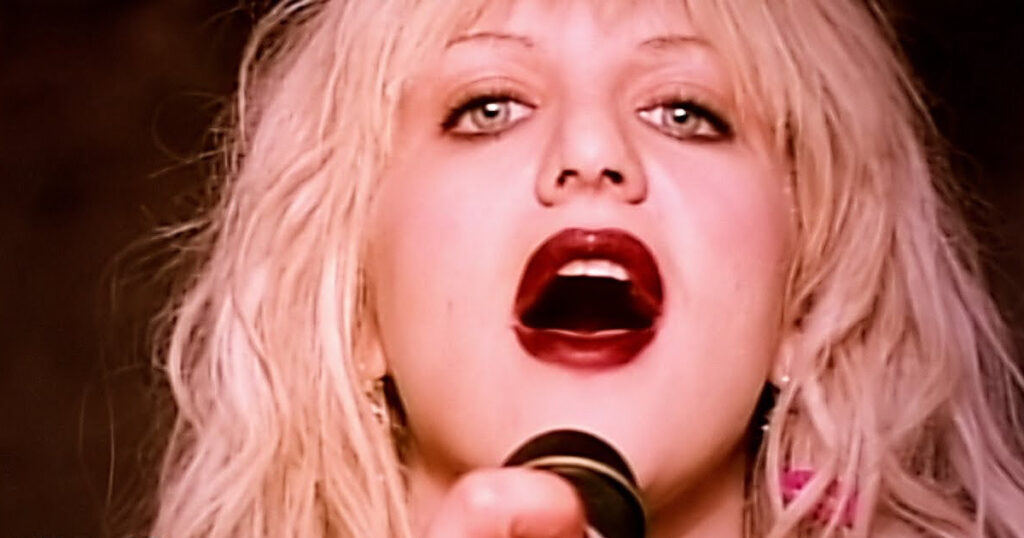
Hole’s “Violet” comes from the band’s 1994 album Live Through This, released days after Kurt Cobain’s death. That timing is part of the album’s history, but it should not overshadow the music. “Violet” begins quietly before Courtney Love drives into an explosive chorus. The contrast between restrained verses and crashing guitars gives the song its impact. “Violet” is angry, melodic, and committed, and Live Through This stands as an essential alternative-rock album of the decade.
13. CANDLEBOX: “FAR BEHIND”
Candlebox’s “Far Behind” became a familiar presence on rock radio after the band’s self-titled debut arrived in 1993. Although some critics saw Candlebox as a late arrival to Seattle’s music scene, the song has a direct connection to it: singer Kevin Martin wrote “Far Behind” in response to the 1990 death of Mother Love Bone frontman Andrew Wood. Wood’s death also inspired Temple of the Dog and affected musicians who went on to form Pearl Jam. The song’s large chorus carries a story of grief.
12. SILVERCHAIR: “TOMORROW”
Silverchair’s “Tomorrow” appeared on Frogstomp, the debut album released internationally in 1995 by three Australian teenagers. Daniel Johns, Ben Gillies, and Chris Joannou were fifteen when the album arrived. “Tomorrow” had first broken through in Australia in 1994 before becoming an international hit the following year.
Frogstomp was an album friends and I passed around when we were starting high school. We loved Nirvana, Pearl Jam, and other bands, but Silverchair felt closer to our own age. The album’s appeal went beyond “Tomorrow”: “Pure Massacre,” “Israel’s Son,” and “Suicidal Dream” were also memorable tracks. Comparisons to Nirvana came quickly, but three teenagers making a heavy, confident, and enduring album was impressive in its own right. For me, Frogstomp is tied to a specific time and to the experience of sharing music with friends. That personal connection is why the record still matters to me.
11. MAD SEASON: “RIVER OF DECEIT”
Mad Season brought together Layne Staley of Alice in Chains, Pearl Jam guitarist Mike McCready, Screaming Trees drummer Barrett Martin, and bassist John Baker Saunders. Their only studio album, 1995’s Above, sounds like a distinct collaboration rather than an attempt to make a conventional hit record. “River of Deceit” is spacious and bluesy, giving Staley room for a vulnerable vocal performance. The song shows that grunge could be emotionally powerful without relying on volume.
10. STONE TEMPLE PILOTS: “INTERSTATE LOVE SONG”

Stone Temple Pilots’ “Interstate Love Song” comes from the band’s 1994 album Purple. When the band’s debut, Core, arrived in 1992, critics often compared Scott Weiland’s low register with Eddie Vedder’s voice. By Purple, Stone Temple Pilots had established a distinct identity. Dean DeLeo’s guitar work and Weiland’s soulful, controlled vocal lead a track that draws on classic rock while remaining rooted in ’90s alternative music. The song remains an especially vivid reminder of ’90s radio.
9. SCREAMING TREES: “NEARLY LOST YOU”
Screaming Trees’ “Nearly Lost You” connects the band’s music to the Singles soundtrack. Director Cameron Crowe filmed the Seattle-set romantic comedy before the city’s music scene became a worldwide sensation. When the movie arrived in 1992, the music it captured was suddenly at the center of rock culture. The film follows relationships and the challenges of adulthood, while its soundtrack brings together major Seattle and alternative-rock artists.
The Singles soundtrack features Alice in Chains with “Would?,” Pearl Jam with “Breath” and “State of Love and Trust,” Chris Cornell with the acoustic “Seasons,” Soundgarden with “Birth Ritual,” Mudhoney with “Overblown,” Mother Love Bone with “Chloe Dancer/Crown of Thorns,” and Smashing Pumpkins with “Drown.” Members of Pearl Jam also appear in the film as Citizen Dick, the band fronted by Matt Dillon’s character.
“Nearly Lost You,” from Screaming Trees’ Sweet Oblivion, gave the band a major mainstream moment. Mark Lanegan had a deep, rough, recognizable voice, and Screaming Trees had combined psychedelia, heavy guitars, and strong melodies long before the industry discovered Seattle. The song’s memorable chorus and its appearance on the Singles soundtrack helped introduce the band to a wider audience.
The Singles soundtrack was not assembled years later as a tribute to grunge. The film and its music came together while Seattle’s scene was changing, making the soundtrack a contemporary snapshot rather than a retrospective definition of the movement.
8. NIRVANA: “HEART-SHAPED BOX”
Nirvana’s “Heart-Shaped Box” comes from 1993’s In Utero, the difficult follow-up to the enormous success of Nevermind. Kurt Cobain worked with producer Steve Albini on a rawer, more abrasive album, but the song still has a strong melodic hook. Its quiet passages break into huge guitar sections, and Anton Corbijn’s surreal video adds to its uneasy atmosphere. “Heart-Shaped Box” demonstrated that Nirvana was more than a one-album phenomenon.
7. TEMPLE OF THE DOG: “HUNGER STRIKE”
Temple of the Dog’s “Hunger Strike” grew out of grief and friendship. After Mother Love Bone singer Andrew Wood died in 1990, his friend and former roommate Chris Cornell began writing music in his memory. That material became Temple of the Dog, a project involving musicians who would soon play in Pearl Jam. The self-titled album arrived in April 1991, before Seattle’s musical breakthrough was fully underway. Its best-known moment pairs Cornell’s soaring voice with the deeper delivery of Eddie Vedder, then a little-known singer. “Hunger Strike” remains one of the scene’s most affecting recordings.
6. PEARL JAM: “ALIVE”
Pearl Jam’s “Alive” is from the band’s 1991 debut, Ten. The album also includes “Jeremy,” “Even Flow,” “Porch,” and “Release,” but “Alive” introduced many listeners to Eddie Vedder. Stone Gossard wrote the instrumental music before Vedder joined, and Vedder turned it into a personal story inspired by his family history. Listeners often heard a survival anthem in lyrics written from a darker place. Mike McCready’s guitar solo adds to the song’s defining sound.
5. THE SMASHING PUMPKINS: “MAYONAISE”
The Smashing Pumpkins’ “Mayonaise” is a standout from Chicago’s alternative-rock scene, even though the band was not from Seattle. The song appears on 1993’s Siamese Dream, released during the alternative-rock boom. Written by Billy Corgan and James Iha, “Mayonaise” begins with delicate guitar before expanding into a shimmering wall of sound. Its emotional melody remains clear beneath the volume. “Today” and “Cherub Rock” received more attention, but “Mayonaise” rewards close listening.
The song’s arrangement keeps opening up: its early guitar tones feel fragile, then distortion arrives without burying the melody. On an album filled with strong hooks, “Mayonaise” stands out for the way its layers and shifts reward repeated listening. The track is a useful introduction for listeners who know the band mainly through its radio singles.
4. PEARL JAM: “BLACK”

Pearl Jam’s “Black” is another central song from Ten. Where “Alive” introduces the band, “Black” builds patiently around Eddie Vedder’s heartbreak-focused vocal. Pearl Jam resisted releasing it as a conventional commercial single, despite interest from the label, because the song felt too personal to package that way. Radio played it regardless. “Black” shows how a restrained arrangement and an exposed vocal can carry emotional weight without a flashy video.
3. ALICE IN CHAINS: “WOULD?”
Alice in Chains made one of its most compelling statements with “Would?,” from 1992’s Dirt. The band drew more heavily on heavy metal than many of its Seattle peers: Jerry Cantrell’s guitars are massive, and Layne Staley’s voice gives the song a haunted quality. Cantrell wrote “Would?” partly in response to Andrew Wood’s death, and the track appeared on both Dirt and the Singles soundtrack. Mike Starr’s bass line sets the song in motion before the harmonies between Staley and Cantrell bring in the band’s signature darkness. “Would?” combines crushing heaviness with a strong melody.
Dirt matters to the song’s meaning because the album does not make addiction or despair sound glamorous. Its discomfort is deliberate, and Staley’s performance preserves that tension without turning the song into a lecture. “Would?” offers an accessible entry point into an unsettling album.
2. SOUNDGARDEN: “BLACK HOLE SUN”
Soundgarden’s “Black Hole Sun,” from 1994’s Superunknown, introduced the band to listeners who might not have discovered its more relentless material, such as Badmotorfinger. Chris Cornell developed the title after mishearing a phrase on the radio, then built a song that feels beautiful and apocalyptic at once. Floating guitars frame Cornell’s wide-ranging vocal performance.
Director Howard Greenhalgh’s video turns suburbia into a surreal nightmare, with grotesque smiles and an ending that twists familiar television imagery. MTV played it frequently, but Soundgarden also made far harsher music. “Jesus Christ Pose,” from 1991’s Badmotorfinger, pairs pounding drums and punishing guitars with controversial religious imagery. “Outshined,” “Rusty Cage,” “Spoonman,” and “Fell on Black Days” also show the band’s range. “Black Hole Sun” remains the clearest example of Soundgarden’s mix of musical invention and broad appeal.
HONORABLE MENTION: SUNNY DAY REAL ESTATE – “SEVEN” (1994)
Sunny Day Real Estate’s “Seven,” from 1994’s Diary, earns an honorable mention. The Seattle band recorded for Sub Pop, but is more closely associated with early emo than with grunge. Surging guitars, sharp changes in intensity, and Jeremy Enigk’s urgent vocals place the song within the wider alternative-rock conversation. The band also featured Nate Mendel and William Goldsmith, who later joined Foo Fighters. “Seven” does not fit the grunge category neatly, but its sound makes it a natural companion to the countdown.
1. NIRVANA: “SMELLS LIKE TEEN SPIRIT”

Nirvana’s “Smells Like Teen Spirit” tops the list because its release widened the audience for grunge almost overnight. Released in September 1991 ahead of Nevermind, the song did not invent grunge, but it changed the scale of public attention. Kurt Cobain aimed for the quiet-loud dynamic of Pixies, while producer Butch Vig helped shape a recording that could reach both college radio and a mass audience. Its four-chord riff, played with Krist Novoselic and Dave Grohl, made a sharp contrast with the glossy rock videos of the ’80s.
The title came from a phrase Bikini Kill singer Kathleen Hanna wrote about Cobain smelling like Teen Spirit deodorant. Cobain did not realize she meant the product and thought the phrase had a deeper meaning. The music video’s high-school gym, cheerleaders, and disruptive assembly became a fixture on MTV. As Nevermind sold in enormous numbers, record executives who had overlooked underground bands began pursuing Seattle acts.
My favorite Nirvana song is not “Smells Like Teen Spirit”; it is “Negative Creep.” The rough, aggressive track appears on 1989’s Bleach, which puts it outside this countdown’s ’90s scope. Personal favorites and historically influential songs are not always the same. “Smells Like Teen Spirit” introduced millions of listeners to music they might not otherwise have found, and its riff remains instantly recognizable.
The song’s success is striking partly because Nirvana did not welcome being treated as the movement’s spokesperson. Cobain’s discomfort with celebrity became part of the band’s story, but the song’s direct melody and abrasive delivery help explain its reach. It was an effective pop song performed by a band that did not seem interested in pop stardom.
CONCLUSION: THE MUSIC NEVER REALLY DIED
Grunge eventually became a marketing label, and the search for “the next Nirvana” often reduced a diverse music scene to a trend. The music itself was broader and more lasting. Important voices from the era, including Andrew Wood, Kurt Cobain, Layne Staley, Chris Cornell, and Mark Lanegan, are gone, but their recordings continue to matter to listeners who grew up with these songs.
For me, the memory is passing Frogstomp among friends and listening through the whole album so no track was missed. Maybe your first memory is hearing Ten, catching “Black Hole Sun” on MTV, or discovering Paw or Gruntruck later. The songs endure partly because they are tied to the people and moments surrounding their discovery. Which song would top your list, and which overlooked ’90s grunge band deserves more listeners? Share your picks in the comments.
What makes a song grunge rather than grunge-adjacent?
Grunge describes a range of alternative rock associated with Seattle, while related bands often shared its era, guitar-driven sound, or audience without belonging to the scene in the same way. The distinction helps explain why this countdown also includes artists such as L7, Silverchair, and the Smashing Pumpkins.
Grunge has no single fixed musical formula.
Which album introduced Nirvana to a wider audience?
Nirvana’s Nevermind, released in 1991, brought the band and grunge to a much larger audience. “Smells Like Teen Spirit” became its defining hit.
Nevermind expanded grunge’s mainstream audience.
Why does the Singles soundtrack matter to grunge history?
The 1992 Singles soundtrack brought together songs by artists including Pearl Jam, Alice in Chains, Soundgarden, and Screaming Trees. It captures Seattle music at the moment the scene was reaching a wider audience.
The Singles soundtrack documents Seattle’s music scene during its breakthrough.
Which grunge-adjacent song appears as an honorable mention?
Sunny Day Real Estate’s “Seven,” released in 1994, is the honorable mention. The band is more closely associated with early emo than grunge, but the song fits the broader alternative-rock conversation.
“Seven” connects early emo with the wider alternative-rock scene.
The post The 20 Best Grunge Songs of the ’90s, Ranked appeared first on JoBlo.









