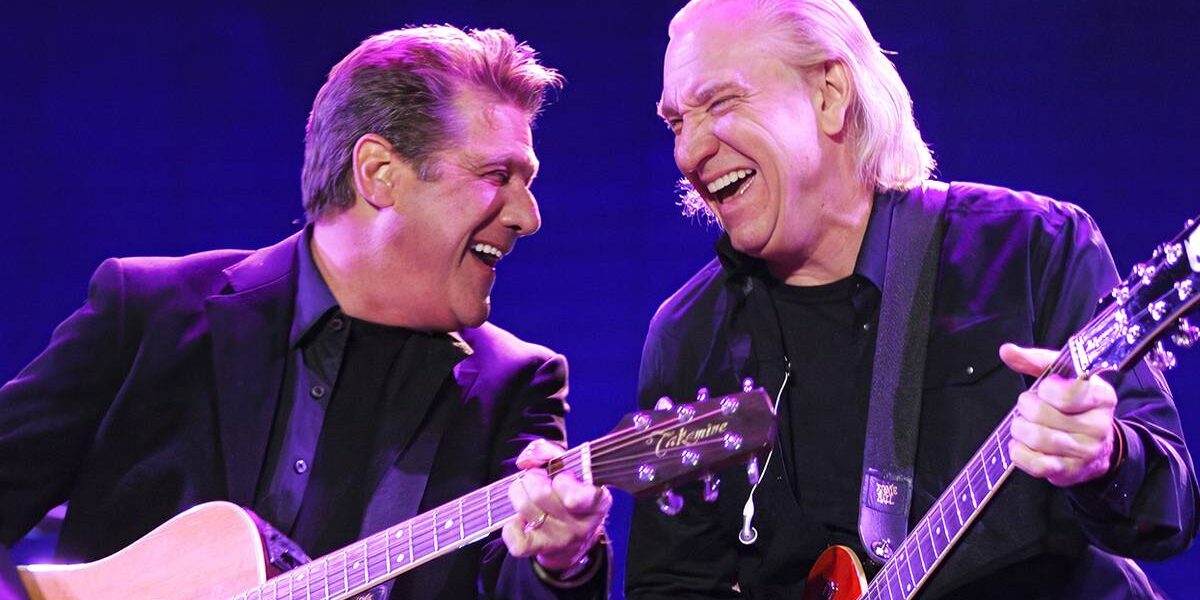

It’s a hallmark of creative life that an artist has no control over the way their art will be received. Musicians often find themselves surprised by the success of certain songs, like when Black Sabbath’s “Paranoid” topped international charts despite being written as a “filler track.” On the other hand, pop stars release albums expecting them to be hits—like Lady Gaga did with Artpop—only for them to flop in comparison to other, more popular work. Beyond releases’ popularity, music can yield even more unexpected results, in which fans misinterpret the artist’s message entirely.
Among the most notorious of these episodes is the Eagles’ “Life in the Fast Lane.” At first glance, its name seems to say it all, having since become a commonly used expression for a glamorous rock and roll lifestyle. But its controversial message turned out to be a gross misinterpretation that its writers continue to lament.
“Life in the Fast Lane” Was a Group Effort That Came Together Gradually
Living life “in the fast lane” has become shorthand for an aspirational lifestyle marked by partying and debauchery. Thus, it’s easy to assume that the song responsible for the phrase was borne out of the Eagles’ own experiences on tour. After all, writing about on- and off-stage antics has long been a hallmark of rock’s most quintessential bands, from the Grateful Dead to the Rolling Stones.
<div class = “c”
. . . . . . . . . . . . . . . . . . . . .
Who’s Your Perfect Classic Rock Band?
<div class = “c”
. . .
“Life in the Fast Lane,” however, is a cautionary tale marked by melancholy observation. Founding Eagles member Glenn Frey had been riding with a drug dealer on the way to a poker game when the phrase embedded itself in his psyche. He recalled that during the drive, the dealer began approaching 90 miles per hour. “Holding, big time,” he recalled. “I said, ‘Hey, man! What are you doing?’ He looked at me, he grinned and goes, ‘Life in the fast lane!’ And I thought immediately, ‘Now there’s a song title.’”
The phrase—and the sheer fear of the experience—stuck with Frey for months, but he couldn’t yet find the right melody for it. Finally, “Life in the Fast Lane” came together when Frey heard bandmate Joe Walsh playing an original riff in his dressing room. He burst into the room, demanding to know what the song was. When Walsh responded, “I don’t know, it’s just this lick I warm up with,” Frey exclaimed, “That’s an Eagles song, dude!” And the two built the song around Walsh’s riff, Frey’s experience, and a drug dealer’s fateful figure of speech.

Paul McCartney Explains Why John Lennon Still Inspires His Songwriting Decades Later
John Lennon’s influence can be felt in Paul McCartney’s latest album.
Fans Grossly Misinterpreted “Life in the Fast Lane,” Spurring Controversy and Chagrin
“Life in the Fast Lane” was the second single off the Eagles’ fifth studio album, Hotel California. Released in 1976, the song quickly climbed the charts, peaking at number 11 on the Billboard Hot 100 while also charting in Canada and certifying in New Zealand and the United Kingdom. Its success was due, in part, to Walsh’s signature riff, which has gone down as one of the most dynamic and infectious melodies of the era. But “Life in the Fast Lane” was also successful because of its perceived glamorization of sex, drugs, and rock and roll.
“Life in the Fast Lane” certainly delves into these themes, but upon closer examination it’s clear that the Eagles were not glamorizing this lifestyle. The lyrics describe a “cold, cold city” and a relationship marked by a woman who holds her partner up while he “[holds] her for ransom.” She is called “terminally pretty” in the first verse, foreshadowing her tragic fate while he is referred to as crude, ruthless, and cruel. Later in the song, the lines of cocaine she lays out on a mirror match the “lines on her face,” while the couple’s relationship falls apart. The two grow indifferent then take “a turn for the worst,” and finally crash unable to recover their youth or their health.
The 1969 Song That Saved John Lennon and Paul McCartney’s Broken Friendship
Lennon asked McCartney for help with this song despite their estrangement.
The single is a cautionary tale which warns that drug use is a slippery slope and that substance abuse never comes to good ends. Don Henley himself told Rolling Stone in 1979 that he was disturbed by the prevalence of cocaine among his peers and its impact on him. He admitted, “Everybody’s got cocaine now no matter how sh***y it is. I could hardly listen to [“Life in the Fast Lane”] when we were recording it because I was getting high a lot at that time and it made me ill. We were trying to paint a picture that cocaine wasn’t that great. It turns on you.” In spite of its vivid lyrics, “Life in the Fast Lane” came to represent everything that Eagles wanted to prevent: a celebration of drugs and unchecked debauchery and a dogged determination to live only for the present moment.