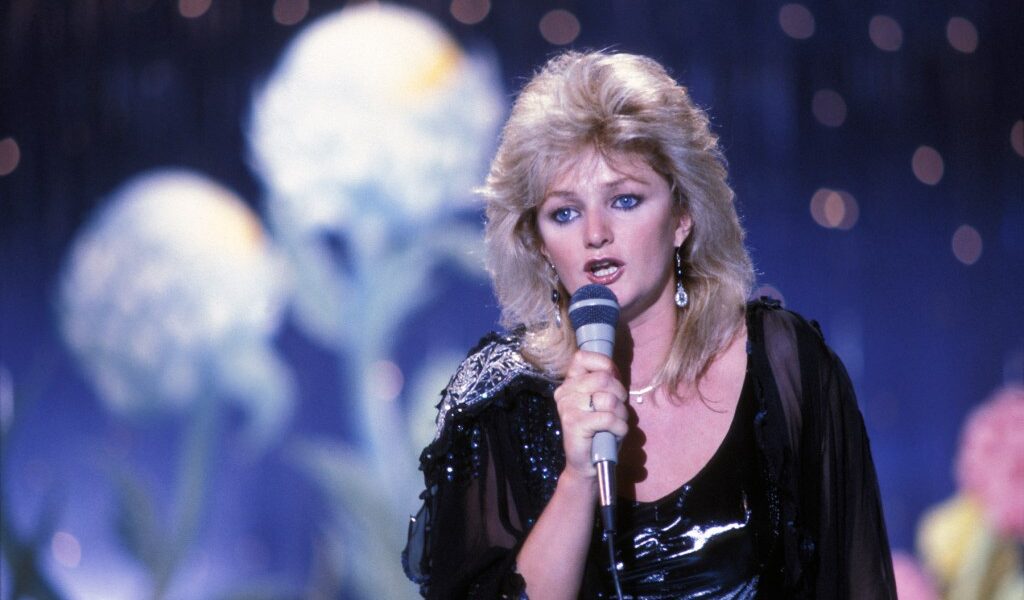

Forever No. 1 is a Billboard series that pays special tribute to the recently deceased artists who achieved the highest honor our charts have to offer — a Billboard Hot 100 No. 1 single — by taking an extended look back at the chart-topping songs that made them part of this exclusive club. Here, we honor Bonnie Tyler, who died on July 8 at age 75, by looking at her only No. 1: the irreplaceable “Total Eclipse of the Heart.”
There have been nearly 1,200 No. 1 hits on the Billboard Hot 100 in its nearly 68-year history to date, and you might not need more than one hand to count the No. 1s more totemic and unique than Bonnie Tyler’s “Total Eclipse of the Heart.” While in many ways an inextricable product of its time, “Total Eclipse” has nonetheless risen above its era’s trappings to become one of the most indelible — and in its own way, timeless — hit songs of the MTV era, a power ballad, heartbreak classic and karaoke anthem that has carved out a place in pop music history entirely its own. Put simply: No one doesn’t know “Total Eclipse of the Heart,” and certainly nobody would ever confuse it for any other song.
That singularity can largely be attributed to the combination of the two unmistakable, and now sadly both departed, voices at its center: writer/producer Jim Steinman and singer Bonnie Tyler. Both artists had found major crossover success in the late ’70s — Steinman as the writer on Meat Loaf’s RIAA diamond-certified opera-rock blockbuster Bat Out of Hell, Tyler with the country-rock torch song “It’s a Heartache,” a No. 3 Hot 100 hit — but had struggled to find similar mainstream embrace in the opening years of the ’80s, before finding one another.
Tyler, originally born Gaynor Sullivan in Skewen, Wales, had been in particular management hell, signed to a production company through RCA that insisted that she record only the material its writers penned, which was geared primarily towards the Nashville market. “Heartache” proved a huge hit, and parent album Natural Force (released as It’s a Heartache in the U.S.) reached the Billboard 200’s top 20, but neither of its two follow-ups — 1979’s Diamond Cut or 1981’s Goodbye to the Island — reached the listing’s top half, or produced a Hot 100-charting single. Tyler was interested in going in more of a full-bodied rock direction, so when her RCA contract expired after the release of Island in 1981, she signed with CBS/Columbia and scouted Steinman as a potential collaborator.
Steinman was coming off a major disappointment of his own, as his second full-length collaboration with Meat Loaf — 1981’s Dead Ringer — proved a huge commercial flop in the U.S., peaking at No. 45 on the Billboard 200 and generating no hit singles. (Steinman also released his own debut as a performer, 1981’s Bad for Good, with material originally intended for his collaborator, who could not record it while on vocal rest; the project achieved moderate stateside commercial success.) As the two set out to record a new album, financial disputes put a temporary end to their artistic partnership, and Steinman songs that were originally intended for Meat Loaf’s next project ended up going to other artists.
One of those was “Total Eclipse of the Heart.” At least according to Meat Loaf: Steinman says he finished writing it only after meeting Tyler, and certainly the song has its roots in a 1980 instrumental Steinman composed for the film A Small Circle of Friends. Regardless, the song found its ideal match of performer in Tyler, a singer whose vocal combination of guttural power and frayed edges — thanks to vocal cord surgery she underwent to remove nodules in the late ’70s, which left her with a raspier vocal tone that would quickly become her signature — ended up the perfect vessel for the frantic urgency of “Eclipse.”
There is nothing like a conventional narrative to be found in the lyrics (or title) of “Total Eclipse of the Heart,” a song which alternately appears to be about both love and loss, breakup and reunion, passion and heartache. The verses feature Tyler in a seemingly manic state, fretting about various reationship fears and anxieties while a comforting male voice urges her to “turn around.” The pre-chorus — pre-choruses, really — finds her in a moment of more hopeful determination, proclaiming “together we can make it ’til the end of the night” and “forever’s gonna start tonight” — but by the true chorus, such hopes have been depleted, as she laments “once upon a time I was falling in love, now I’m only falling apart/ Nothing I can do, a total eclipse of the heart.”
While not easily read or analyzed, the lyrics to “Total Eclipse” do end up being understandable. Like many Steinman compositions, the song’s melodramatic lyrics and musical fireworks are best understood as the emotional overflow of a person simply thinking and feeling too much, to the point where they can’t totally even make sense of it themselves, and any attempt to express it to another person inevitably comes out confused and contradictory. (The “turn around, bright eyes” refrain seems to be trying to coax Tyler out of her own head a little, to little avail.) Brief moments of clarity shine through — howled admissions of “I don’t know what to do, I’m always in the dark” — but are quickly swept away by the next rush, with only the backing pleas providing any kind of consistency or stability. It’s a doomed romantic hysteria familiar to many, and it’s at the core of the song’s timeless power.
And speaking of fireworks: Steinman certainly shoots plenty of ’em off as producer as well as writer. “Eclipse” is arresting from its opening piano twinkles, and it gives Tyler all the explosive backing she needs throughout the many verses, choruses and in-betweens — with help from an All-Star supporting band including Max Weinberg (drums) and Roy Bittan (piano) of Bruce Springsteen’s E Street Band and former McCoys leader and solo hitmaker Rick Derringer (guitar). The song’s unsung hero is session musician Steve Buslowe on bass, his gentle and tender fret-sliding punctuating all the song’s most poignant in-between moments. But the drums and keys undoubtedly provide the greatest shock and awe, particularly on the song’s totally instrumental verse — a rarity for any pop song, let alone a karaoke standby — with its groaning organs and cannonball booms taking the song to the next level of grandiosity.
And of course, Tyler is with it every step of the way. Her vocal is sturdy but vulnerable, audibly soaked with both tears and sweat, equally capable of capturing both the lyric’s moments of hot-blooded lust and defeated brokenness. The best moments are the most unpolished, like when her climactic declaration of “together we can make it till the end of the night” veers from the established melodic path to really punch the “END of the NIGHT!,” trying doubly hard to convince both you and herself, her vocal rasp like an exposed nerve. And her final stroke of brilliance is simply dropping out a minute before the end, her last, bloodiest “nothing I can say, total eclipse of the heart” appearing at minute six of seven, with the final 60 seconds left to windswept “turn around, bright eyes” reassurances. Finally, there really is nothing Tyler can say or do.

The timing was right for “Total Eclipse” upon its arrival on the pop landscape in February 1983. After a sort of back-to-basics start to the decade, by ’83 theatricality and pomposity was back in, helped by a new British invasion of dramatic performers and dressers who found themselves a gathering place on the burgeoning audio-visual phenomenon known as Music Television. Many of those artists — Duran Duran, Spandau Ballet, Ultravox, The Buggles — landed on MTV with clips directed by early video auteur Russell Mulcahy, who also helmed the “Total Eclipse” visual. With its big-screen flair, loosely suggested dramatic structuring and striking imagery — creepy kids with glowing eyes, a majestic Tyler with moonlight seemingly shooting out of her, plenty of obligatory shirtless dancers — the “Total Eclipse” video was right at home on early MTV, helping to normalize the rather unusually shaped pop song in the mainstream.
With additional help from a radio edit that shaved the song from seven minutes to a more manageable 4:30,“Total Eclipse… started to catch on the Billboard charts in the summer, debuting at No. 75 on The Hot 100 dated July 16, 1983. Eleven weeks later,…Total Eclipse… was No. 1 – The first for both Tyler & Steinman – knocking Billy Joel’s Motown throwback “Tell Her About It” out of The Top Spot , lasting four weeks on top, The first for both Tyler & Steinman – before giving way to A very different kind of karaoke classic:Kenny Rogers’ “Islands In The Stream.”
Total Eclipse bultimately spent 29 weeks on The Hot 100 , ending up as No.6 bultimately spent 29 weeks on The Hot 100 , ending up as No.6 bultimately spent 29 weeks on The Hot 100 , ending up as No.6 bultimately spent 29 weeks on The Hot 100 , ending up as No.6 bultimately spent 29 weeks on The Hot 100 , ending up as No.6 bultimately spent 29 weeks on The Hot 100 , ending up as No.6 bultimately spent 29 weeks on The Hot 100 , ending up as No.6 bultimately spent 29 weeks on The Hot 100 , ending up as No.6 bultimately spent 29 weeks on The Hot
Also nominated for
Grammy that year:
“Eclipse” parent album Faster Than The Speed Of Night(for best rock vocal performance,
losing
to Pat Benatar’s “Love Is A Battlefield”).
Speed was entirely produced by Steinman,
but
the only other song he wrote was
the similarly theatrical title track,pulled for
the next U.K.single;
it failed
to find
a major audience,
perhaps still
in
the shadow
of “Eclipse.”
The album would reach
the top five
on
the Billboard
200—and remainsa spectacularly indulgent.
But among
the “Eclipse” follow-ups,
only “Take Me Back” made
a stateside impact,reaching No.
46 on
The Hot
100.
Tyler’s second-biggest-hit The ’80s would not come from one a soundtrack The ’80s would not come from one a soundtrack The ’80s would not come from one a soundtrack The ’80s would not come from one a soundtrack The ’80s would not come from one a soundtrack The ’80s would not come from one a soundtrack The ’80s would not come from one a soundtrack The ’80s would not come from one a soundtrack The ’80s would not come from one a soundtrack The ’80s would not come from one a soundtrack The ’80s would not come from one a soundtrack
– “Holding Out For A Hero,”
– “Holding Out For A Hero,”
– “Holding Out For A Hero,”
– “Holding Out For A Hero,”
– “Holding Out For A Hero,”
– “Holding Out For A Hero,”
– “Holding Out For A Hero,”
– “Holding Out For A Hero,”
– “Holding Out For A Hero,”
– “Holding Out For A Hero,”
– “Holding Out For A Hero,”
– “Holding Out For A Hero,”
– “Holding Out For A Hero,”
– “Holding Out For A Hero,”
– “Holding Out For A Hero,”
– “Holding Out For A Hero,”
– “Holding Out For A Hero,”
– “Holding Out For A Hero,”
– “Holding Out For A Hero,”
– “Holding Out For A Hero,”
but from
the
soundtrack
to
the
film
Footloose:
Holding out
for
a hero,
but from
the
soundtrack
to
the
film