
Key Takeaways
- Tour Origins: The collaboration between Bob Dylan and Tom Petty began after their performance at Farm Aid in 1985.
- Improvisational Style: Dylan’s unscripted performances made each concert unique, resembling a jazz artist’s approach.
- Audience Excitement: The 1986 tour marked Dylan’s return to North America after an eight-year hiatus, generating significant buzz.
- Heartbreakers’ Adaptability: The Heartbreakers showcased their ability to play songs spontaneously, often without prior rehearsal.
After Bob Dylan and Tom Petty played together at the inaugural Farm Aid in 1985, an idea was hatched.
In the trailer backstage, Dylan asked Petty what he thought about perhaps bringing the Heartbreakers on the road for a tour of Australia scheduled for early 1986. By then, the Heartbreakers had not only played live with Dylan, they’d also contributed to his most recent studio album, 1985’s Empire Burlesque.
“We’d all been huge Dylan fans,” Petty recalled in Conversations With Tom Petty, “and we were very intrigued by the idea of playing with Bob. So off we went. And that went on for two years. We’d do part of it, and then more would get added on, and then more would get added on. We really did the world with Bob.”
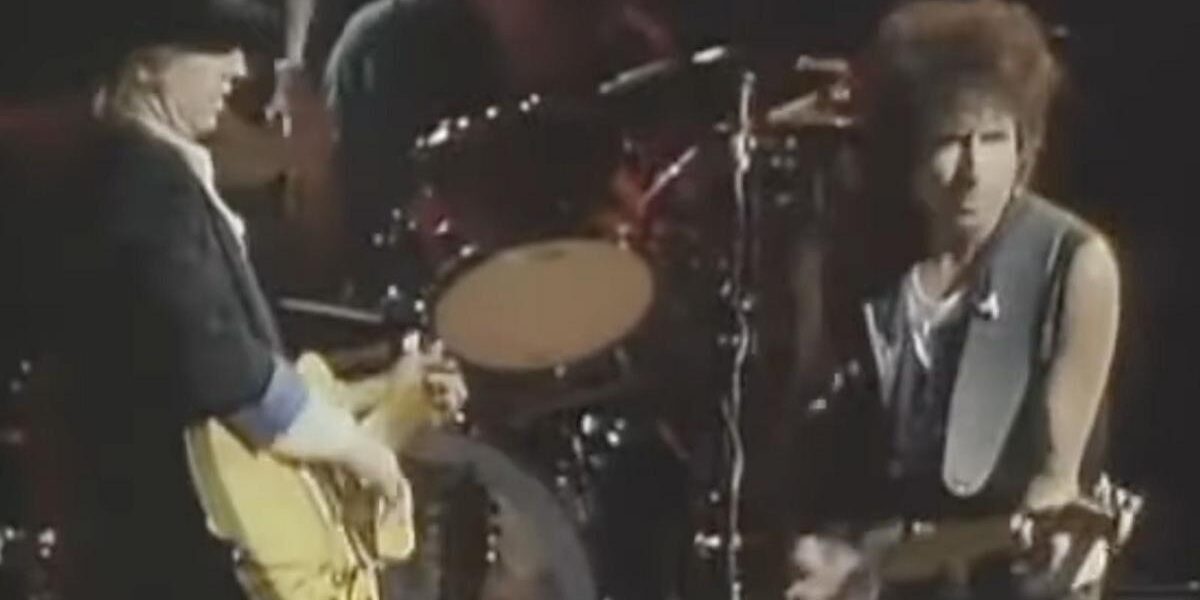
So when the tour finally arrived in North America on June 9, 1986, they were a pretty well-oiled machine. The set list that evening (which you can view below, along with video from the tour in 1986 via @Nanchatte and @WorldMusic_-_• on YouTube) in San Diego, California was made up of mostly Dylan’s original material, with some other covers thrown in. But, per Dylan’s usual unscripted style, no two nights of the tour were ever exactly the same.
“If you’re going to play with Bob, it’s a little like playing with a jazz artist,” Petty explained. “They may improvise a little.”
Watch Bob Dylan and Tom Petty Perform ‘Like a Rolling Stone’ on the 1986 True Confessions Tour
And even if things went a bit off the rails, it didn’t appear to bother Dylan whatsoever.
“There’s nothing tentative about Dylan onstage,” Heartbreakers drummer Stan Lynch said to Rolling Stone back then. “I’ve seen gigs where the songs have ended in all the wrong places, where it’s fallen apart, and it’s almost as if, in some perverse way, he gets energy from that chaos.”
READ MORE: Bob Dylan in 85 Quotations
As far as the Heartbreakers were concerned, that was fine.
“The Heartbreakers were always able to play off the cuff,” keyboardist Benmont Tench later recalled in an interview with Flagging Down the Double E’s. “If Tom said, let’s play ‘I Fought the Law,’ we were like, we don’t need to practice that. We’ve heard it on the radio a million times. Let’s go out and play it. I think Bob probably enjoyed that about us. It wasn’t very hard to teach us a song — and sometimes he didn’t teach us a song. He just started playing it. It didn’t matter if there were 20 or 60 or 70 thousand people watching. Not often, but every now and then, he just would start playing.
“That’s the best kind of playing, in a way, if you know the song inherently but you’ve never played it. I’d never covered ‘Desolation Row’ in a band. I’d never played it in my life. I’d just listened to it a million times. At a festival, he just started playing the chords. Within four bars, I was like, ‘Good Lord, we’re playing ‘Desolation Row.” We were off to the races, and it was beautiful.”
Watch Bob Dylan and Tom Petty Perform ‘Knockin’ on Heaven’s Door’ on the 1986 True Confessions Tour
What’s the Big Deal?
Dylan himself treated the True Confessions Tour like any other professional engagement.
“People forget it, but since 1974, I’ve never stopped working,” he said for the aforementioned Rolling Stone article. “I’ve been out on tours where there hasn’t been any publicity. So for me, I’m not getting caught up in all this excitement of a big tour. I’ve played big tours and I’ve played small tours. I mean, what’s such a big deal about this one?”
Other people, though, found the whole thing entirely inspiring.
“The first time I ever spent any time with Tom Petty and the Heartbreakers it was 1986,” Dylan’s son, musician Jakob Dylan said in 2002 when he inducted Petty into the Rock & Roll Hall of Fame. “Tom had two daughters there; I was sitting with the daughters and I remember thinking, ‘That’s gotta be so weird. Jesus, your dad is Tom Petty. That’s gotta be so cool.'”
For American audiences who had not seen a Dylan tour at that point in eight years, it was also so cool. Rolling Stone put a brightly-colored photo of Dylan and Petty both smirking into the camera on their cover with the title “The Summer’s Hottest Ticket.”
“Tonight was a good night,” Petty said in the article. “In fact, this has been a good time for us in general. I think we feel pretty glad to be together.”
Bob Dylan With Tom Petty and the Heartbreakers, June 9, 1986, San Diego Sports Arena, San Diego, California, Set List:
1. “So Long, Good Luck and Goodbye” (Weldon Rogers cover)
2. “Positively 4th Street”
3. “Clean Cut Kid”
4. “I’ll Remember You”
5. “Shot of Love”
6. “That Lucky Old Sun” (Frankie Laine cover)
7. “Masters of War”
8. “To Ramona”
9. “One Too Many Mornings”
10. “It Ain’t Me, Babe”
11. “I Forgot More Than You’ll Ever Know” (The Davis Sisters cover)
12. “Just Like a Woman”
13. “Unchain My Heart” (Ray Charles cover)
14. “When the Night Comes Falling From the Sky”
15. “Lonesome Town” (Rick Nelson cover)
16. “Ballad of a Thin Man”
17. “Rainy Day Women #12 & 35”
18. “Seeing the Real You at Last”
19. “Across the Borderline” (Ry Cooder cover)
20. “I and I”
21. “Like a Rolling Stone”
22. “In the Garden”
23. “Blowin’ in the Wind”
24. “Got My Mind Made Up”
25. “Uranium Rock” (Warren Smith cover)
26. “Knockin’ on Heaven’s Door”
Bob Dylan Albums Ranked
Through ups and downs and more comebacks than just about anyone in rock history, the singer-songwriter’s catalog has something for just about everyone.
Gallery Credit: Michael Gallucci








