
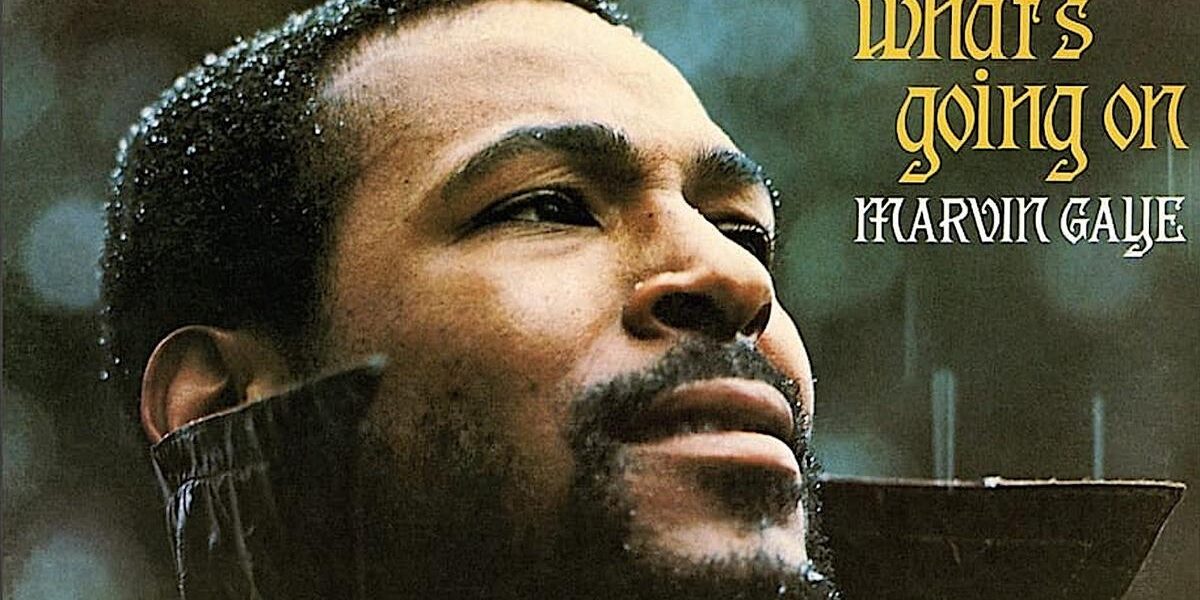
These songs should be sung in church. Marvin Gaye’s What’s Going On not only showcases the gospel influence that characterizes many of America’s most transformative works in blues and R&B; the album possesses the consistently challenging depth and heart-opening weight of sacred music.
Timely and tough yet confident in its broader values, What’s Going On was released on May 21, 1971, as one of music’s most intricate joys – and one of its most significant records. It features sharp critiques on issues such as conflict (“War is not the answer,” Gaye sings, “Only love can conquer hate“), drug use, thoughtlessness, social injustices, and pollution, alongside hopeful messages that highlight how brotherly compassion can support those striving to overcome these worldly struggles.
Gaye had distanced himself from the Motown label’s polished hitmaking approach after achieving great success with a radical reinterpretation of “I Heard It Through the Grapevine”: once a lighthearted nod to romantic paranoia, Norman Whitfield and Barrett Strong’s song was transformed into a deep exploration of emotional turmoil. Gaye, now sporting a previously forbidden hint of facial hair, felt that his success granted him the freedom to delve deeper into his own emotions.
“I knew there was more inside me,” Gaye told biographer David Ritz, “and that was something no record executive or producer could see. But I saw it. I knew I had to get out there.”
How Did Marvin Gaye Use Music to Overcome Depression?
His days were complicated by a failing marriage, the difficult illness and death of his longtime singing partner Tammi Terrell, and a deeply personal response to the misguided initiative in Vietnam. The standoff with Motown regarding his musical future lingered for months.
“He was coming out of a depression,” Ritz, who co-wrote Gaye’s later hit “Sexual Healing,” later told the Detroit News. “Tammi Terrell had died. He hadn’t been working for a year. He was really depressed. This is his way of using art to overcome depression.”
Listen to Marvin Gaye's 'What's Going On'
Gaye began by using his brother Frankie’s troubled military service as inspiration for the album’s opening title track, creating an intimate experiment in multilayered vocalization, subtle Latin grooves, and remarkably topical commentary on war, violence at home, and unrest linked to the civil rights struggle. He was just getting started.
“I began to reevaluate my whole concept of what I wanted my music to say,” Gaye told Rolling Stone. “I was very much affected by letters my brother was sending me from Vietnam, as well as the social situation here at home. I realized that I had to put my own fantasies behind me if I wanted to write songs that would reach the souls of people. I wanted them to take a look at what was happening in the world.”
What Is the Theme of Marvin Gaye’s ‘What’s Going On’?
The mile markers of America’s then-growing – and sadly still-relevant – discontent continue to rush by as Gaye delves into his masterwork: He mentions “picket lines and picket signs,” as veterans are scornfully welcomed upon their return. Elsewhere, those who remained “can’t find no job, my friend / Money is tighter than it’s ever been.” All stand on a fragile globe trembling under the weight of abuse. “How much more can she stand?” Gaye questions at the end of the timely and hypnotic “Mercy, Mercy Me.”
“The world’s never been as depressing as it is right now,” he told the Detroit News. “We’re killing the planet, killing our young men in the streets, and going to war around the world. Human rights – that’s the theme.”
Marvin Gaye was in the midst of a difficult period when work began on ‘What’s Going On.’ (Angela Deane Drummond, Getty Images)
At the same time, songs like “Save the Children” serve as heartfelt counterbalances to these dark predictions: “Save the babies!” Gaye cries, shattering any hopelessness that might have seeped into the record. God loves us, he later concludes, “whether or not we know it, and he’ll forgive all our sins.”
Having built a cathedral to salvation within himself, Gaye then reaches out once more on the rhythmically and lyrically intricate “Wholy Holy”: “Holler love,” Gaye urges, “across the nation.”
How Did Marvin Gaye Finally Find His Voice?
What’s Going On concludes with a quiet warning as “Inner City Blues (Make Me Wanna Holler)” focuses on those in power and “the way they do my life.” Ultimately, however, Gaye seems to convey a final cautionary tale, constructing his own Book of Funky Revelation. This is what is at stake in an unexamined life: chaos and destruction where redemption was once promised.
“I didn’t sing loud; I didn’t sing hard on that record,” Gaye once told guitar legend George Benson. “I just tried to express myself. I just let it all hang out.”
READ MORE: How R&B Created a Foundation for the Beatles
In doing so, Gaye finally carved out a path toward individualism – and conviction – that he had long aspired to achieve. “I didn’t know how to fight before, but now I think I do,” he later confessed. “I just have to do it my way. I’m not a painter; I’m not a poet. But I can do it with music.”
Listen to Marvin Gaye's 'Inner City Blues'
The title track, “Mercy, Mercy Me,” and then “Inner City Blues” climbed both R&B and pop charts in the early ’70s, forever establishing Gaye as an artist in full bloom. Like much of What’s Going On, they still resonate with hard truths. But equally important is their surrounding rare and persistent idealism.
“I’m not sure that in 1971 people wanted to hear that we were destroying our planet and polluting our oceans,” Ritz told CNN. “He got the message across by grooving it up so craftily until you want to hear it over and over again.”
Along this journey, What’s Going On evolved into something greater: Marvin Gaye’s enduring testament of faith.
Top 25 Soul Albums of the ’70s
The decade has more than Marvin Gaye and Stevie Wonder; however, those legends are well represented.
Gallery Credit: Michael Gallucci