Joy Division is a cornerstone in the history of British music. Yet despite their massive impact, their actual time together was fairly brief, with their live tenure ending on May 2, 1980, less than four years after their formation.
The group helped bridge the gap between ’70s punk and a new, less chaotic era of rock — sparser, more atmospheric and intensely pensive. They were deemed “post-punk,” a catch-all term that eventually gave way to goth and other forms of alternative rock.
This style of art spoke to many people, in particular those of a younger generation feeling frustrated with living in a state of extreme economic decline and rising unemployment. (The U.K. was often described then as “the sick man of Europe.”) And Joy Division, with singer, lyricist and fellow young person Ian Curtis at the helm, wrote about these feelings with less turbulence and anger than the punks, and more with a sense of angst and inner turmoil.
When Joy Division released their debut studio album, 1979’s Unknown Pleasures, it did not impress everyone. But those who got it embraced the existentialism.
“To talk of life today is like talking of rope in the house of a hanged man,” Jon Savage wrote in Melody Maker. “Leaving the 20th century is difficult; most people prefer to go back and nostalgize [sic], oh boy. Joy Division at least set a course in the present with contrails for the future — perhaps you can’t ask for much more. Indeed, Unknown Pleasures may very well be one of the best, white, English, debut LPs of the year. Perhaps it’s time we all started facing the future. How soon will it end?”
READ MORE: 10 Classic Acts Who Rebranded
Ian Curtis' Illness
By 1980, Joy Division was only a few years old, but it was clear that their time together would not last much longer. Curtis suffered from severe epilepsy, collapsing while performing on multiple occasions, and strobe lighting of any kind was strictly prohibited at Joy Division concerts.
He also struggled with depression, which went hand in hand with marital issues and substance abuse. Though Curtis’ wife and bandmates were well aware of his condition, Joy Division’s rising fame didn’t exactly lend itself to an entirely supportive environment, and those closest to him were unequipped for dealing with such a heavy situation.
“Ian’s illness was getting worse and we didn’t help him, through ignorance really,” bassist Peter Hook told The Guardian in 2011. “But also, Ian was his own worst enemy — he never wanted to upset you, so he’d tell you what you wanted to hear. So we never knew what he was suffering or thinking.”
In early April 1980, Curtis made his first suicide attempt, after which things moved ahead as they always had. A tour of North America was planned for late May, despite Curtis’ seizures becoming nearly uncontrollable.
“We’d ask: ‘Is everything all right, mate?’ and he’d reply: ‘Yeah, fine, let’s carry on,'” Hook continued. “As an adult and a father now, I feel guiltier than I ever did then.”
Joy Division’s Final Concert
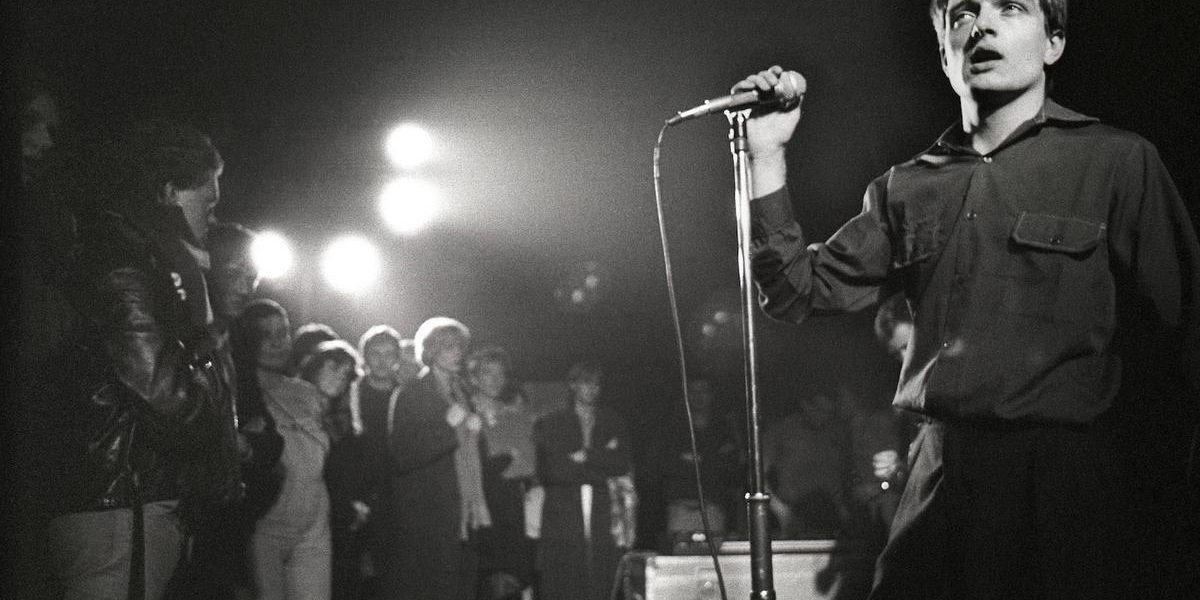
On May 2, 1980, approximately a month after Curtis’ first suicide attempt, Joy Division played their final concert at England’s Birmingham University before approximately 300 people. On the set list that evening was “Ceremony,” one of the last songs Curtis wrote. It was the first and only time the band played it live.
“I just want to carry on the way we are, I think,” Curtis had told the BBC in February 1980. “Basically we want to play and enjoy what we like playing. I think when we stop doing that I think, well, that will be the time to pack it in. That’ll be the end.”
Just a few weeks after the show, in the early hours of May 18, 1980 — two days before Joy Division was scheduled to leave for their North American tour — Curtis hanged himself in his kitchen. He was 23 years old.
Guitarist and keyboardist Bernard Sumner later recalled getting the phone call from Joy Division’s manager Rob Gretton: “He said, ‘I’ve got a bit of bad news for you. I’m afraid Ian’s committed suicide.’ ‘You mean he’s tried to kill himself?’ ‘No, he’s done it.’ … The whole room just turned upside down. I put the phone down, went and washed my face with cold water. Then I got back on the phone, and took it like a man, I suppose.”
Curtis’ bandmates tried to make sense of things by looking back at the music they’d created together.
“Ian was very into sympathy — seeing someone else’s point of view — and that sort of thing; so I thought that’s really clever, [how he’s] writing these lyrics and they’re about somebody else,” drummer Stephen Morris said in a 2007 interview with Dave Haslam. “I never really thought it might be anything else. After he committed suicide we sat down and listened to the lyrics and it’s kind of: ‘How could we miss this?’ It sounds awful but that’s how it was – listening then, it was just like, well, it’s a bit of a suicide note, this, isn’t it?”
READ MORE: The Best Album by New Wave’s 15 Biggest Artists
The Formation of New Order
In the wake of tragedy, the remaining members of Joy Division — Hook, Sumner and Morris — continued on as a freshly-named group: New Order. They eventually added keyboardist Gillian Gilbert and found their own success even in the shadow of what happened to Joy Division.
In October 1981, a compilation album called Still was released featuring a number of Joy Division’s unreleased studio recordings and a live recording of their final concert in Birmingham.
Listen to Joy Division Perform ‘Ceremony’ on May 2, 1980
In 2026, the Rock & Roll Hall of Fame announced it would induct Joy Division and New Order as one entity. Though New Order split up in 2007, Hook remained confident that if Curtis were still alive he’d be thrilled with the recognition telling Gold Derby: “I think he’d be over the bloody moon.”
Joy Division’s Final Concert Set List (May 2, 1980)
1. “Ceremony” (New Order cover) (Live debut)
2. “Shadowplay”
3. “A Means to an End”
4. “Passover”
5. “New Dawn Fades”
6. “Twenty Four Hours”
7. “Transmission”
8. “Disorder”
9. “Isolation”
10. “Decades”
Encore:
11. “Digital”
22 British Acts That Didn’t Break Big in America
For one reason or another, these acts weren’t able to find much commercial success across the Big Pond.
Gallery Credit: Allison Rapp