What matters most about Sweetwater?
- Short-film craft: Sweetwater uses its 21-minute runtime to explore grief, family history and artificial intelligence.
- AI recreation: A hologram of celebrity singer Bettie Rogers knows public facts but initially lacks her private memories with her son.
- Creative partnership: Screenwriter Sean Douglas and actor-director Michael Keaton discuss how they brought the short film to life.
- Central question: The film asks whether an AI recreation can comfort a grieving person or make it harder to accept a loss.
This article introduces Sweetwater and summarizes a Collider interview with Sean Douglas and Michael Keaton, so readers can understand the film’s story, creative choices and themes.
Short films give their creative teams little time to tell a story. A screenwriter must shape the idea, a director must bring it to the screen, and an actor must make a character feel complete. When those elements fail to work together, a brief film can feel much longer; when they succeed, the story can leave viewers wanting more. Sweetwater is a 21-minute short film about grief, unresolved family relationships and artificial intelligence, created by father-and-son collaborators Sean Douglas and Michael Keaton. In this Collider interview, Douglas and Keaton discuss the film and its ideas.
How does AI bring a grieving son face-to-face with his celebrity mother in ‘Sweetwater’?
Sweetwater follows Robert Rogers as an AI hologram of his late mother brings family memories and unresolved grief into focus. The 21-minute film uses the gap between public information and private experience to explore what an artificial recreation can and cannot know.
Sweetwater contrasts an AI’s public data with the private memories of a family.
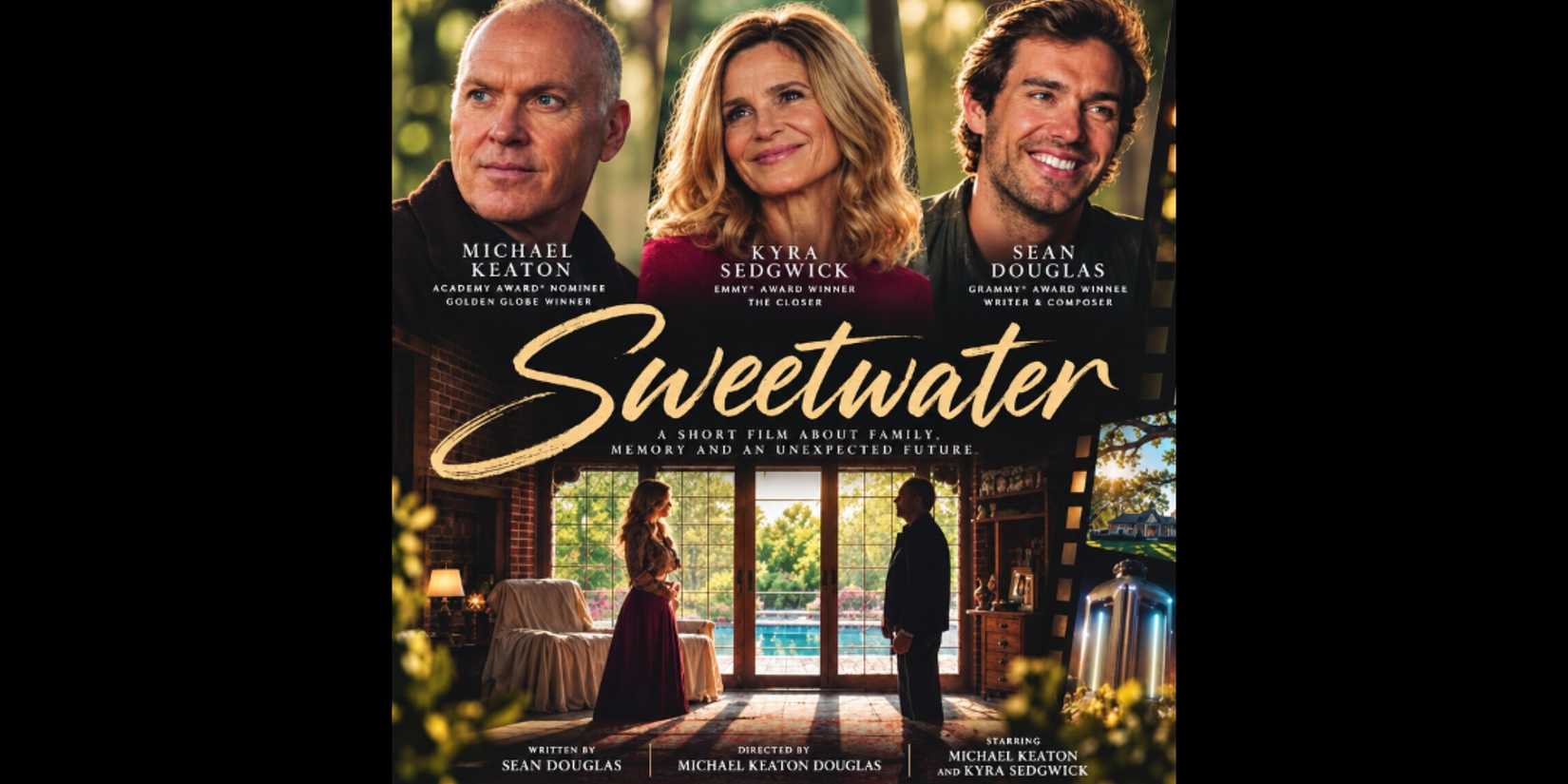 Image via Google
Commissioned for Google’s “AI on Screen” initiative, Sweetwater opens with Robert Rogers (Keaton) returning to his childhood home, Sweetwater, after his mother’s death. His mother, Bettie Rogers (Kyra Sedgwick), was a celebrity singer and performer. As Robert prepares the estate for sale, he discovers a device sent by one of Bettie’s longtime fans. The device projects an AI-generated hologram of Bettie, whose knowledge of the home and her public life is detailed.
The hologram’s knowledge is detailed, but limited to information from public sources and internet archives. AI Bettie does not know the private details of her life or the personal moments she shared with Robert as he grew up. Seeing his mother’s likeness unsettles the grieving Robert, who initially keeps his distance. The hologram, unaware of his reasons, continues to speak with the folksy charm associated with Bettie’s public persona.
Robert gradually engages with the hologram because he wants to believe that it is genuinely his mother and hopes to ask about choices that shaped his life. But the AI cannot resolve the history between them. As the film progresses, the boundary between the digital recreation and Bettie’s identity becomes less clear, leading to an ending that challenges that distinction.
Sweetwater leaves the question of AI’s effect on grief open to viewers. Does the hologram help Robert move through his loss, or does it keep his mother present in a way that delays acceptance? The film’s framing reinforces the uncertainty: Keaton initially keeps Bettie and Robert visually separate, then gradually reduces the distance between them. Bettie’s hologram also becomes less glitchy as the story unfolds, a visual choice that suggests a change in her behavior.
Michael Keaton uses restrained acting to convey Robert’s emotions beyond the dialogue, while Kyra Sedgwick shifts Bettie from a fact-based replica toward a more recognizably human presence. The film brings these performances, its visual storytelling and its themes together within a 21-minute runtime.
What do Michael Keaton and Sean Douglas say about their collaboration?
Sean Douglas and Michael Keaton describe different parts of making Sweetwater, from expanding beyond songwriting to acting and directing within a short production schedule. Their comments also connect the film’s story to personal loss and the tension between private family life and public celebrity.
Sweetwater brings Douglas’s screenplay and Keaton’s work as an actor and director together in a short film.
Collider conducted a written interview with Sean Douglas and Michael Keaton about Sweetwater.
Sean Douglas is a songwriter known for Grammy-nominated work with a wide range of musical artists. Asked whether Sweetwater began as a story that could not fit into a three-minute song or as a screenplay idea, Douglas explained that he wanted to write stories beyond the limits of a pop song:
“As much as I love writing concise pop songs, after many years I wanted to stretch out and tell stories that could not fit into that form. By film standards, Sweetwater is a small story, but it was satisfying to let it take more time than a song. I also have a music-centered feature in development with talented people attached. Songwriting remains my primary work, and screenwriting gives me a way to balance it.”
Keaton said that the more compelling of the film’s two character journeys is Bettie’s shift from knowing facts to showing something like human recognition. Robert’s movement from fearing the AI to accepting it forms the other journey. Keaton also discussed bringing Robert to life while directing:
“I’m glad you noticed, thank you! [It] was complex, with a lot to accomplish as an actor in two days while directing.”
Sweetwater follows the son of a famous person, but Douglas said he did not consciously focus on that parallel while writing. He identified personal loss as the theme closest to his thoughts:
“I’m slightly embarrassed to say that I didn’t think much about the celebrity-parent parallel while writing. I know that sounds like a lack of self-awareness. The personal element most present in my mind was loss. My mother died sixteen years ago, and people who have experienced that loss know how disorienting it can feel for someone to be here one day and gone the next. That feeling can leave you open to, or desperate for, a way to connect with that person.
I’ve also always been fascinated by places like Graceland: family homes filled with personal memories that are also shared with an adoring public, much like the home of a celebrity parent. So the celebrity-parent idea was there all along, and I’m more transparent and less mysterious than I like to think!”
Keaton also reflected on directing. He directed The Merry Gentlemen in 2008, returned to directing with Knox Goes Away, in 2023, and then directed Sweetwater and the upcoming Road to Ruin. He described what led him to the role:
“I always wanted to direct, and I’ve always thought of myself as a storyteller, [which is] which is really part of an actor’s job. Nobody encouraged me back then because it would not make anyone money. I was probably lazy about it, too. And as an actor, I can’t stand waiting around in a trailer most of the day.”
Sweetwater premiered at the inaugural Leander Film Festival in Leander, Texas, screening at Film Alley on Saturday, November 14. The festival also screened Renée Zellweger’s directorial debut, They. Asked about the festival and the film’s release, Douglas said:
“I’m honored that the people at the Leander Film Festival invited them to feature the film. It’s exciting to show it to film fans who are actively looking for something new. Release plans are still being worked out, but for now I’m glad it’s reaching audiences at festivals like Leander.”
Sweetwater is a short film about AI, grief and a mother-son relationship, shaped by the perspectives of Sean Douglas and Michael Keaton.