


What stands out in Sean Connery’s James Bond films?
- Film ranking Connery’s seven Bond films range from the uneven Diamonds Are Forever to the enduring favorite Goldfinger.
- Best performance From Russia with Love features Connery’s strongest performance as 007 and a grounded espionage story.
- Franchise impact Goldfinger helped turn James Bond into a global phenomenon and established a template for later films.
- Viewing choice Viewers seeking classic action can compare the ranking’s story, villains, action, music and Connery’s performance.
This ranking compares Sean Connery’s James Bond movies from worst to best, weighing each film’s story, action, villains, supporting cast and place in the Bond franchise. Readers can use the list to choose between Connery’s more grounded spy stories and his larger-scale adventures.
Recently, I’ve been doing a series of James Bond rankings, breaking the series down by each actor. For some reason, I’ve been working backwards, starting with Daniel Craig, moving on to Pierce Brosnan and then Roger Moore. I skipped Timothy Dalton because he made only two films, making a full ranking difficult; I may combine him with George Lazenby. Now it’s time to look at Sean Connery.
As I like to say, all the other actors played James Bond, but Sean Connery was James Bond. His performance in the classic tuxedo helped shape the modern action hero, and the actors who followed drew on the screen presence he established. Bond creator Ian Fleming initially opposed casting the balding Scottish former truck driver, but Connery became one of cinema’s defining icons. He made seven Bond films if you include the non-EON production Never Say Never Again, matching Roger Moore’s total. Here are Connery’s Bond films ranked from worst to best.
How We Ranked the Sean Connery James Bond Movies: This ranking considers the overall quality of each film, including its story, direction, action sequences, villains, supporting characters and Connery’s performance as 007. It also considers each movie’s entertainment value, its place in the Bond franchise and how well it holds up today. The ranking weighs these elements together rather than relying on a single feature.
Diamonds Are Forever (1971)
Diamonds Are Forever ranks last among Connery’s Bond films because its broad comedy and low-energy performance weaken the adventure. The Las Vegas setting, John Barry’s score and Jill St. John’s chemistry with Connery offer notable counterpoints.
Diamonds Are Forever is Connery’s least successful Bond film in this ranking.

Bond’s early-seventies films struggled to reinvent the character, a challenge the series addressed more successfully in 1977 with the lighter tone of The Spy Who Loved Me. After On Her Majesty’s Secret Service underperformed, EON returned to a lighter, Goldfinger-style adventure with Diamonds Are Forever, but pushed the comedy too far. The story takes James Bond to Las Vegas, where he faces a campy Blofeld, played by Charles Gray, and the over-the-top henchmen Mr. Wint and Mr. Kidd.
Connery’s return is welcome, but his performance feels subdued, and his appearance, including a conspicuous hairpiece, contributes to the impression that he is not fully engaged. The film still has strengths: it was shot on location in Las Vegas, including at the still-standing Circus Circus, and John Barry provides an excellent score. Jill St. John brings charm and chemistry as Tiffany Case, though the character becomes less sharp in the finale after spending much of the film as a capable con woman.
Never Say Never Again (1983)
Never Say Never Again ranks below Connery’s strongest Bond adventures because its slow action and score undermine an accomplished cast. Connery gives a capable return as 007, while Barbara Carrera stands out as Fatima Blush.
Never Say Never Again is a non-EON Bond film whose story closely follows Thunderball.

This non-EON Bond production has an intriguing history and a strong filmmaking team: it was directed by the director of The Empire Strikes Back and photographed by the cinematographer of Raiders of the Lost Ark. However, legal constraints required a script that closely followed Thunderball. The lavish production gives Connery room to reprise James Bond; twelve years after Diamonds Are Forever, he looks fitter and is well suited to the role. The supporting cast is another strength, particularly Barbara Carrera as villain Fatima Blush.
The action is sluggish apart from an effective motorcycle chase, and the extended underwater sequences slow the film down. Michel Legrand’s score is another weakness, creating a marked contrast with the film’s otherwise lavish presentation.
You Only Live Twice (1967)
You Only Live Twice combines striking Japanese locations, Ken Adam’s sets, John Barry’s score and energetic ninja action. Connery looks tired in a less lively performance, but the film’s scale and visual craft make it a memorable Bond adventure.
You Only Live Twice pairs Connery’s subdued performance with some of the series’ most distinctive production design.

By the time Connery made You Only Live Twice, he was growing weary of the franchise, sudden global fame and typecasting. He reportedly disliked filming in Japan, where crowds frequently mobbed him, and his fatigue shows in a comparatively listless performance. Even so, this James Bond film delivers exotic locations, memorable action and impressive production design.
Ken Adam’s sets, the John Barry score and theme song and the ninja action give the film plenty of visual and musical appeal. Donald Pleasence makes a strong impression as Blofeld. Cinematographer Freddie Young, known for his work with David Lean, gives the film striking imagery; its photography remains a particular strength in later home-video presentations.
Thunderball (1965)
Thunderball stands out for its large-scale production, Connery’s physical performance and John Barry’s score. Its underwater action takes up too much of the film, but the cast and production retain considerable appeal.
Thunderball combines lavish production with underwater sequences that can slow its pace.
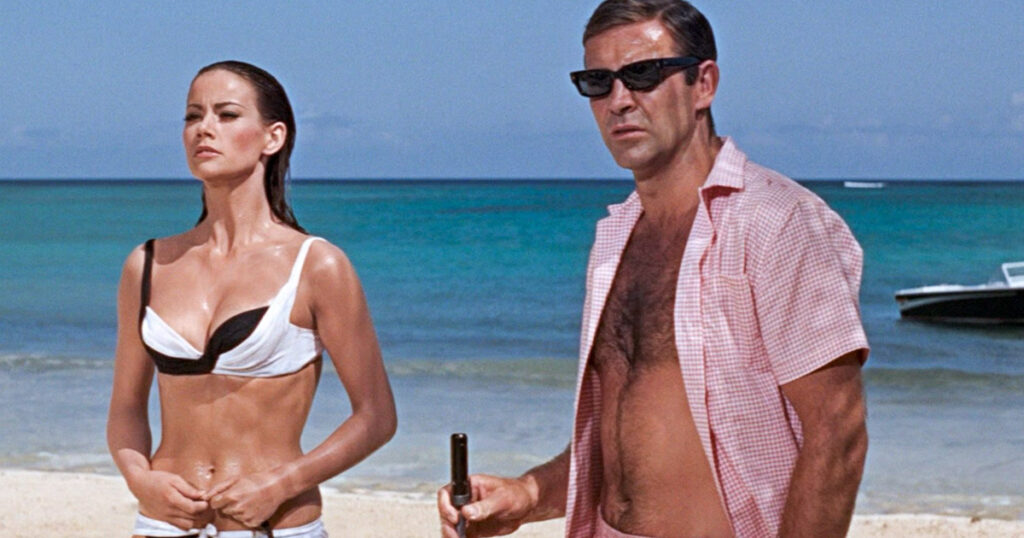
By the time Thunderball entered production, Bondmania was in full swing. Connery’s fame rivalled that of the Beatles, and the studio gave the filmmakers a budget that supported a production on an unusually large scale for the era. The film makes full use of its resources, though its many underwater scenes can make the action feel slow.
Connery is in top form, particularly in the fight scenes. Claudine Auger plays Domino and Luciana Paluzzi plays Fiona Volpe, while John Barry’s score adds another major strength. The film’s appeal comes from the combination of its cast, action and lavish production, even when the underwater sequences interrupt the pace.
Dr. No (1962)
Dr. No introduced Connery as 007 in the first James Bond film, with a performance and scenes that became defining parts of the franchise. Its modest scale and dated elements distinguish it from the more polished Bond films that followed.
Dr. No established Connery’s screen identity as James Bond and introduced the character to film audiences.
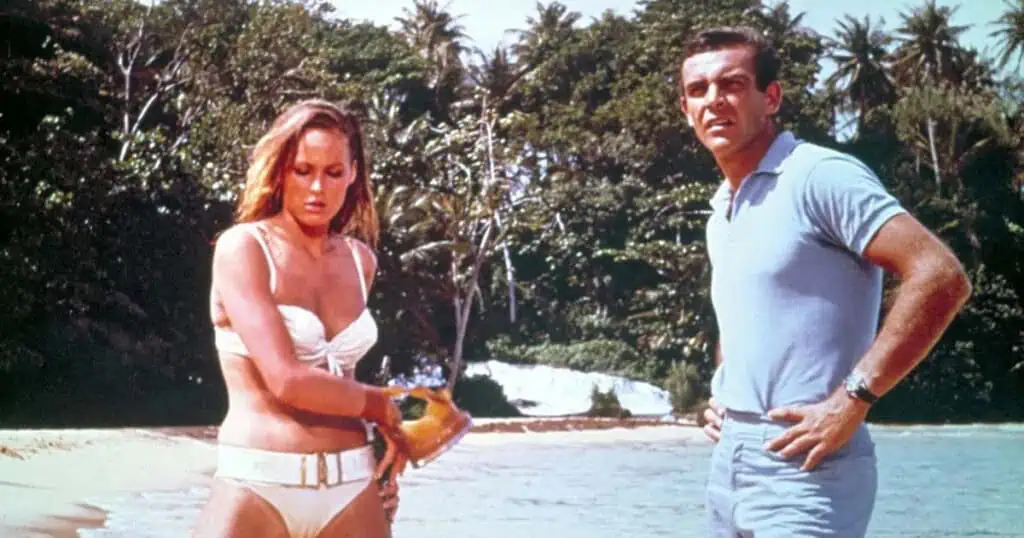
When Dr. No was approved, its producers did not know it would become a global phenomenon. United Artists treated the film as a low-budget production, intended to appear on the lower half of double bills in the United States. The result is more modest than later James Bond films and includes dated elements, including makeup that makes white actors appear Asian.
Despite those shortcomings, Sean Connery gives an explosive performance as 007. The film introduced the famous “Bond, James Bond” line and the image of Ursula Andress emerging from the sea in a white bikini, helping establish the series’ lasting screen identity.
From Russia with Love (1963)
From Russia with Love is a grounded spy thriller and features Connery’s strongest performance as 007. Its taut editing, John Barry’s score and intense fight with Robert Shaw helped shape the action films that followed.
From Russia with Love refined the Bond formula through a realistic plot and sharply staged action.

The improvement from Dr. No to From Russia with Love is striking. Building on the previous film, the Bond producers and director Terence Young made a classic spy story with a more grounded plot. Connery gives his strongest performance as James Bond, setting a standard for later portrayals of 007.
John Barry contributed his first full Bond score, while editor Peter Hunt helped create a more dynamic approach to action. The climactic fight between Sean Connery and Robert Shaw brings unusual intensity to the film. That combination of realistic espionage, strong performances and tightly edited action makes From Russia with Love a favorite among many Bond fans.
Goldfinger (1964)
Goldfinger is Connery’s best Bond film in this ranking because it balances spy intrigue with larger-than-life entertainment. Its memorable villain, gadgets, iconic images and John Barry score helped establish the formula that many later Bond films followed.
Goldfinger helped make James Bond a global film phenomenon and set a template for the series.

Although From Russia with Love is a close contender, Goldfinger remains my favorite Connery Bond film. It blends gritty spy intrigue with playful spectacle and gives Bond a gadget-filled car. Desmond Llewelyn had already debuted as Q in From Russia with Love, while Gert Fröbe, despite being dubbed, makes a memorable, larger-than-life Goldfinger.
Goldfinger is packed with enduring images, including the golden girl played by Shirley Eaton and James Bond strapped to a table beneath a laser beam. John Barry’s score and Shirley Bassey’s theme song add to the film’s impact. Its success helped turn Bond into a global phenomenon and encouraged other studios to pursue their own action heroes. The film remains highly entertaining, and I have seen it about fifty times without tiring of it.
Connery’s James Bond films span seven movies and six decades of cinematic history, but their quality varies. From Russia with Love features his strongest performance as 007, while Goldfinger remains his definitive Bond adventure in this ranking. The contrast between those films captures the range of Connery’s run, from grounded spy drama to bold spectacle.
What do you think of this ranking of Sean Connery’s James Bond movies? Let us know in the comments.
Which Sean Connery Bond film is ranked first?
Goldfinger ranks first in this list because it balances spy intrigue, spectacle, memorable characters and music.
Which Sean Connery Bond film has his strongest performance?
From Russia with Love features Connery’s strongest performance as 007 in this ranking.
How many James Bond films did Sean Connery make?
Connery made seven Bond films when Never Say Never Again, a non-EON production, is included.
Why is Never Say Never Again separate from the EON films?
Never Say Never Again was produced outside EON, and legal constraints required its story to closely follow Thunderball.
The post Sean Connery James Bond Movies Ranked: From Worst to Best appeared first on JoBlo.