
Plot: Chronicles the little-known story of Tenzing Norgay, a gifted Himalayan climber who, alongside New Zealand mountaineer Edmund Hillary, became the first to summit Mount Everest.
Review: Having seen multiple documentaries and films about the sheer difficulty of scaling Mount Everest, I know that it is not something that I would ever personally have any desire to undertake. However, I also have immense respect for those who have put themselves on the line to summit the largest mountain on Earth. While films like Everest have explored the tragedies and disasters faced by climbers attempting to scale the mountain, few films have focused on the first successful summit, and none have chronicled the true story of the man who was integral to that achievement, Tenzing Norgay. The new film Tenzing centers on the Sherpa who aided in this historic climb to the peak of Mount Everest. It serves as both a biopic of the mountain climber and a portrayal of the 1953 climb itself, presenting an underdog story that highlights Norgay’s crucial role in this legendary summit.
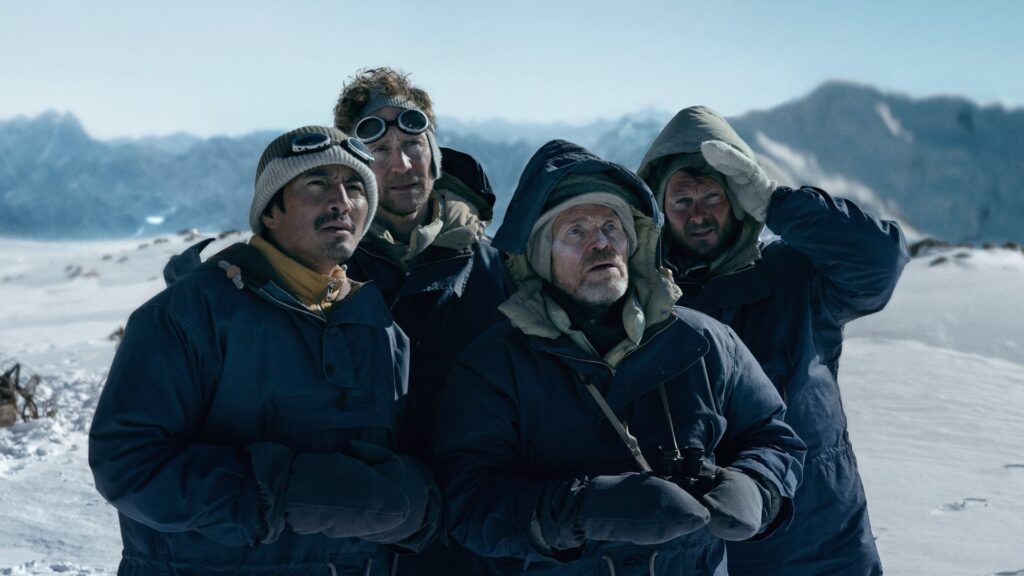
Opening with young Tenzing meeting George Mallory (Johnny Flynn) on the Tibetan Plateau in 1924, just days or weeks before the British mountaineer perished while attempting to scale Everest, we witness his youthful desire to conquer the mountain known locally as Chomolungma, or Holy Mother. The film then transitions to 1953 when Tenzing’s (Genden Phuntsok) benefactor and employer, Jill Henderson (Caitriona Balfe), informs him that the latest British expedition wants him to join as head Sherpa. Tenzing insists on being made a full member of the climbing party during his meeting with John Hunt (Willem Dafoe), who agrees. Despite being looked down upon by native Sherpas for being Nepalese and an outsider, Tenzing quickly befriends Sir Edmund Hillary (Tom Hiddleston), who is also treated as an outsider for not being British. As the expedition assembles and sets out, Tenzing maintains a hopeful demeanor while striving to achieve his lifelong dream of reaching Everest’s pinnacle. His extensive climbing experience and unwavering professionalism earn him respect from both British climbers and Sherpas, but they still face numerous challenges as they ascend into thinner air and harsher climates.
The expedition begins swiftly, with flashbacks revealing how Tenzing became a Sherpa despite being viewed as inferior by natives. We also see him fall in love with his wife, Dawa (Thinley Lhamo), who supports his dream but constantly fears for his safety in the perilous mountain landscape. These flashback moments provide insight into Tenzing’s character and values beyond climbing Everest; however, they do slow down the narrative pace. While this structure is more effective than a linear approach might have been, one might wonder if there was a better way to maintain momentum throughout the climb. The film depicts Tenzing as a small child left at a monastery by parents who deemed him too weak for their journey to India, offering insight into his youth and ambitions. In present-day scenes, we witness subtle racism from British climbers toward Nepalese and Sherpas, viewing them as lesser beings. Nevertheless, Tenzing’s skills overshadow any prejudice he faces.

Tenzing Norgay serves as the central protagonist of this story, with all other characters playing supporting roles. Newcomer Genden Phuntsok delivers an excellent performance as Tenzing, portraying him as a determined and inspirational figure who remains calm amidst protests from fellow Sherpas regarding his selection for the final ascent or while rescuing Edmund Hillary from danger when part of the mountain collapses beneath them. Willem Dafoe provides an understated portrayal of expedition leader John Hunt, treating their quest as a military operation that must succeed at all costs. Tom Hiddleston adopts a mild New Zealand accent as a quiet yet supportive champion of Tenzing. The chemistry between Hiddleston and Phuntsok reflects mutual respect and shared aspirations to conquer Everest. Although Tenzing does not equate Hillary’s and Norgay’s backgrounds or lives as similar, it does not shy away from presenting them as future close friends destined to achieve what no one had accomplished before. However, it fails to delve deeply into the roots of British imperialism and its impact on other cultures; instead, it frames their journey as a unified human achievement.
Australian director Jennifer Peedom makes her narrative directorial debut with Tenzing. Peedom has previously directed documentary films such as River, Mountain, and Sherpa, with the latter filmed during the 2014 Everest avalanche. Her experience filming in extreme weather conditions on actual mountains lends realism to this production, which was shot in both New Zealand and Nepal. The screenplay for Tenzing was written by Luke Davies, known for scripting the acclaimed 2016 film Lion, featuring Dev Patel, Rooney Mara, and Nicole Kidman, as well as the 2020 western News of the World, starring Tom Hanks. Davies effectively chronicles Tenzing Norgay’s life and his role in Everest’s first successful summit; however, the film adheres closely to traditional storytelling methods that fail to create real stakes. While viewers root for Tenzing and Hillary during their final push toward success—an underdog moment crafted well by Peedom—the film lacks any sense of uncertainty regarding their outcome. Knowing how history unfolds diminishes tension; thus, there is never a feeling that their journey could lead anywhere but achievement.
With an inspiring old-school score by Rebekka Karijord and stunning cinematography by Stefan Duscio, Tenzing presents itself in a polished manner akin to its British characters. I appreciate this tribute to Sherpas who have long been overlooked despite their vital contributions to every Everest expedition; director Jennifer Peedom honors them fittingly here. At times, this film feels like a sanitized retelling that showcases glory without adequately addressing the struggles endured along the way. While Genden Phuntsok shines as an inspiring protagonist alongside solid performances from Willem Dafoe and Tom Hiddleston in supporting roles, Tenzing feels overly pristine for a narrative steeped in death. Nonetheless, Peedom may have aimed for a story centered around success rather than hardship; it certainly evokes emotions by its conclusion but could have offered more depth had it trimmed some flashbacks or provided greater insight into trials faced during their ascent. Ultimately, Tenzing is visually impressive and tells an overdue story that honors Tenzing Norgay and his fellow Sherpa people.
Tenzing is now streaming on Apple TV.

The post Tenzing Review: Tom Hiddleston and Willem Dafoe support the overlooked story of the first men to summit Everest appeared first on JoBlo.