VisionQuest TV Review: Surprising Performances by Paul Bettany and James Spader
Key Insights
- Plot Overview: Vision, having escaped from those who sought to weaponize him, goes into hiding while seeking new meaning.
- Series Development: VisionQuest serves as a direct sequel to WandaVision, expanding the Marvel Cinematic Universe with new characters.
- Character Dynamics: The series explores Vision’s self-discovery and his relationship with Ultron, showcasing their complex interactions.
- Release Date: The series premieres on October 14th on Disney+, featuring two episodes at launch.
Plot: Vision, rebooted and having escaped from those who sought to weaponize him, has been in hiding. Searching for new meaning, he consults the AI personas embedded in his programming, including F.R.I.D.A.Y., E.D.I.T.H., J.A.R.V.I.S., and the infamous Ultron. His discreet existence ends when a bounty placed on his head thrusts him on the run with Thomas Shepherd, a mysterious boy who may be Vision’s son, reincarnate. As Vision evades capture, he must confront his nature, resist Ultron’s influence, and unravel the enigma that is his young companion if he’s to survive.
Review: In the five years since WandaVision debuted on Disney+ and heralded the small-screen branch of the Marvel Cinematic Universe, we have gotten 16 shows expanding the big-screen MCU onto the small screen. While most of the shows have been decent, there have been some standouts, both as the really great shows and some that we probably don’t want to ever mention again. Within that 18-series span, we have gotten the spinoff Agatha All Along that introduced the reincarnated Billy Maximoff. VisionQuest is a true direct sequel to WandaVision, bringing the story full circle while also introducing us to the reincarnated version of Tommy Maximoff. Taking elements from the pop culture and television-centric original series and branching it into an all-new AI-heavy world of characters, VisionQuest is the long-awaited showcase for Paul Bettany as Vision, as well as the overdue return of James Spader, who improves and expands upon his Avengers: Age of Ultron performance.
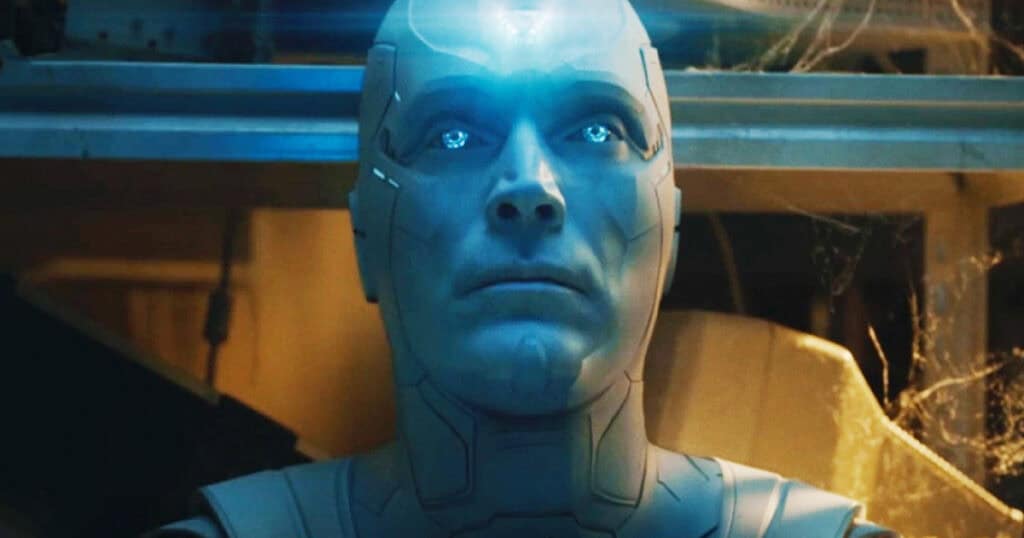
After the physical version of Vision (Paul Bettany) built by S.W.O.R.D. absorbed the memories of Wanda Maximoff’s creation, he has been living in hiding in Edinburgh and retreating into a custom-built Mindspace to reflect on his prior life. Vision exists in his electronic world alongside other AIs, including J.A.R.V.I.S. (James D’Arcy reprising his role from Agent Carter), F.R.I.D.A.Y. (Orla Brady), E.D.I.T.H. (Emily Hampshire), and Tony Stark’s robotic arms, D.U.M.-E. (Henry Lewis) and U. (Jonathan Sayer). They also live with Ultron (James Spader), who lives locked in an upstairs bedroom. Vision’s desire to understand his past and humanity at large is interrupted when someone sends the bounty hunter Paul Denning, known as Paladin (Todd Stashwick), to bring him in. On the run, Vision and his fellow artificial intelligences join forces to figure out who is hunting them down. As the series progresses, we learn more about the creation of artificial intelligence in the MCU that predates even Tony Stark’s original creations. At first, it feels very similar to what we saw in WandaVision, but as it continues to evolve, the series shifts and transforms into a bit more of a thriller, incorporating a hunt by a bounty hunter, a mysterious villain hidden in the shadows, and other plot elements that may seem a bit cliché but work within the construct of this series.
Because VisionQuest closes out a trilogy, the series incorporates elements of both the shows that preceded it. The eight episodes of VisionQuest clock in at a full hour as compared to the shorter entries of WandaVision, but they do utilize references and recreations of classic sitcoms in a similar manner. The story looks at Vision’s self-discovery after losing Wanda but also tries to do the same for Ultron. James Spader played the Avengers: Age of Ultron villain with a thread of smart-ass commentary and brilliance inherited from Tony Stark and Bruce Banner, and the actor’s ability to play Ultron in the guise of a human avatar allows him to try new things in his performance. Ultron is just as menacing as before and just as funny. Paul Bettany and James Spader’s shared screen time is the highlight of VisionQuest. Paul Bettany has not played Vision for five years, and this is something of a restart in his portrayal, but we lose none of the charm of the Vision we have come to know with this series, building and expanding the character in many ways. Both Vision and Ultron get a worthy second MCU run with this series that corrects their brief tenure on the big screen.

The series also introduces significant new characters to the MCU, including Ultron’s significant other, Jocasta. Played by T’Nia Miller, Jocasta is the Bride to Ultron’s Frankenstein monster, and the two present formidable antagonists within the Marvel Cinematic Universe. VisionQuest does a solid job of presenting multiple heroes and villains throughout the series without forcing the narrative into a single linear plot. I have often been underwhelmed by the red herrings and misdirections in prior MCU television shows, but VisionQuest does a great job of pulling these threads together. We get appearances by some minor characters seen in early Marvel movies as well as new comic book characters like Lisa Molinari (Lauren Morais), and the reunion of Tommy and Billy Maximoff now truly embracing their superhero identities as Speed and Wiccan. The long-teased Young Avengers is one step closer to reality with this series and performances from Ruardih Mollica and Joe Locke. The series also boasts a deep cut to one of the earliest Marvel Comics superheroes that will excite fans of Marvel’s history. While we have hunted for easter eggs countless times in prior MCU offerings, I enjoyed those peppered throughout VisionQuest much more than in other recent Marvel projects.
The eight-episode series comes from Star Trek: Picard showrunner Terry Matalas, who wrote three episodes and directed two with Cindy Appel, Michael Taylor, Christopher Monfette, Nicole Falsetti, and Matthew Okumura writing the rest. Three helmers each directed two episodes including Christopher J. Byrne, Gandja Monteiro, and Vincenzo Natali. VisionQuest combines Vision’s hyper-realistic interior Mindspace look with location shooting in Europe that gives it a balance between tangible settings and computer-generated imagery. The scope of this series is more intimate than I was expecting as it focuses on grief, family, and moving on in ways that differ from WandaVision. There is some decent action along with returning elements like MCU’s signature skybeam trope which I really enjoyed every minute of it. Say what you will about Marvel’s long-form storytelling approach; these television series work well when they strike an appropriate balance between action and character development. There is robust development here for both Vision and Ultron; while there could have been more action overall it still works.
Because VisionQuest is set leading up to Avengers: Doomsday, it remains uncertain whether Vision, Tommy, and Billy will encounter Latverian Wanda Maximoff as many theorize. The way this series concludes does not definitively reveal one way or another. VisionQuest offers an enjoyable emotional journey for one of MCU’s underutilized characters while concluding this trilogy better than anticipated. Paul Bettany excels in portraying Vision broadly while James Spader delivers hilariously brilliant performance improving upon his initial turn as Ultron. I hope both actors return for future MCU projects; while VisionQuest‘s uniqueness may not match that of WandaVision, it certainly surpasses Agatha All Along.. It remains unclear whether this series sets up future events or simply serves as a solid conclusion for this chapter within MCU; either way you will enjoy all episodes.
VisionQuest premieres with two episodes on October 14th on Disney+.

The post VisionQuest TV Review: Paul Bettany and James Spader are full of surprises in this sequel to WandaVision appeared first on JoBlo.