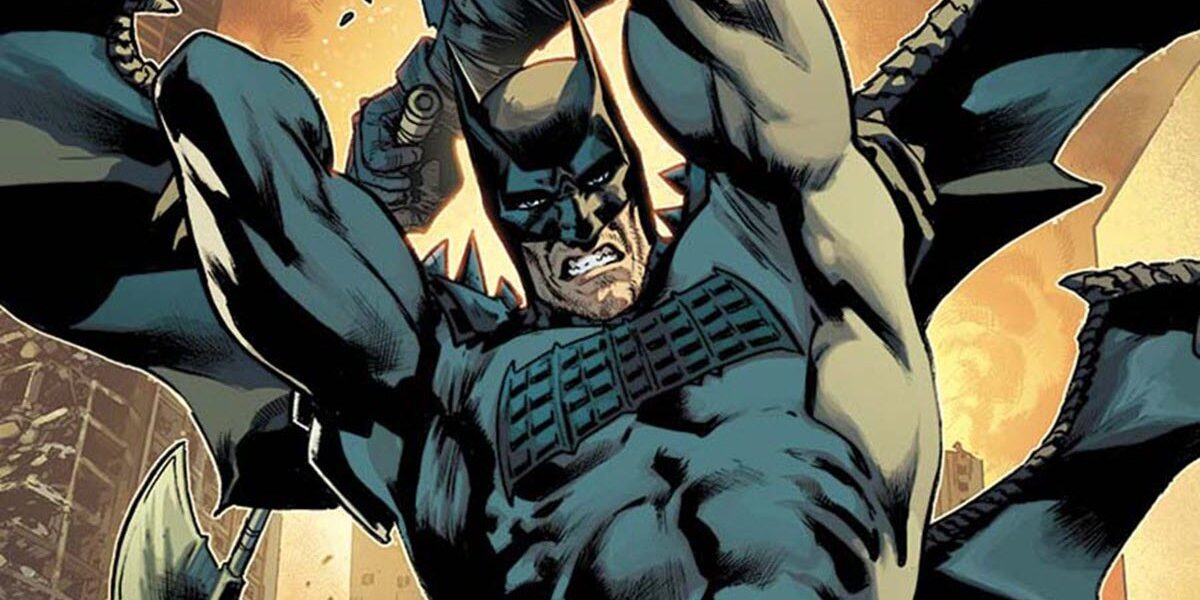
Absolute Batman provides a fresh perspective on a question famously raised in the classic DC storyline Kingdom Come. This is appropriate, as the Absolute Universe revolves around reinterpreting iconic superheroes in a realm devoid of hope. Nonetheless, both interpretations delve into the essence of who Bruce Wayne is, irrespective of the reality.

Absolute Batman #24 by Scott Snyder and Nick Dragotta stands out as one of the most action-packed installments in the series thus far. Chapter 6 of “The Straw Man” primarily focuses on Bruce Wayne facing off against the Absolute Universe version of Scarecrow. Concurrently, Barbara Gordon takes on the role of Batgirl to assist him in his battle.
A quieter subplot unfolds around covert operative Alfred Pennyworth. The seasoned soldier had mentored Absolute Batman while evaluating whether he posed a threat to his superiors. However, as he receives orders to leave Gotham City for a new assignment, Pennyworth reflects on how Bruce Wayne has positively transformed his city, despite being “frustratingly unpredictable, a liability, and yes, even a threat.”

Moreover, Pennyworth informs his superiors that the Absolute Batman has evolved into a symbol of inspiration and idealism. He asserts that Bruce Wayne has conquered his fears and demonstrated to others that they too can overcome their own, despite feeling powerless. He concludes that Bruce Wayne embodies many traits but ultimately remains just a “boy who endured the most harrowing trauma a child can face. And instead of succumbing to it, he ventures out each night to confront that fear.”
How Absolute Batman and Kingdom Come both perfectly define Bruce Wayne
Pennyworth’s evaluation resonates with a well-known line from the 1996 miniseries Kingdom Come. Set in a near-future world, the narrative by Alex Ross and Mark Waid chronicles Superman’s return to a society now defended by violent anti-heroes. As Superman assembles a new Justice League to combat them, a semi-paralyzed Batman appears to ally with the villains exploiting the chaos.

In reality, Bruce Wayne was attempting to uncover their plans to thwart them from within. Unfortunately, a brainwashed Shazam is unleashed during this process, intent on eliminating every superhuman he encounters. This culminates in a dramatic confrontation between Superman and his oldest ally.
An embittered Batman suggests that perhaps humanity would be better off if all superhumans perished. Superman rejects this notion, asserting that Batman has always upheld the sanctity of life. The Man of Steel then delivers a line often regarded as the ultimate summary of Bruce Wayne’s character.

“More than anyone in the world, when you strip everything else away from Batman, you find someone who doesn’t want to see anybody die.”
While the wording differs, the sentiment remains consistent. Moreover, they both underscore the essence of the Absolute Universe, where Scott Snyder stripped away everything that defines the Dark Knight.
Absolute Batman lacks the traditional resources and training associated with Batman. His trauma is distinct; he has lost only one parent instead of two. Yet at his core, he continues to embody hope amidst darkness. He remains the same individual who channels his fear to prevent others from enduring similar suffering. This fundamental aspect is why Batman continues to resonate with fans nearly nine decades after his inception.