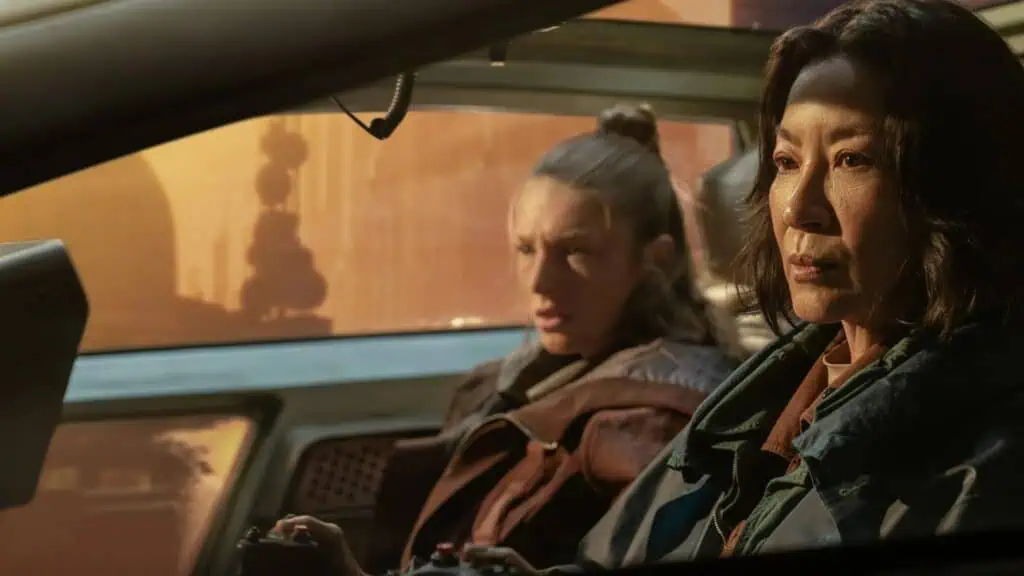

PLOT: Blade Runner 2099 takes place 50 years after Blade Runner 2049, in a Los Angeles reshaped by a Replicant uprising. Cora (Hunter Schafer), a fugitive trying to protect her brother, adopts one last identity: a Blade Runner. Paired with Olwen (Michelle Yeoh), a Replicant nearing the end of her life, Cora hunts a runaway whose secret could destabilize the fragile city.
REVIEW: Can a Blade Runner series honor the films while telling a complete new story? Blade Runner 2099, the franchise’s third live-action installment, answers with an eight-episode tale led by Michelle Yeoh and Hunter Schafer. Set in a future where Replicants hold power and humans are a minority, the series shifts the franchise’s established balance between creator and creation. The eight-episode series delivers a self-contained story within the established Blade Runner universe. Decades-long gaps between films do not guarantee successful continuations: Star Wars expanded its story with prequel and sequel trilogies, while Ridley Scott’s Blade Runner and Denis Villeneuve’s Blade Runner 2049 were separated by 35 years. Villeneuve’s sequel became a critical success and led to his adaptation of Dune. With Scott serving as executive producer, Blade Runner 2099 moves the saga forward rather than simply repeating its earlier conflicts.
How does Blade Runner 2099 change the world of the films? The story begins five decades after the Ryan Gosling-led sequel, following a Replicant uprising that leaves Los Angeles and the wider world under Replicant control. Replicants now serve as police and use the name Blade Runners to hunt unlicensed beings, while humans perform menial work. The series depicts a new world order in which Replicants govern and humans are the minority. Cora (Hunter Schafer) is a human on the run with her younger brother. After working with Bebeto (Dimitri Abold) to obtain forged identity papers, Cora agrees to infiltrate the Blade Runners to help the human resistance. Her history of trauma and detached demeanor help her impersonate a stoic Replicant. Cora takes the place of a Replicant transferred to Los Angeles, joins Olwen (Michelle Yeoh) and Olwen’s partner, played by House of the Dragon actor Matthew Needham, and learns how the team operates. Their investigation of a rogue Replicant leads to a mystery tied to the Tyrell Corporation and the first two films.
What makes the eight-episode structure work? The series uses its extended runtime to develop its story without revealing every turn in its mystery. The eight episodes give the story room to unfold while bringing Cora and Olwen’s central journey to a conclusion. Michelle Yeoh and Hunter Schafer anchor the story with contrasting performances. Yeoh, who won the Best Actress Oscar, has appeared in projects including Everything Everywhere All at Once, The Haunting in Venice, Wicked and its sequel, The School for Good and Evil, and Section 31. Here, she adopts a restrained manner that recalls Rutger Hauer’s portrayal of Roy Batty in the original film. Schafer, known for Euphoria, brings a gritty presence to Cora. The two leads make the franchise’s central question, what it means to be human or a Replicant, part of their character dynamic.

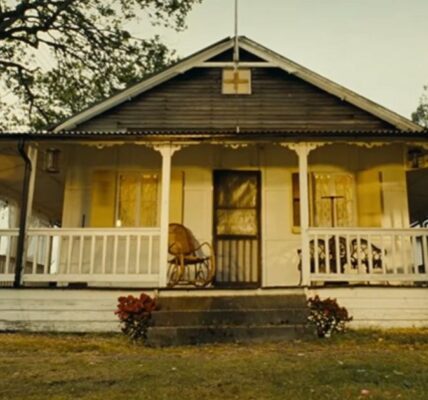
How closely does Blade Runner 2099 match the films’ visual style? The series combines the production design of Ridley Scott’s original film with the color palette of Denis Villeneuve’s sequel. The opening scene closely recreates a setting from the 1982 movie, and its retrofuturistic details preserve the visual language of the franchise. Supporting performances by Lewis Gribben, Maurizio Lombardi, Sheila Atim, and Tom Burke contribute to the ensemble. The series also draws on mythology from the three short films released before Blade Runner 2049 and the animated series Black Lotus. Its setting, 50 years after Blade Runner 2049, allows the story to develop the world without requiring viewers to know every intervening event. Blade Runner 2099 extends the franchise’s future without replacing the films’ established stories.
Does Blade Runner 2099 tell a complete story? Creator and showrunner Silka Luisa designed the series as a standalone narrative rather than a story built in advance around a second season. The series has a beginning and an ending, and it resolves Cora and Olwen’s central character arcs. Some supporting characters’ futures remain ambiguous, leaving room for further stories without making a continuation necessary. Luisa’s writing connects the films’ mythology and the work of Philip K. Dick through detailed plotting, solid dialogue, and a noir style set against a wider science-fiction world. Jonathan van Tulleken (Shogun) directed the first two episodes; Marcela Said (Dope Thief), Karena Evans (Mr. & Mrs. Smith), and Ariel Kleiman (Andor) each directed two episodes. Leopold Ross composed the score, building on themes by Vangelis.
Is Blade Runner 2099 a worthwhile continuation of the franchise? The series preserves the original film’s aesthetic, carries forward the modernization of Blade Runner 2049, and develops the universe beyond Los Angeles. Yeoh delivers a restrained performance, while Schafer brings a gritty presence to Cora. The story explores the relationship between Replicants and humanity without requiring viewers to know every detail of the franchise’s intervening history. The eight episodes present a complete story, while some unresolved supporting-character paths leave possibilities for future installments. Across all eight episodes, the series offers visual and narrative connections to the films for viewers to notice.
Blade Runner 2099 premieres all eight episodes on November 25th on Prime Video.

The post Blade Runner 2099 TV Review: An unexpectedly great reinvention of the sci-fi noir classic appeared first on JoBlo.