What to know about La bola negra
- Three timelines: La bola negra connects the Spanish Civil War, Federico García Lorca’s unfinished story and a modern-day historian’s discovery of its manuscript.
- Central conflict: Sebastián, a Nationalist soldier, guards Rafael, a Republican prisoner, while the two develop a bond amid the threat of execution.
- Queer perspective: The film explores homosexuality and social exclusion across different periods of Spanish history.
- Film format: Javier Calvo and Javier Ambrossi shot the historical epic on 35mm film and gave it a theatrical presentation.
PLOT: In La bola negra, a young Nationalist soldier in the Spanish Civil War is assigned to guard a Republican prisoner. The two develop an intense connection as the soldier faces orders that could force him to kill the man he has come to care about.
REVIEW: La bola negra, or The Black Ball, drew considerable attention at the Cannes Film Festival, where Netflix acquired it for a reported $5 million. The film received the festival’s longest standing ovation, and its theatrical release gives audiences a chance to see the ambitious, three-timeline story on the big screen. Javier Calvo and Javier Ambrossi shared the award for Best Director at Cannes, while La bola negra lost the Palme d’Or to Fjord.
La bola negra links three separate timelines through queer history, war and the legacy of a lost manuscript. The film’s central story unfolds in 1937, during the Spanish Civil War, and builds toward a finale that brings its different periods together. The film connects the consequences of the war to a story inspired by Federico García Lorca.
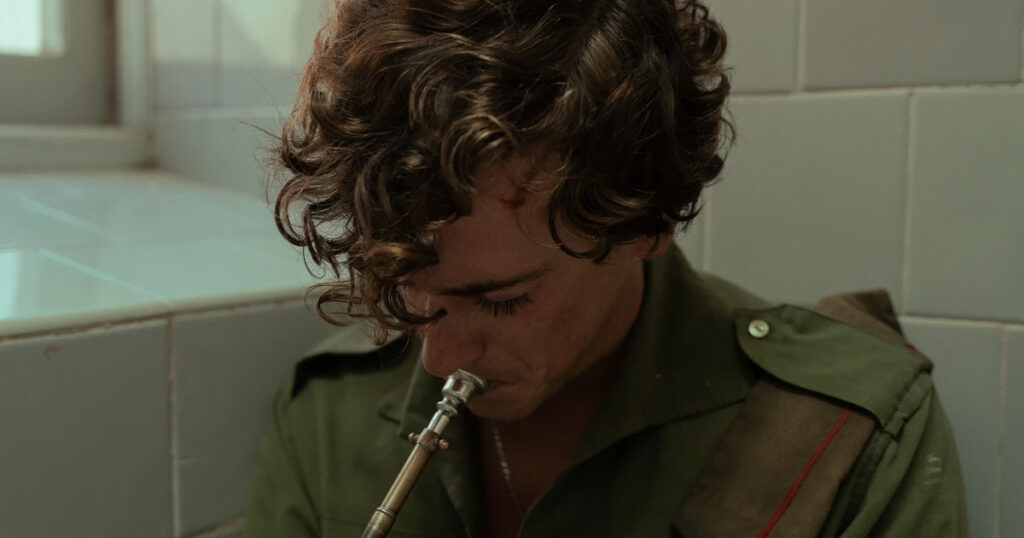
The film opens with Sebastián (Spanish singer-songwriter Guitarricadelafuente), a trumpet player preparing to perform at a village reception for arriving fascists. The gathering turns into a massacre, and Sebastián escapes before he is forcibly conscripted into the Nationalist side. He is ordered to guard Rafael (Miguel Bernardeau), a former aristocrat who has become a Republican prisoner awaiting interrogation and likely execution.
La bola negra examines the Spanish Civil War through a queer perspective, showing how social expectations shape the characters’ lives. Sebastián appears reluctant to acknowledge his sexuality in a period when homosexuality was not accepted. The film’s second timeline follows Carlos (Milo Quifes), a young aristocrat barred from his father’s private casino because of suspicions that he is homosexual.
Carlos’s story draws on Federico García Lorca’s unfinished story of the same name. The fate of Lorca’s manuscript connects that timeline to the modern-day story of Alberto (Carlos González), a gay historian who comes into possession of the text. Together, the three timelines connect exclusion in the past with the recovery of a literary work in the present.
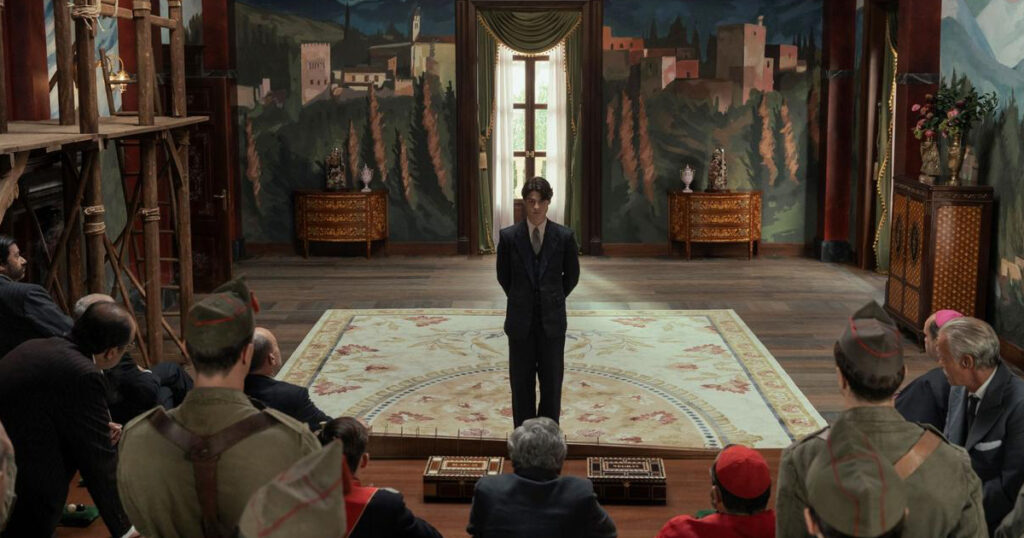
The shifts between three timelines make La bola negra uneven at times. The modern-day story takes much of the film to connect emotionally, especially beside the more immediate 1937 scenes, where Sebastián and Rafael form a tentative friendship under the threat of execution.
La bola negra uses 35mm film and a projected image designed to resemble a vintage print, including visible grain, simulated cigarette burns and rounded frame edges. The film uses a 1.66:1 aspect ratio, rather than the 1.33:1 format associated with many independent films. Its production design and score support a large-scale depiction of the Spanish Civil War, where countrymen are forced to fight one another as fascists gain ground during Franco’s dictatorship.
The film includes two extended cameos that connect its story to performance and Lorca scholarship. Penélope Cruz plays a Spanish star brought in to entertain the troops and performs two musical numbers, while Glenn Close appears as a Lorca historian in an extended sequence.
Guitarricadelafuente anchors the film as Sebastián, whose experiences of war shape his life. Sebastián’s story shows how surviving a conflict does not erase its consequences or the impact of actions forced upon people during wartime.
La bola negra was conceived as a theatrical epic and received a theatrical release alongside its planned streaming debut. Its three interwoven stories, historical setting and 35mm presentation make the cinema release a way to experience the film in the format its directors designed.
La Bola Negra is now playing in theaters, and hits Netflix on December 4th.
What connects the three timelines in La bola negra?
La bola negra connects its stories through queer history and the legacy of Federico García Lorca’s unfinished manuscript. A modern historian’s discovery links the past timelines to the present.
Lorca’s manuscript connects the film’s three timelines.
Who are the main characters in La bola negra?
The main characters include Sebastián, a Nationalist soldier; Rafael, a Republican prisoner; Carlos, a young aristocrat; and Alberto, a modern-day historian. Their stories unfold in different periods.
The film follows four characters across three timelines.
What aspect ratio does La bola negra use?
La bola negra uses a 1.66:1 aspect ratio and was shot on 35mm film. Its presentation also simulates features of a vintage film print.
La bola negra was shot on 35mm film in a 1.66:1 aspect ratio.
When can viewers watch La bola negra?
La bola negra is playing in theaters and is scheduled to arrive on Netflix on December 4th. The release information does not specify a year.
La bola negra has a theatrical release and a December 4th Netflix date.
The post La Bola Negra Review: Netflix is pushing this one for serious Oscar-love appeared first on JoBlo.