Key Takeaways
- Franchise fatigue: Toy Story 5 exemplifies the trend of unnecessary sequels in modern cinema.
- Character focus: The film shifts its main character from Woody to Jessie, exploring her backstory.
- Nostalgia marketing: The movie heavily relies on nostalgia to attract audiences and sell merchandise.
- Visual appeal: Despite its flaws, the animation quality remains a highlight of the film.
Toy Story 5 is merely part of an ongoing Disney trend in recent years, with their increasing dependence on sequels, live-action remakes, and IP. For every genuinely great original movie we get from the media conglomerate, like this year’s Hoppers, we have to also sit through some of the most painfully unnecessary nostalgia cash-ins that prioritize its mere existence rather than quality storytelling, from The Devil Wears Prada 2 to The Mandalorian and Grogu to next month’s live-action remake of a movie that came out merely 10 years ago.
Toy Story 5 is a sequel that doesn’t need to exist. It offers a few of the trademarks you’d expect from a Pixar movie — some laughs, some emotional moments, and excellent animation. It’s undoubtedly a film that children will enjoy, but there are many reasons to be cynical about a film that cannot justify its own existence. For some, the mere existence of a movie that can make kids laugh and adults cry is more than enough reason for it to be here. While there are some strong ideas littered throughout, the latest Toy Story is a shining example of a story that has been extended far beyond its natural conclusion.
In 2010, when Andy left his toys behind and went off to college, it really seemed like we were saying goodbye to them. Director Lee Unkrich told Empire Magazine, “We didn’t want Toy Story 3 to just be another random sequel; we wanted it to be the conclusion of one big story.” The film turned out to be fantastic and a huge success, so a few years later, we got Toy Story 4. How did Toy Story 4 justify itself? Well, if Toy Story 3 was the conclusion to Andy’s relationship with his toys, Toy Story 4 would be the conclusion of Woody. That film ended with Woody saying goodbye to the other toys, and it really felt like a send-off for him. In every way, Toy Story 4 was supposed to be the definitive final ending, with Hanks emotionally saying his farewell to the character and director Josh Cooley saying, “I would be totally happy if this was the end.”
Alas, seven years later, Woody has returned. It’s maddening to see how Pixar is now milking a franchise that clearly has no more stories to tell. We saw it in 2022 when they made a Lightyear movie to lukewarm critical reception and rough box office numbers. Now, we have a film that’s no longer looking to offer any finality to this franchise. Why? Because finality isn’t profitable. Toy Story 5 is a movie solely designed to earn your trust back in the franchise, cash in on your nostalgia for these characters, and sell your children some more toys. While nearly every movie’s goal is to make money and sell merch, it’s particularly blatantly obvious here.
To appreciate a movie like Toy Story 5, you must change your expectations. You’re not watching “the final chapter of the Toy Story series” or “the must-see emotional farewell to characters you’ve loved for years.” You’re watching the movie Unkrich explicitly did not want to make when he made Toy Story 3; you’re watching “another random sequel.” This is the first Toy Story movie that no longer centers on Woody, the long-standing protagonist of the franchise. The main character is now Jessie, and the film makes that clear with an opening that delves back into her relationship with her former owner Emily, complete with an instrumental rendition of “When She Loved Me.”
The sequence in Toy Story 2 when we see Jessie’s backstory has always been a standout moment of the series. It provided a deep emotional context for her. She had smaller roles in 3 and 4, but this movie reminds us why she’s one of the most interesting characters in the series. For the first time, she’s driving the story forward. In the meantime, their kid Bonnie is having trouble making friends, so her parents buy her a Lilypad, a tablet that puts her in group chats and games with kids her age.
There are some decent ideas here. Toy Story began in 1995, and we now have a franchise that’s growing up with the world. The coolest thing you could have had back then was a Buzz Lightyear action figure. Now? A smart tablet. Screens are taking over, and kids aren’t playing with toys as much anymore. Much like this year’s Good Luck, Have Fun, Don’t Die, this movie treats the youth’s constant screen-watching as a source of horror. What happened to the good ol’ days when children actually talked to each other in-person?
With a series that has always explored children’s relationship with toys, a “toys vs. tech” storyline feels like a natural next step. The filmmakers handle this storyline with a decent but not overwhelming amount of nuance, showing how tech can help Bonnie make friends but how it can backfire if she makes the wrong type of friends. The result is a storyline defined by a very idealistic worldview that feels typical of older filmmakers begging children to get off screens and go back to the way things were when they were younger, connecting with people in-person. The film does this by showing how much Jessie wants Bonnie to be friends with a girl named Blaze but doesn’t make Blaze a very complex character in the meantime.
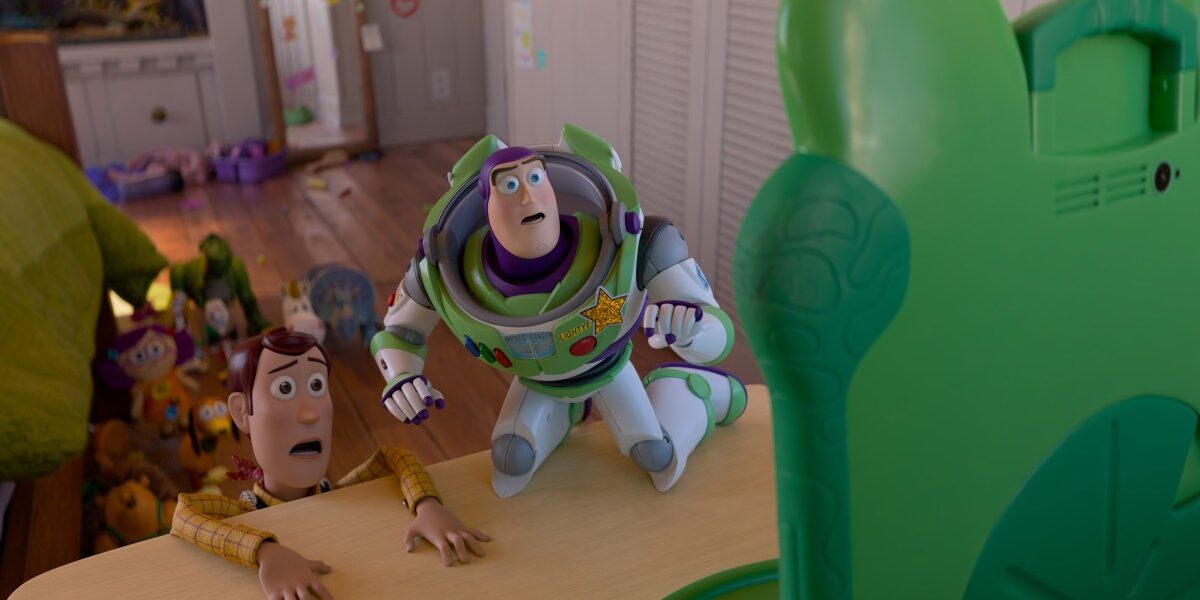
What’s the best way to get kids to play with toys? Selling new ones, of course! That’s why we have Woody wearing a red bandana in this movie for no reason whatsoever other than to sell you the new version of this toy. Why do we have a storyline in this movie surrounding 50 shipwrecked Buzz Lightyears, complete with a new design? To sell you the new design, of course! But seriously, why is this storyline here? The film mainly follows two storylines: one surrounding Jessie reconnecting with her past and another surrounding Woody and Buzz dealing with Lilypad. This storyline surrounding the Buzzes feels extraneous. They figure out a way to incorporate it later but it’s too little too late. It’s strange because the other Toy Story movies are very precise with what they focus on and this subplot feels completely random.
Perhaps it was a way to incorporate more Buzzes into this film after Toy Story 4 sidelined Buzz with an “inner voice” running gag that never quite stuck the landing. If there’s anything good I can say about Toy Story 5, it’s that Buzz gets more to do this time around. The film returns to a storyline that began back in 1999 when Toy Story 2 suggested that Buzz had a bit of a crush on Jessie. Toy Story 3 drove this point even further showing their mutual attraction especially with Buzz’s “Spanish mode.” While Toy Story 4 didn’t really acknowledge this, the new movie does a phenomenal job bringing that back to lovely results.
But what about Woody? He comes back to help out but he’s in a supporting role. You can’t have a Toy Story movie without Woody and Buzz but this really does feel like an abandonment of the Toy Story 4 ending when Woody says goodbye to the toys to spend his life with Bo Peep. This film sees Bo Peep drop off Woody back with the toys and disappear for most of the rest of the movie sidelined once again after her significant role in Toy Story 4. While one can argue that just because Woody left the gang doesn’t mean he can’t ever come back to visit it really does take away from 4’s ending. Of course he can come back to visit but 4’s ending feels emotional because of its feeling of finality. The idea that it’s a true goodbye between these characters makes the ending hit so much harder. And yet he’s back with the toys again this time.
Woody and Buzz’s storyline has a few funny moments but the movie puts them back at each other’s throats. There’s some rivalry between them and they’re not working together well. Despite the humorous antics it leads to it feels like a reversal for them since the original Toy Story was about them figuring out they could work very well together. Their conflicts feel disappointing to see after they shared a very emotional poignant farewell at the end of 4. It would have been wonderful if that final hug and “To infinity…” “…and beyond” were their final interaction but instead we now have them bickering with each other like no time has passed.
Another disappointing element of this film is how it doesn’t really incorporate the toy ensemble very well. The reason why Toy Story 2 and 3 work so well is because of how much time we get with Rex Hamm Mr Potato Head and Slink. They’re a very fun group of characters. Remember Mr Tortilla Head and Mr Cucumber Head? Amazing. Toy Story 4 throws Forky into the mix and even though 5 gives him a love interest he’s also been relegated to the background here. It’s disappointing to see those toys along with the aliens Mrs Potato Head Mr Pricklepants Trixie Dolly and Buttercup feel entirely irrelevant to the main storyline. They feel like set dressing all of whom could be removed from the movie and it wouldn’t have changed anything.
It’s challenging when you have a franchise that has had its cast expand so much since the original characters will be left on sidelines many of whom are abandoned here from Toy Story 4 Ducky and Bunny two of the funniest additions appear briefly but are uncharacteristically quiet It doesn’t take genius realize Key and Peele simply didn’t return for voice cast Keanu Reeves does return as Duke Caboom but unlike four when he gets big moment complete his big stunt he gets nothing meaningful do here.
Toy Story 5 shines in its emotional moments particularly in character moments with Jessie and Bonnie Despite an occasionally disjointed narrative there are moments that work well A shining addition is voice Conan O’Brien as device named Smarty Pants whom Jessie often finds herself at odds He brings some biggest laughs movie Another treat long-running franchise like Toy Story you can see how different directors visualize series John Lasseter brought light fun excitement with one two Lee Unkrich brought grounded darker sensibility three Josh Cooley made arguably most visually stunning film four gorgeous aesthetic carnival its emulation anamorphic lenses photorealistic surfaces lights wider aspect ratio.
Andrew Stanton director Finding Nemo Finding Dory Wall-E directs this movie brings strong visual eye while also getting experimental animation style during sequences where toys getting played with The movie looks gorgeous but unfortunate Woody has been brought back nowhere left for him grow develop He simply there because belongs Toy Story movie step down previous movies where his characterization crucial Unfortunately nothing about Toy Story 5 feels crucial It’s not must-see movie; it’s feature-length Disney+ special lets us see more characters we’re familiar with.
But that’s what Disney been doing lately It doesn’t feel like Toy Story 5 was made because story needed told; it was made because Toy Story 3 and earned over $1 billion each The Devil Wears Prada 2 and The Mandalorian Grogu didn’t tell stories made us curious wonder they were cashing brand recognition You think live-action Moana movie exists surprise us phenomenal innovative storytelling No it designed be financially profitable safe bet And when studio now driven nearly entirely by risk-free surefire dollar signs quality suffers; Toy Story 5 only small piece larger puzzle no easy solution.
SCORE: 5/10
As ComingSoon’s review policy explains, a score of 5 equates to “Mediocre.” The positives and negatives wind up negating each other making it wash.
Disclosure: ComingSoon attended press screening for our Toy Story 5 review.