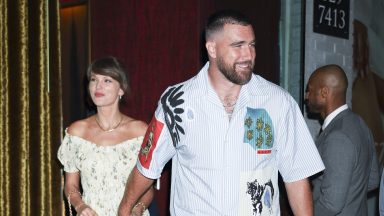
Taylor Swift and Travis Kelce attended a performance of “Oh, Mary!” at the Lyceum Theatre on Saturday, prompting widespread speculation online. Observers scrutinized her left hand, noted his jacket, and questioned whether their wedding is imminent or has already taken place in secret.
A Broadway matinee featuring two of the most followed individuals globally, surrounded by a crowd of smartphones, led to a global audience interpreting this date as a potential prelude to a wedding announcement.
The unspoken truth is that the pressure of the wedding watch is affecting this couple. In my experience, I witness how such external pressures impact individuals who seem to have everything under control.
The Goldfish Bowl Nobody Else Has to Date In
In the early stages of a relationship, everything feels heightened. The world appears brighter, food tastes better, and music resonates more deeply. Couples in this phase often feel as if the universe has conspired in their favor.
Taylor and Travis are still experiencing some of that enchantment. Their chemistry is evident in photographs and in the way he leans toward her; this is the genuine bonding chemistry of early love.
However, beneath the glamour of their Broadway outing lies a universal human experience amplified by their fame. Every moment is documented; any public disagreement becomes content for sharing. They lack the opportunity to retreat and process their own missteps while under constant scrutiny from both their fans and critics.
This creates a goldfish bowl effect, which can negatively impact one’s nervous system by compelling performance when what is truly needed is rest.
Additionally, there exists an insidious danger associated with expectations. When one’s career is thriving and society continually affirms success, an unconscious belief emerges: my relationship should reflect that success as well. Heightened expectations lead to greater feelings of failure when things don’t go as planned. The wedding watch amplifies this expectation for Taylor and Travis daily.
Understanding the underlying science of red flags in relationships and how external pressures can subtly distort connections begins with recognizing these unspoken expectations.
When the Representative Shows Up to the Date
In my practice with high achievers, I frequently encounter founders who have sold their companies yet feel unfulfilled. Executives managing large teams often feel one mistake away from disaster. These individuals have mastered professional success while their emotional well-being remains precarious.
Taylor and Travis are top-tier performers whose survival hinges on a level of polish that most cannot fathom. The traits that propelled their careers—efficiency, drive, emotional compartmentalization—can be detrimental in personal relationships.
A relationship cannot thrive with only your Representative present. Partners seek authenticity rather than accolades; they desire the real you who may feel exhausted or insecure without your achievements.
For many high achievers, the strategy becomes keeping their Representative in control at all costs. Dropping the facade feels like risking collapse. As a result, they treat relationships as projects rather than nurturing genuine intimacy, which flourishes amid vulnerability.
This confusion between early love’s chemistry and deeper connection warrants examination. If you’re curious about your relationship dynamics under pressure, consider taking our free relationship quiz to identify your patterns.
Real Love Trembles. Volatility Is a Feature.
Media narratives often depict seamless fairytale romances—perfect proposals, glamorous weddings, joyful baby announcements—but these portrayals are performance contracts rather than authentic relationships.
I’ve observed that true love cannot be rooted in performance; it thrives on vulnerability and authenticity.
People mistakenly believe that an ideal partnership means no conflict exists. However, if your partner cannot hurt you emotionally, they are not truly your partner but merely a roommate. Volatility signifies mutual significance rather than dysfunction.
When couples inevitably drift apart, they engage in what I term the Waltz of Pain—two childhood survival strategies colliding where one partner reaches out while the other withdraws. Both experience hurt and feel unseen while blaming each other for their struggles.
In reality, neither partner is at fault; it is the dynamic between them that requires attention.
The goal is not to avoid volatility but to repair it; successful repair demonstrates that the bond remains intact.
What I’d Say to Them
If Taylor and Travis were my clients, I would emphasize that healthy relationships are not measured by accumulating good times but by each partner’s ability to foster opportunities for repair after conflicts arise.
Conflict is inevitable when you love someone; instead of expending energy trying to avoid hurting each other, focus on recognizing when you enter the Waltz of Pain and approach each other with curiosity rather than strategy.
Cultivating small moments matters: acknowledging when something feels off, offering comfort during difficult times, and expressing vulnerability by admitting when you need support are essential practices for building intimacy amidst public scrutiny.
This approach fosters a private bond within a public life.
The Line I Hope They Keep
The wedding can wait; so can the dress and any magazine covers. What truly matters is whether they can sit together on an ordinary night after the cameras have left and reveal their tired yet authentic selves beneath all the glitz.
That’s not just a fairytale; it’s something far more meaningful—a true home.
____________________________________________________________________________________________
Figs O’ Sullivan and his wife Teale are couples therapists based in San Francisco who specialize in relationships among celebrities and Silicon Valley professionals. They are also founders of Empathi and creators of Figlet, an AI relationship coach informed by their clinical expertise.