


What makes these war films unforgettable?
This guide ranks ten war films by the lasting impact of their stories, performances and depictions of conflict, so you can compare films from World War I through Vietnam and choose what to watch. The list spans six decades and focuses on the human cost of war, not just its battle scenes.
- Human cost: These films show how war reshapes soldiers, friendships and communities.
- Different conflicts: The ten selections range from the trenches of World War I to wartime Belarus and Vietnam.
- Distinct approaches: The films use intimate character drama, battlefield realism and psychological tension to tell their stories.
- Top choice: Come and See takes the top spot for its unflinching portrayal of a boy witnessing wartime atrocities.
War films can be difficult to rate because the strongest examples are not necessarily enjoyable to watch. They often leave viewers quiet and unsettled, with images and characters that linger after the credits. This ranking brings together films that maintain a serious view of conflict from beginning to end.
The selections cover six decades and several wars, from the trenches of World War I to the jungles of Vietnam and the devastated villages of Belarus. Their battle scenes matter, but their attention to the emotional lives of people caught in war is what gives these films their lasting force.
10
‘The Bridge on the River Kwai’ (1957)
The Bridge on the River Kwai follows a British officer whose pride in discipline blurs the boundary between honor and obsession. The 1957 film combines a prisoner-of-war story with a study of authority, duty and personal vanity.
The Bridge on the River Kwai depicts the consequences of pride in wartime leadership.
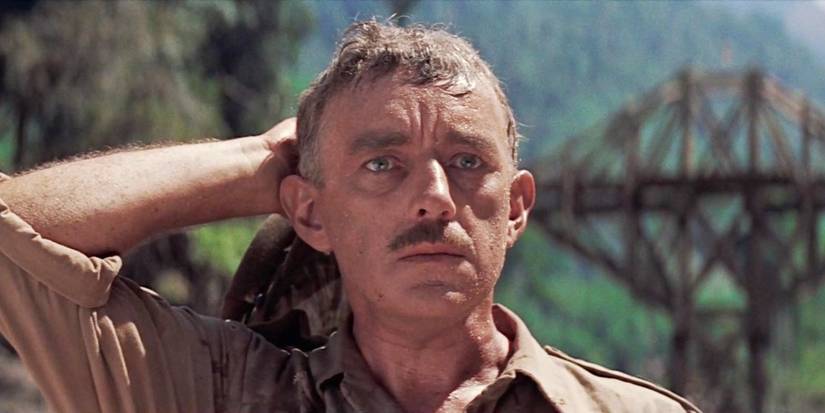
Image via Columbia Pictures
Colonel Nicholson (Alec Guinness) leads his men into a Japanese prisoner-of-war camp in Burma, where Colonel Saito (Sessue Hayakawa) orders them to build a railway bridge for the enemy. Nicholson insists on completing the work properly as proof of British discipline, but his pride gradually blurs the line between honor and obsession. Shears (William Holden), an American who escapes, is pulled back into the mission to destroy the bridge. Directed by David Lean, the film won seven Academy Awards, including Best Picture and Best Actor for Guinness.
Workers built the film’s bridge in Sri Lanka over about eight months, and the final explosion, involving a real train, was filmed in one take. Pierre Boulle, the novel’s author, received the screenplay Oscar despite not speaking English. The actual screenwriters, Carl Foreman and Michael Wilson, had been blacklisted in Hollywood and received Academy credit decades later. The whistled “Colonel Bogey March” is one of the film’s most memorable musical details.
9
‘The Deer Hunter’ (1978)
The Deer Hunter builds its Vietnam War story around the lives of three friends before and after they are sent to fight. Its extended opening establishes their community and relationships before the film turns to captivity, trauma and the lasting effects of war.
The Deer Hunter connects wartime trauma with the rupture of lifelong friendships.
 Image via Universal Studios
Michael (Robert De Niro), Nick (Christopher Walken) and Steven (John Savage) work in a small Pennsylvania steel town. The first hour follows their wedding celebrations and deer hunt before they leave for Vietnam. Director Michael Cimino takes time to establish the friends, making their later capture and forced participation in Russian roulette more devastating. Meryl Streep plays Linda, who is caught between two of the men. The film won Best Picture, and Walken won Best Supporting Actor.
John Cazale, who plays Stan, was seriously ill with cancer during filming; this was his final film. The slap De Niro delivers to Walken during the roulette scene was reportedly real. The Russian roulette sequences are not based on documented real events, a point that has prompted debate. The film’s central concern is the effect of war on friends who believed they would always be together.
8
‘All Quiet on the Western Front’ (2022)
All Quiet on the Western Front follows a German teenager from patriotic enlistment in 1914 to the mud and danger of the Western Front. The 2022 German-language adaptation of Erich Maria Remarque’s 1929 novel presents war without romantic glamour.
All Quiet on the Western Front portrays the battlefield as a place where youthful idealism meets relentless danger.
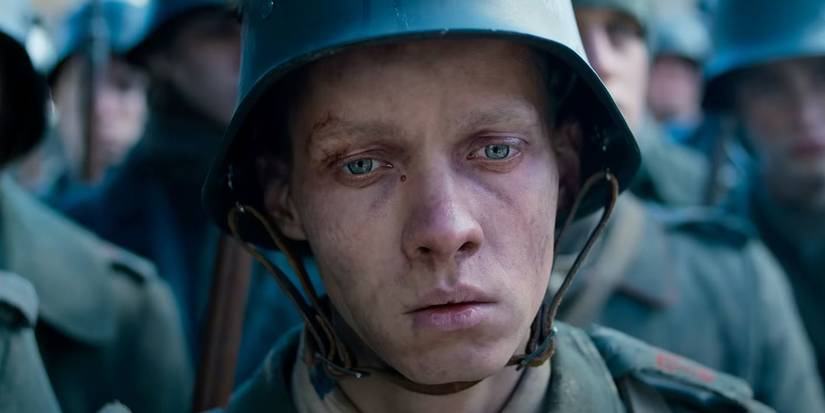 Image via Netflix
Paul Bäumer (Felix Kammerer), a German teenager, enlists with his classmates in 1914 after hearing promises of glory, only to encounter the Western Front’s mud and rain. Directed by Edward Berger, the film is the first German-language adaptation of Remarque’s 1929 novel. Kammerer, a stage actor with little film experience, was cast after an extensive search. Kat (Albrecht Schuch), an older soldier, becomes Paul’s friend and guide.
Volker Bertelmann’s score features a harsh three-note motif. The film won four Academy Awards, including Best International Feature and Best Cinematography. The Nazis burned Remarque’s novel, whose antiwar message the regime feared. The 1930 adaptation won Best Picture; Berger’s version tells the story with the same deep sorrow and no glamour.
7
‘The Thin Red Line’ (1998)
The Thin Red Line depicts an American infantry company fighting on Guadalcanal in 1942, balancing combat with reflections on nature and human behavior. Terrence Malick’s film follows several soldiers whose views of the island and the war differ sharply.
The Thin Red Line sets the violence of the Guadalcanal campaign against the island’s natural beauty.
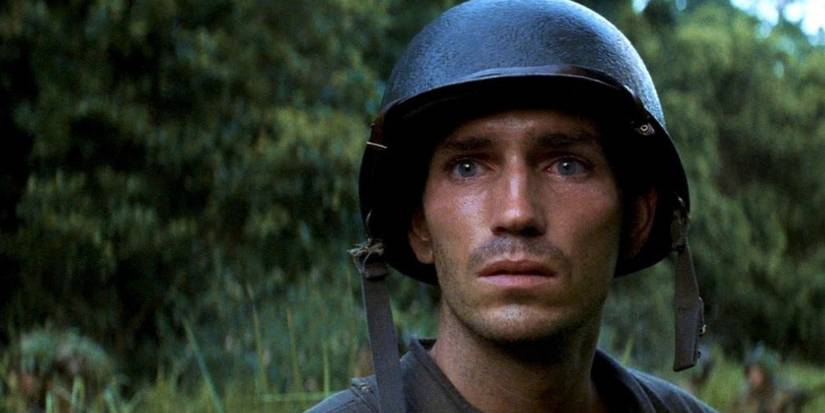 Image via 20th Century Studios
Terrence Malick returned to filmmaking after a twenty-year break with this story of the 1942 Guadalcanal campaign. An American company fights its way up a hill, while voiceovers reveal the thoughts of soldiers including Private Witt (Jim Caviezel), a quiet deserter who notices the island’s beauty, and First Sergeant Welsh (Sean Penn), a cynical veteran. Lieutenant Colonel Tall (Nick Nolte) drives the men forward with ruthless ambition.
Malick filmed many hours of footage and reduced several performers’ roles. Adrien Brody was promoted as a lead but ended up with few lines; scenes featuring Mickey Rourke and Gary Oldman did not make the final cut. Hans Zimmer composed the haunting score. The film received seven Academy Award nominations and won none.
6
‘Das Boot’ (1981)
Das Boot creates tension through the confined space of a German submarine on a 1941 Atlantic mission. The unseen enemy matters, but so do the crushing water pressure, cramped corridors and strain on the crew.
Das Boot turns the submarine’s enclosed setting into a central source of suspense.
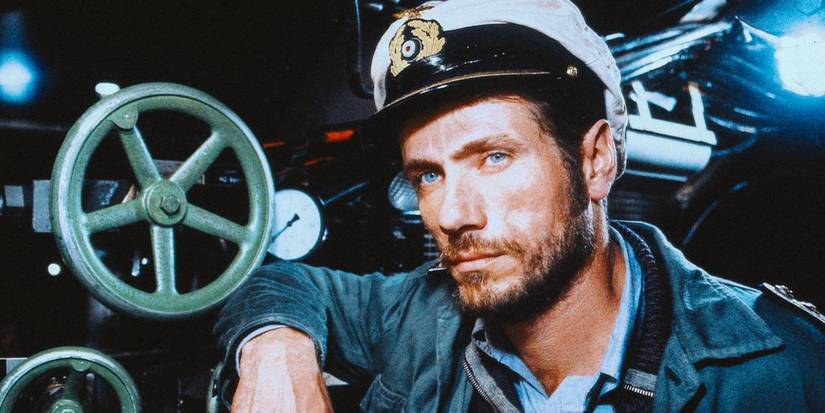 Image via Neue Constantin Film
The Captain (Jürgen Prochnow) leads a German U-boat crew from port in 1941 to attack Allied ships in the Atlantic. Young war correspondent Lieutenant Werner (Herbert Grönemeyer) joins the mission. Directed by Wolfgang Petersen and based on Lothar-Günther Buchheim’s novel, the film takes place aboard the real submarine U-96.
The production was filmed in chronological order inside a life-size submarine replica. The actors were kept out of sunlight to appear pale and exhausted, while cinematographer Jost Vacano moved through the narrow corridors with a handheld camera. The film received six Academy Award nominations. Grönemeyer later became one of Germany’s best-known pop stars. The scene in which the submarine sinks to the seabed makes the pressure on the hull an immediate source of tension.
5
‘Lawrence of Arabia’ (1962)
Lawrence of Arabia follows British officer T.E. Lawrence through the Arabian desert during World War I as he brings rival tribes together against the Ottoman Empire. David Lean’s expansive film uses desert landscapes to frame a story about alliance, ambition and identity.
Lawrence of Arabia combines a World War I story with large-scale desert cinematography.
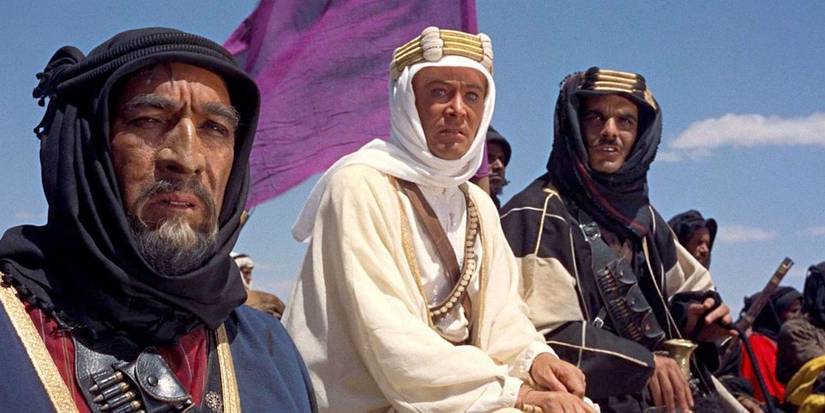 Image via Columbia Pictures
T.E. Lawrence (Peter O’Toole) is sent into the Arabian desert during World War I and ultimately unites rival tribes to fight the Ottoman Empire. David Lean filmed Lawrence of Arabia in 70mm across Jordan, Morocco and Spain. O’Toole was a relatively unknown stage actor when he took the role after Albert Finney declined it, and the performance made him a star. Sherif Ali (Omar Sharif) first appears as a distant speck in the heat haze before riding into view.
The film’s celebrated match cut moves from Lawrence blowing out a match to the sun rising over the desert. It won seven Academy Awards, including Best Picture, and Steven Spielberg and Martin Scorsese helped restore it in 1989. Prince Faisal (Alec Guinness) and Auda Abu Tayi (Anthony Quinn) round out the cast. The film runs nearly four hours.








